
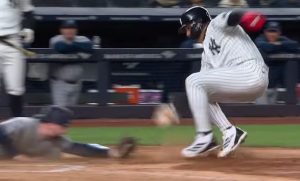
Yes. New York Yankees rookie George Lombard Jr.’s spectacular jumping maneuver around Tampa Bay Rays catcher Liam Hicks was legal under Major League Baseball’s baserunning rules.
During the Yankees’ 6-4 comeback victory over Tampa Bay on September 24, 2026, Lombard appeared certain to be tagged out at home after a pitch bounced to the backstop and ricocheted directly back toward Hicks. Lombard began a feet-first slide, popped back onto his feet, jumped over the diving catcher, twisted his body and reached down with his right hand to touch home plate before Hicks could tag him. He was ruled safe. [AP]
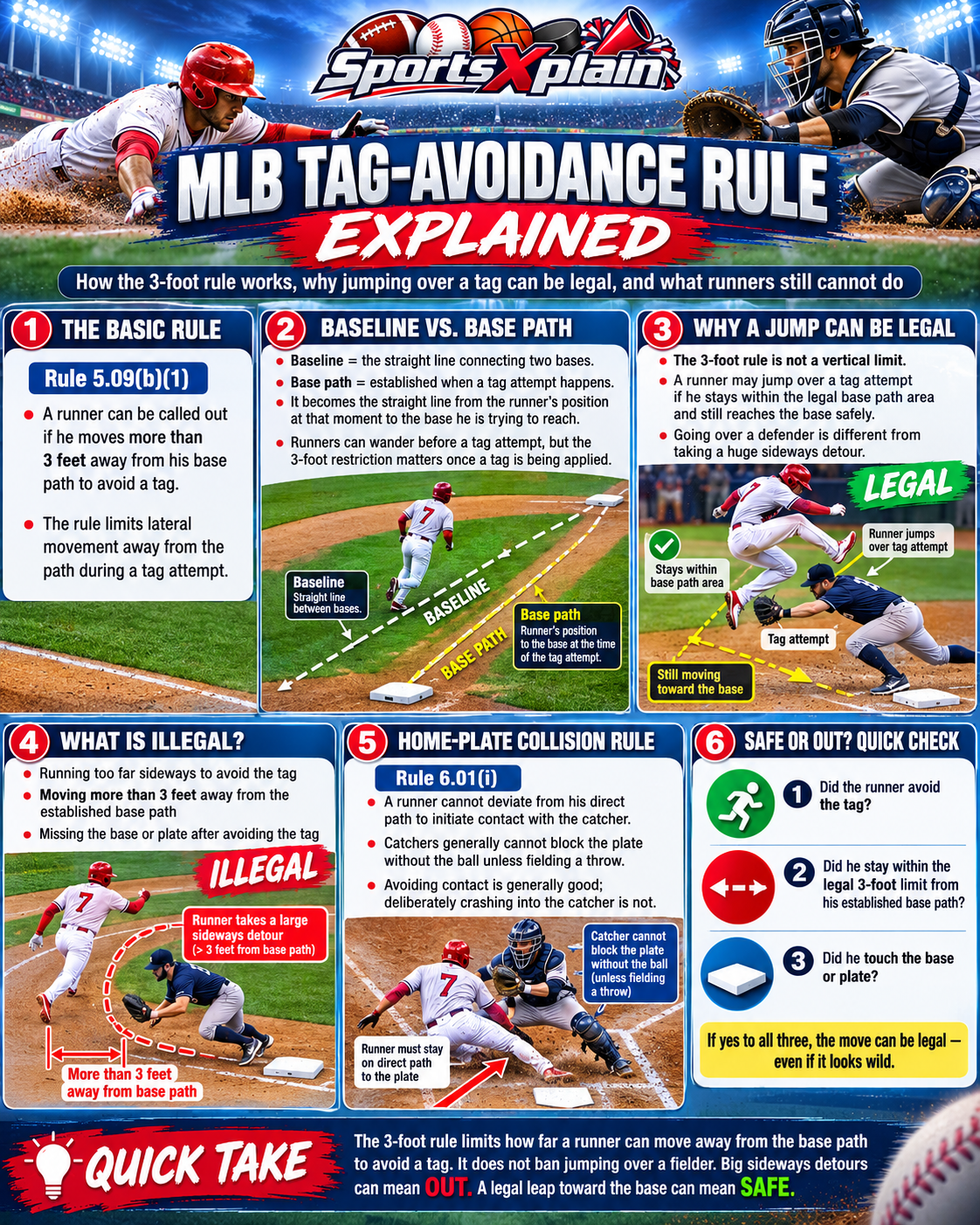
The play looked so unusual that it raised an obvious rules question: Can a runner actually jump over a fielder to avoid a tag? MLB’s rules generally say yes. A runner cannot move more than three feet away from his established base path to avoid a tag, but the rule restricts how far a runner can move sideways from that path. It does not establish a similar three-foot vertical limit preventing a runner from jumping over a tag attempt. [MLB]
What Did George Lombard Jr. Do?
Lombard was on third base during the Yankees’ comeback against the Rays when Tampa Bay pitcher Brady Hopkins threw a pitch that got away from catcher Liam Hicks.
The ball went to the backstop, and Lombard immediately broke for home.
Unfortunately for Lombard, the ball took an unusually favorable bounce for Tampa Bay and caromed back toward Hicks. The catcher recovered it and moved toward home plate with Lombard still approaching. [AP]
Lombard initially started a feet-first slide. When he realized Hicks had reached the plate quickly enough to tag him, Lombard changed course in the middle of the play.
He popped up, jumped over the catcher, twisted in the air and extended his right hand downward to touch home plate.
Hicks missed the tag.
Lombard was safe, cutting Tampa Bay’s lead to 4-3. [AP/CBS]
Was George Lombard Jr.’s Jump Legal?
Yes.
There is no general MLB rule prohibiting a baserunner from jumping over a fielder who is attempting to make a tag.
The relevant restriction is Official Baseball Rule 5.09(b)(1), which says a runner can be called out when he moves more than three feet away from his base path in an attempt to avoid being tagged.
The important phrase is “base path.”
A runner’s base path is established when a tag attempt occurs. It is a straight line from the runner’s position at that moment toward the base he is attempting to reach safely. [MLB]
Lombard did not run several feet sideways around Hicks. He continued toward home and used an acrobatic vertical maneuver to get over the catcher and his glove.
That is legal.
Can An MLB Runner Jump Over A Tag?
Yes.
Baseball’s three-foot rule does not say that a runner must remain within three feet of the ground.
The restriction concerns moving away from the runner’s base path to avoid a tag. Jumping upward while continuing toward the base does not automatically violate that rule.
Texas Rangers outfielder Wyatt Langford provided another dramatic example in 2025. Langford leaped over Tampa Bay first baseman Jonathan Aranda while attempting to reach first base. After replay review, Langford was ruled safe. MLB’s own explanation of the play noted that Rule 5.09(b) restricts runners from straying more than three feet from their base path but does not prohibit going over a tag. [MLB]
Lombard’s maneuver followed the same basic principle.
What Is MLB’s Three-Foot Rule?
The three-foot rule is commonly misunderstood as requiring runners to remain inside an invisible three-foot-wide lane connecting two bases.
That is not how the rule works.
Under Rule 5.09(b)(1), a runner can be declared out when he moves more than three feet away from his base path in order to avoid a tag. [MLB]
The rule exists so runners cannot simply run far around a defender whenever someone attempts to tag them.
For example, imagine a runner approaching home plate when the catcher steps directly into his path with the ball.
The runner can move around the catcher.
But if the runner veers more than three feet away from the base path established when the catcher attempts the tag, the umpire can declare him out even if the catcher never physically touches him.
What Is The Difference Between A Baseline And A Base Path?
This distinction is essential to understanding Lombard’s play.
A baseline is the direct line connecting two bases.
A runner’s base path, however, does not necessarily follow that line.
The runner’s base path is established when a fielder attempts to tag him. At that moment, the relevant path becomes the straight line between the runner and the base he is trying to reach. [MLB]
That means runners are allowed to take wide turns, change directions and run in places that are technically outside the traditional baseline when nobody is attempting a tag.
The three-foot restriction becomes relevant when a tag attempt occurs.
Does The Three-Foot Rule Apply Vertically?
MLB’s rule is applied to a runner moving away from his established base path, not as a height restriction.
There is no rule saying a runner becomes out merely because his body travels more than three feet above the ground while avoiding a tag.
That distinction is what makes spectacular hurdling plays possible.
MLB explicitly discussed this concept after Wyatt Langford’s 2025 leap, explaining that while a runner cannot simply run around a tag by leaving his base path, the rules do not prohibit a runner from going over the attempted tag. [MLB]
Could Lombard Have Been Called Out For Going Around Hicks?
Yes, if he had moved far enough laterally.
Lombard could not simply sprint several feet toward the Yankees dugout, circle around Hicks and then return to touch home plate.
Once Hicks attempted to tag him, Lombard’s base path was established. Moving more than three feet away from that path specifically to avoid the tag could have resulted in an out under Rule 5.09(b)(1). [MLB]
Instead, Lombard largely continued toward the plate while changing the vertical position of his body.
That difference is why the play remained legal.
Did Liam Hicks Tag George Lombard Jr.?
No.
Hicks had the ball and appeared to be in excellent position to make the play, but Lombard’s sudden movement caused him to miss the tag.
“I saw him sliding, so I went to slide to get the plate,” Hicks said afterward. “He just made a good move.” [AP]
Lombard managed to touch the plate with his right hand before Hicks could make contact with him while holding the ball.
Did George Lombard Jr. Touch Home Plate?
Yes.
Avoiding Hicks was only half of what Lombard needed to accomplish.
He still had to legally touch home plate.
As Lombard went over and around the catcher, he extended his right arm downward and slapped the plate with his hand. Because Hicks had not tagged him first, the run counted. [AP]
What Would Have Happened If Lombard Missed Home Plate?
If Lombard had avoided Hicks but failed to touch the plate, he would not automatically have scored simply because the umpire initially missed the tag.
He would have needed to return and touch home before the defense properly completed a play against him.
That is why the final part of Lombard’s maneuver was so important. He maintained enough body control to reach down and touch the plate while passing over Hicks.
Did Lombard Have To Slide At Home Plate?
No.
Baseball does not have a general rule requiring a runner to slide whenever there is a play at home.
A runner can remain on his feet, dive, slide headfirst, slide feet-first or attempt another legal maneuver to reach the plate.
What the runner cannot do is initiate certain prohibited contact with the catcher or violate the base-path rules simply to avoid being tagged.
What Is MLB’s Home-Plate Collision Rule?
MLB also has a separate rule governing collisions at home plate: Rule 6.01(i).
The rule restricts both the runner and the catcher.
A runner attempting to score cannot deviate from his direct pathway to the plate for the purpose of initiating contact with the catcher or another player covering home. A violation can result in the runner being called out. Catchers, meanwhile, generally cannot block the runner’s pathway to the plate without possession of the ball unless they are legitimately fielding a throw. [MLB]
The rule was introduced to reduce dangerous collisions in which runners deliberately crashed into catchers.
Did Lombard Violate The Home-Plate Collision Rule?
No.
Lombard did essentially the opposite of what the collision rule is designed to prevent.
Instead of deliberately initiating contact with Hicks, he performed an extraordinary maneuver specifically to avoid the catcher.
There was therefore no basis for calling him out for an illegal home-plate collision.
Was Hicks Allowed To Block The Plate?
Because Hicks possessed the ball while attempting the tag, he was allowed to position himself to make the play.
The home-plate collision rule primarily prevents a catcher without possession of the ball from improperly blocking a runner’s pathway to the plate.
Once the catcher has possession and is attempting to make a tag, he has considerably more freedom to position himself between the runner and home. [MLB]
So there was nothing inherently illegal about Hicks’ attempt either. Lombard simply found a way around it.
Why Didn’t Lombard Just Run Around The Catcher?
Because that could have created a three-foot-rule problem.
The ball’s fortunate ricochet put Hicks between Lombard and home plate. Once Hicks possessed the ball and attempted a tag, Lombard could not take an unlimited detour around him.
Going upward instead of dramatically sideways gave Lombard a way to avoid both the glove and a potential out-of-the-base-path ruling.
It was an improvised solution rather than a rehearsed move.
Did George Lombard Jr. Plan The Move?
Apparently not.
Lombard said afterward that it was the first time he could remember performing that particular maneuver in a game.
He also admitted that when he saw Hicks with the ball approaching the plate, his initial reaction was essentially that he was going to be out and needed to invent something immediately. [AP]
The result was a combination of a slide, stop, jump and reach for home that happened within a matter of seconds.
Have Other MLB Players Jumped Over Tags?
Yes.
One recent example came from Texas Rangers outfielder Wyatt Langford on June 4, 2025.
Tampa Bay first baseman Jonathan Aranda attempted to tag Langford near first base after an errant throw. Instead of trying to run around Aranda, Langford vaulted over him and landed on the base.
There was confusion over the initial ruling, but replay review ultimately determined Langford was safe. [MLB]
The play demonstrated the same basic rules principle Lombard exploited: the three-foot rule prevents excessive lateral deviation from the base path, but it does not prohibit an athletic runner from going over an attempted tag.
Why Was Lombard’s Slide Important To The Yankees-Rays Game?
The play was not merely a highlight in a blowout.
New York had fallen behind Tampa Bay 4-0.
Austin Wells homered in the sixth to begin the comeback. Lombard then drove in another run with a double in the seventh before reaching third.
His acrobatic run made it 4-3, and Paul Goldschmidt subsequently tied the game with an RBI single. [AP/CBS]
Lombard then delivered again in the eighth inning, hitting a two-run homer into the second deck in left field to give New York the lead.
The Yankees completed the comeback with a 6-4 victory. [AP]
What Is The Simplest Explanation Of Why Lombard Was Safe?
Lombard’s play was legal because baseball’s tag-avoidance rule restricts how far a runner can move away from his base path; it does not prohibit him from jumping over a defender.
He still had to satisfy three basic requirements:
- avoid Hicks’ tag;
- avoid illegally moving more than three feet away from his established base path; and
- touch home plate.
Lombard accomplished all three.
He did not take a huge lateral detour around Hicks. He jumped over the tag attempt, twisted his body and reached down to touch home before the catcher could tag him.
It looked more like gymnastics than conventional baserunning, but under MLB’s rules, unusual does not mean illegal. The safe call was consistent with the league’s tag-avoidance rule and with previous MLB rulings on runners who have leaped over attempted tags. [MLB]