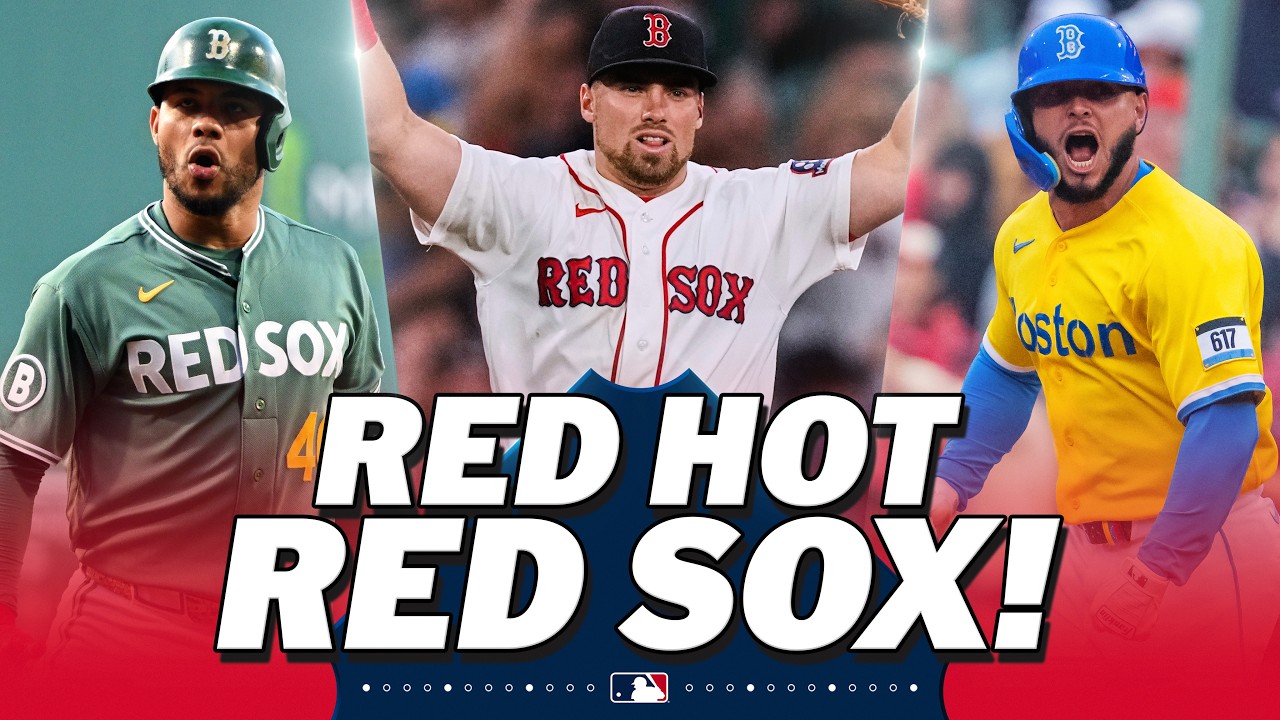
The Boston Red Sox looked like one of baseball’s biggest disappointments for nearly half of the 2026 season. They started 10-17, fired World Series-winning manager Alex Cora in April and eventually fell to 32-46 — 14 games below .500 — by late June.
Then the entire season changed.
Under interim manager Chad Tracy, Boston swept the rival New York Yankees, went on a franchise-record-tying 15-game winning streak and produced the best 30-game stretch in Red Sox history. A team that appeared likely to sell players at the trade deadline instead became a buyer, added catcher Adley Rutschman and ultimately clinched an American League Wild Card berth on September 20.
The turnaround was not built around one superstar. Boston combined improved offense, strong starting pitching, one of baseball’s best bullpens, contributions from young players and veterans, and a clubhouse that survived major injuries and a dramatic managerial change.
How Bad Was The Red Sox’s Start To The 2026 Season?
Boston opened the season 10-17 and dramatically underperformed expectations during the first month.
The Red Sox had made the playoffs in 2025 and entered 2026 expecting to contend again. Instead, their offense struggled, several important players underperformed and the team quickly fell to the bottom of the American League East.
Boston’s front office decided that the poor start required a major change rather than simply waiting for the season to correct itself.
On April 25, the Red Sox fired manager Alex Cora along with hitting coach Peter Fatse, assistant hitting coach Dillon Lawson, bench coach Ramón Vázquez, third-base coach Kyle Hudson and hitting strategy coach Joe Cronin. Jason Varitek was reassigned within the organization. [MLB]
Why Did The Red Sox Fire Alex Cora?
The Red Sox believed their roster was better than its 10-17 record and wanted to make a change while most of the season was still available to save.
Chief Baseball Officer Craig Breslow said Boston’s decision reflected the organization’s belief in its players. By acting after only 27 games, the team still had 135 games remaining to reverse course. [MLB]
The timing was extraordinary.
Cora was fired just hours after Boston beat the Baltimore Orioles 17-1. According to Elias, the 16-run margin was the largest victory in a manager’s final game with a team during MLB’s modern era. [MLB]
Cora’s departure was especially significant because he had managed Boston to a franchise-record 108 wins and the World Series championship in 2018.
How Did Chad Tracy Become Red Sox Manager?
Boston promoted Triple-A Worcester manager Chad Tracy to replace Cora on an interim basis.
Tracy was already familiar with many of Boston’s younger players because he had managed Worcester since 2022. Breslow specifically cited Tracy’s relationships with players and his ability to get the most out of young talent when explaining the promotion. [MiLB]
Tracy won his first Major League game on April 26, beating Baltimore 5-3.
But the managerial change did not instantly fix the Red Sox.
Did Boston Immediately Improve After Firing Alex Cora?
No. The Red Sox continued struggling for nearly two more months.
That is one of the most important parts of the 2026 turnaround.
By June 24, Boston had fallen to 32-46. The Red Sox were 15 1/2 games behind first place in the AL East, six games out of a Wild Card position and had eight teams between themselves and the final playoff berth. [MLB]
The Red Sox were 14 games under .500 after 78 games.
At that point, the more realistic question appeared to be which veterans Boston would trade away rather than whether the Red Sox could reach the postseason.
Were The Red Sox About To Become Sellers At The Trade Deadline?
Yes. Boston was openly considering changing direction before its summer surge.
Red Sox president and CEO Sam Kennedy acknowledged on June 12 that the organization’s original plan had been to add players at the trade deadline but said Boston might have to pivot unless the team dramatically improved. [MLB]
Veteran starting pitcher Sonny Gray and closer Aroldis Chapman were among the players who would have been attractive to contenders if Boston decided to sell. [MLB]
Then came the series that changed the season.
Was Sweeping The Yankees The Turning Point?
Yes. Boston’s four-game sweep of the Yankees at Fenway Park from June 25-28 was the beginning of the historic run that rescued the season.
The series began under unusual circumstances. Travel problems forced the Red Sox to arrive back in Boston at approximately 5 a.m. before the June 25 opener.
That night, Caleb Durbin hit a key home run and Boston won.
Three days later, Sonny Gray carried a no-hitter into the eighth inning and Jarren Duran delivered the walk-off hit in a wild 10th inning as Boston completed the four-game sweep. [MLB]
The sweep gave Boston its first four-game winning streak of the season.
The Red Sox were still only 36-46, but the direction of their season had changed.
How Big Was The Red Sox’s 2026 Winning Streak?
Boston eventually won 15 consecutive games, tying the franchise record.
The streak began July 3 and reached 15 games when the Red Sox beat Baltimore 6-3 in the first game of a July 22 doubleheader.
The only other Red Sox team to win 15 straight was the 1946 club led by Ted Williams, Bobby Doerr, Johnny Pesky and Dom DiMaggio. [MLB]
Boston lost the nightcap of the doubleheader 5-1, preventing the 2026 team from establishing the record outright.
The Red Sox went 27-3 over a 30-game span from July 3 through August 7, the best 30-game stretch in franchise history.
Boston was only 37-48 when that stretch began. [MLB]
The run included:
A 15-game winning streak.
A separate nine-game winning streak.
Multiple series sweeps.
A sweep of the defending champion Los Angeles Dodgers.
Boston’s first 9-0 road trip since 1977.
When the earlier four-game Yankees sweep is included, Boston went an extraordinary 32-5 from June 25 through August 7. [MLB]
How Rare Was Boston’s 27-3 Stretch?
The Red Sox became only the 10th MLB team since 1900 to win at least 27 times during a 30-game stretch within one season.[MLB]
The list includes historically dominant teams such as the 1906 Cubs, 1909 Pirates, multiple Yankees championship-era clubs, the 1977 Royals and the 2017 Cleveland team that won an American League-record 22 consecutive games.
What made Boston’s run particularly important was where it started. The Red Sox were not merely adding wins to an already strong season — they were climbing out of a 14-game hole below .500.
What Changed With The Red Sox Offense?
Boston went from being a below-average offensive team to an offense capable of scoring in several different ways.
During the first 20 games of the turnaround beginning June 25, the Red Sox scored 106 runs, fifth-most in MLB over that span. [MLB]
Tracy said the most important improvement was not simply hitting more home runs. Boston began:
Grinding through longer at-bats.
Drawing more walks.
Putting more balls in play.
Taking advantage of defensive mistakes.
Scoring without relying exclusively on home runs.
Still producing enough power to change games with one swing.
That versatility was visible throughout the winning streak. In one July victory over Tampa Bay, Boston scored three runs in an inning without recording a hit, using a passed ball, productive ground balls and aggressive baserunning. [MLB]
How Important Was Willson Contreras?
Willson Contreras became both Boston’s best hitter and one of the clubhouse leaders behind the turnaround.
Boston acquired Contreras from the St. Louis Cardinals before the season. By late September he was hitting .276 with 27 home runs, 81 RBIs, a .387 on-base percentage and a .905 OPS. [MLB]
His impact went beyond the numbers.
MLB described Contreras as the team’s “spiritual leader.” During Boston’s difficult first half, Contreras sent a message to the team urging everyone to keep believing in the group. [MLB]
After Boston clinched its postseason berth, Contreras addressed the clubhouse and emphasized that the team had survived injuries and a coaching change without losing belief in one another.
How Important Was Caleb Durbin?
Caleb Durbin became one of the clearest symbols of Boston’s transformation from struggling offense to winning baseball.
The turnaround essentially began with Durbin’s clutch home run against Yankees ace Cam Schlittler on June 25.
Durbin had suffered a partial dislocation of his left pinkie the previous day but insisted on remaining in the lineup. [MLB]
During the 15-game winning streak he repeatedly contributed in high-leverage situations, including a go-ahead eighth-inning home run against Baltimore on July 21 that extended Boston’s streak to 14 games. [MLB]
Who Else Powered The Red Sox Offense?
Boston’s lineup became difficult to navigate because production came from several different players instead of one superstar.
Roman Anthony also returned from a finger injury and provided another dangerous bat for the stretch run.
How Did Starting Pitching Help Turn The Season Around?
Starting pitching was arguably the most stable part of Boston’s team even while the offense struggled.
During an 18-2 portion of the summer surge, Red Sox pitchers produced a 2.46 ERA, third-best in MLB. They ranked second in opponents’ batting average, WHIP and opponents’ OPS during that span. [MLB]
Even more impressively, Boston did most of that without Garrett Crochet.
Crochet, the reigning American League Cy Young runner-up, went on the injured list with left shoulder inflammation after his April 25 start and later suffered a low-grade lat strain during his rehabilitation. [MLB]
Instead of collapsing without its ace, Boston found replacements throughout the rotation.
How Important Was Sonny Gray?
Sonny Gray effectively became the Red Sox ace while Crochet was injured.
Gray was 12-1 with a 2.48 ERA by July 20 and anchored the rotation during Boston’s hottest stretch. [MLB]
On July 19, Gray completed his ninth consecutive quality start, the longest such Red Sox streak since Chris Sale during Boston’s 2018 championship season. [MLB]
By late September, Gray was 17-5 with a 2.82 ERA in 28 starts. [MLB]
Who Is Payton Tolle And Why Was He Important?
Rookie left-hander Payton Tolle became another major reason Boston survived the loss of Crochet.
Tolle did not make the Opening Day roster but was recalled in April and quickly demonstrated that he belonged, including an 11-strikeout performance against the Yankees. [MLB]
By the stretch run, Tolle had made 25 starts and was 9-6 with a 3.02 ERA, 166 strikeouts and a 1.07 WHIP over 143 innings. [MLB]
His emergence gave the Red Sox a legitimate postseason-caliber starter from within their own system.
Who Was Jake Bennett?
Jake Bennett became one of the most unexpected contributors to the comeback.
Boston called the left-hander up from Triple-A after surprisingly optioning Brayan Bello.
Bennett had not pitched above Double-A before 2026, but during the beginning of Boston’s surge he went 4-1 with a 1.17 ERA across six starts. [MLB]
Contributions like Bennett’s allowed Boston to continue winning despite injuries and instability in the rotation.
How Good Was The Red Sox Bullpen?
The bullpen was one of the most important and least-publicized reasons Boston stayed in contention.
Beginning with the June 25 win over the Yankees, the Red Sox bullpen posted a 2.49 ERA during the first part of the surge, third-best in MLB. Opponents hit just .196 against Boston relievers, and the bullpen led MLB with a .565 opponents’ OPS. [MLB]
Aroldis Chapman and Garrett Whitlock provided a high-leverage combination at the back of games, while Tyron Guerrero, Greg Weissert and Justin Slaten supplied important innings in front of them.
That pitching depth allowed Tracy to protect narrow leads during a stretch in which seemingly every close game began going Boston’s way.
What Did Chad Tracy Change?
Tracy’s biggest impact appears to have been communication and stability rather than a single dramatic tactical change.
Boston did not immediately become good after he replaced Cora. Instead, Tracy kept a struggling team together long enough for the offense, pitching and young players to begin producing simultaneously.
Contreras praised Tracy for maintaining the same temperament after victories and losses and for communicating effectively with both younger players and veterans. [MLB]
That approach mattered on a club that could easily have fractured after a 10-17 start, the firing of a championship manager and a slide to 14 games below .500.
What Was Boston’s Record Under Chad Tracy?
By September 22, Boston had gone 74-55 under Tracy.
The Red Sox improved from 10-17 when Cora was fired to 84-72 after clinching their postseason berth. [Reuters]
Stage Of Season
Record
When Alex Cora was fired
10-17
June 24 low point
32-46
After 27-3 surge
64-51
At playoff clinch
84-72
How Did The Winning Streak Change Boston’s Trade Deadline?
The surge completely reversed Boston’s deadline strategy.
A team that appeared ready to trade away veterans suddenly had one of the American League’s best records and a legitimate opportunity to reach the postseason.
Rather than sell, Breslow aggressively added talent.
Why Did The Red Sox Trade For Adley Rutschman?
Boston made one of the biggest deals of the 2026 trade deadline by acquiring catcher Adley Rutschman from the Baltimore Orioles.
The Red Sox needed more production at catcher and were suddenly in a position where sacrificing prospects for immediate Major League help made sense.
Boston sent a substantial prospect package to Baltimore headlined by MLB Pipeline Top 100 pitching prospect Anthony Eyanson. The Orioles also received pitcher Kyson Witherspoon, outfielder Enddy Azocar, catcher Carlos Narváez and a player to be named later. Boston received Rutschman and catcher Jake Rogers. [MLB]
The trade was an important symbolic moment in the comeback: Boston had gone from contemplating a sell-off to spending significant prospect capital for a playoff run.
What Other Trade Deadline Moves Did Boston Make?
The Red Sox also strengthened the bullpen and outfield depth.
Boston traded infielder Marcelo Mayer to the San Francisco Giants for left-handed reliever Erik Miller and Minor League outfielder Carlos Gutierrez. The Red Sox also added veteran outfielder Eli White to provide a right-handed bat and defensive flexibility. [MLB]
Miller became another late-inning option and remained part of Boston’s expected postseason bullpen.
How Did The Red Sox Play After The All-Star Break?
Boston did not collapse once the historic winning streak ended.
That was crucial.
A hot streak can pull a team back into contention, but reaching the postseason still requires winning for another two months.
Through the September 20 clincher, Boston was 38-24 in the second half, the second-best record in the American League over that period. [MLB]
The Red Sox therefore converted their summer explosion into sustained playoff-level performance rather than giving all the gains back.
How Did The Red Sox Clinch A Playoff Spot?
Boston officially secured its postseason berth on September 20.
The clincher itself was unusual.
The Red Sox lost 5-1 to the Tampa Bay Rays that afternoon. Boston still needed the Houston Astros to lose to Atlanta.
Atlanta’s Mike Yastrzemski — grandson of Red Sox legend Carl Yastrzemski — then hit a three-run home run that helped the Braves beat Houston and mathematically put Boston into the postseason. [MLB]
The Red Sox celebrated in the visiting clubhouse in Tampa Bay once the Astros result became final.
How Historic Was Boston’s Comeback?
The Red Sox did something no previous MLB team had done under the circumstances of their start.
According to MLB, Boston became the first team in history to finish above .500 after losing as many as 46 of its first 78 games — and the Red Sox went further by qualifying for the postseason. [MLB]
The numbers illustrate the magnitude of the reversal:
Point
Red Sox Situation
April 25
10-17; Alex Cora fired
June 24
32-46; 14 games under .500
June 25-28
Four-game sweep of Yankees
July 3-22
15-game winning streak
July 3-Aug. 7
27-3, best 30-game run in franchise history
June 25-Aug. 7
32-5 overall
Sept. 20
Clinched AL Wild Card berth
Sept. 22
Chad Tracy named permanent manager
Did The Red Sox Make Chad Tracy The Permanent Manager?
Yes. Two days after Boston clinched its playoff spot, the Red Sox removed Tracy’s interim label.
On September 22, Boston announced a three-year contract with Tracy covering the 2027 through 2029 seasons, with a team option for 2030. [MLB]
Tracy officially became the 49th manager in Red Sox history.
The club simultaneously exercised 2029 and 2030 options on Breslow’s contract, effectively rewarding both the executive who made the managerial change and the manager who oversaw the turnaround. [Reuters]
What Were The Biggest Reasons For The Red Sox Turnaround?
No single development explains it. Several things changed at approximately the same time.
Chad Tracy stabilized the clubhouse. His familiarity with younger players and even temperament helped Boston survive a turbulent managerial transition.
The offense finally started producing. Boston became more patient, generated longer at-bats and learned to score without depending entirely on home runs.
Sonny Gray became the rotation’s ace. Gray carried the pitching staff while Garrett Crochet missed most of the season.
Young pitching emerged. Payton Tolle and Jake Bennett supplied important innings that Boston could not have expected entering the season.
The bullpen became dominant. Chapman, Whitlock and the relief corps consistently protected leads.
The Yankees sweep created momentum. The June 25-28 series was the clear dividing line between the struggling first-half team and the club that went 32-5 over the next six weeks.
The 15-game streak erased the deficit. Boston went from essentially out of contention to holding a Wild Card position.
The front office changed from seller to buyer. Rutschman and other deadline additions reinforced a team that had proven it was worth investing in.
The hot streak became sustainable winning. Boston followed its historic summer run with one of the AL’s best second-half records.
What Is The Simplest Explanation For The 2026 Red Sox Comeback?
Boston survived long enough for all parts of the roster to start working at the same time.
The managerial change alone did not save the season. Neither did one trade or one player.
Tracy kept the team together while Boston’s pitching remained competitive. The offense finally came alive in late June. The bullpen consistently protected leads. Young players stepped into unexpectedly important roles. Veterans such as Gray and Contreras became anchors. Then the Yankees sweep ignited a run so extreme that Boston erased nearly three months of poor baseball in roughly six weeks.
Once the Red Sox climbed back into contention, Breslow reinforced the roster rather than dismantling it.
The result was a team that went from 14 games under .500 on June 24 to the MLB postseason less than three months later.
2026 Red Sox Turnaround FAQ
What was the Red Sox’s worst record in 2026?
Boston fell to 32-46 on June 24, putting the Red Sox 14 games under .500.
How far out of the playoffs were the Red Sox?
On June 24, Boston was six games behind the final American League Wild Card spot with eight teams ahead of it. The Red Sox were also 15 1/2 games behind first place in the AL East. [MLB]
When did the Red Sox season turn around?
The clearest turning point was June 25, when Boston began a four-game sweep of the Yankees at Fenway Park.
How many games in a row did the Red Sox win?
Boston won 15 consecutive games from July 3 through July 22, tying the franchise record established by the 1946 Red Sox.
What was the Red Sox’s 27-3 streak?
Boston won 27 of 30 games between July 3 and August 7, the best 30-game stretch in franchise history.
What was Boston’s record during the entire turnaround?
Beginning with the June 25 Yankees game, the Red Sox went 32-5 through August 7.
Why did the Red Sox fire Alex Cora?
Boston started 10-17 despite entering the season with playoff expectations. The front office believed changing the manager and coaching staff early enough could create a fresh environment while 135 games remained.
Who replaced Alex Cora?
Triple-A Worcester manager Chad Tracy took over on an interim basis on April 26 and was made the permanent manager on September 22.
Did Boston’s turnaround begin immediately under Chad Tracy?
No. The Red Sox continued struggling and eventually fell to 32-46 nearly two months after Tracy’s promotion. The dramatic improvement began in late June.
Who were the most important Red Sox players?
Willson Contreras led the offense and clubhouse, Sonny Gray anchored the rotation, Payton Tolle emerged as a dependable rookie starter, and players including Caleb Durbin, Wilyer Abreu, Ceddanne Rafaela and Jarren Duran supplied important offense and defense.
Did Garrett Crochet help lead the winning streak?
Not directly. Crochet was sidelined for most of the season with shoulder and lat injuries. One of the remarkable parts of Boston’s turnaround was that it occurred largely without its presumed ace.
Who did the Red Sox acquire at the trade deadline?
The biggest addition was catcher Adley Rutschman from Baltimore. Boston also acquired left-handed reliever Erik Miller and additional roster depth.
When did the Red Sox clinch the playoffs?
Boston clinched an American League Wild Card berth on September 20, 2026.
How did Boston clinch despite losing that day?
The Red Sox lost to Tampa Bay but clinched when Atlanta defeated Houston. Mike Yastrzemski, grandson of Red Sox Hall of Famer Carl Yastrzemski, hit a crucial three-run homer for the Braves.
How did a team that started 32-46 make the playoffs?
Boston produced an extraordinary midsummer surge, going 32-5 from June 25 through August 7, and then continued playing winning baseball through September. The combination of improved offense, strong starting pitching, a dominant bullpen, contributions from young players and Chad Tracy’s steady leadership transformed what appeared to be a lost season into a playoff season.