The NFL’s overtime rules changed significantly before the 2025 season, and those rules remain in effect for the 2026 NFL season.
The biggest change is simple: an opening-drive touchdown no longer automatically ends a regular-season overtime game.
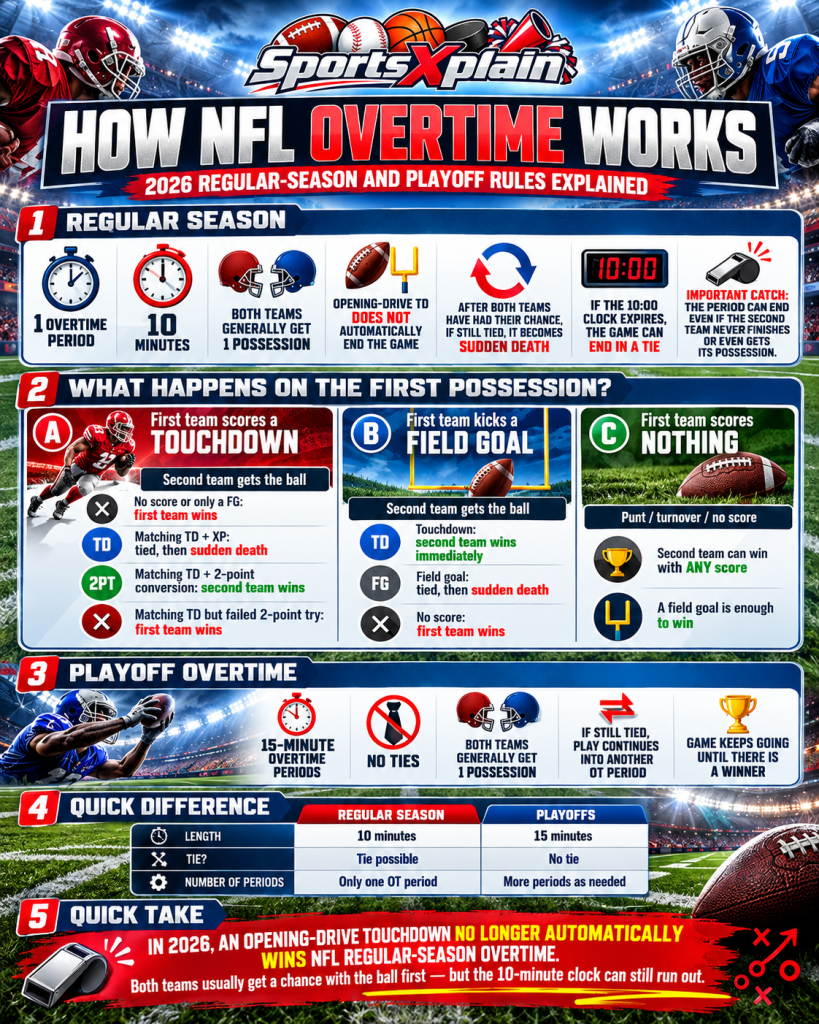
Both teams now generally get an opportunity to possess the football at least once, whether the first team kicks a field goal or scores a touchdown. After both teams have had that opportunity, the game becomes sudden death if the score is still tied.
There is one important complication: regular-season overtime still lasts only 10 minutes, and that clock can expire even if the second team’s possession has not been completed.
Can A Touchdown On The First Possession Still Win NFL Overtime?
No, not by itself.
Under the current NFL rules, the team receiving the opening overtime kickoff can score a touchdown, but the opponent still generally receives an opportunity to possess the football.
This is different from the old regular-season overtime rule, under which an opening-drive touchdown immediately ended the game.
The NFL changed the regular-season rule in 2025 to align it more closely with the postseason system. [NFL][NFL Football Operations]
What Happens If The First Team Scores A Touchdown?
Suppose Team A receives the overtime kickoff and scores a touchdown plus an extra point, taking a 7-0 lead.
Team B then gets an opportunity to possess the ball.
Several things can happen:
If Team B does not score, Team A wins.
If Team B kicks only a field goal, Team A wins.
If Team B scores a touchdown and kicks the extra point, the game is tied 7-7 and becomes sudden death.
If Team B scores a touchdown and successfully goes for two, Team B wins 8-7.
If Team B scores a touchdown and fails on a two-point attempt, Team A wins 7-6.
This creates an important strategic decision for the team possessing the ball second: after matching an opening touchdown, it can either kick the extra point and extend the game or attempt a two-point conversion to win immediately.
If the team receiving the opening kickoff punts, turns the ball over or otherwise finishes its possession without scoring, the next team can win with any score.
That means the second team does not need a touchdown.
A field goal is enough to win because the first team has already had its opportunity to possess the ball and failed to score.
Does Each Team Really Get A Guaranteed Possession?
Not absolutely.
This is one of the most important details in the 2026 rule.
The NFL says both teams must have an opportunity to possess the ball once, but regular-season overtime is also limited to a single 10-minute period.
The rule specifically states that the overtime period ends after 10 minutes even if the second team has not had an opportunity to possess the ball or if its initial possession has not ended.
That means an extremely long opening drive could consume nearly the entire overtime period.
If time expires and one team is ahead, that team wins. If the score is tied when the clock reaches zero, the regular-season game ends in a tie.
Could A Team Use All 10 Minutes On The First Possession?
Yes.
Nothing in the overtime rule creates additional time simply to guarantee completion of the second team’s possession during the regular season.
For example, if the first team controls the football for almost all 10 minutes and kicks a field goal just before the clock expires, there may not be enough time for the other team to complete its possession.
This is one of the biggest differences between regular-season and playoff overtime.
The basic possession concept is similar, but playoff games cannot end in ties.
Postseason overtime periods last 15 minutes instead of 10.
Both teams generally receive an opportunity to possess the football at least once.
If the first 15-minute overtime period ends before the second team’s first possession is finished, the game simply continues into another overtime period.
The teams continue playing as many overtime periods as necessary until a winner is determined.
A safety creates a special exception to the usual possession rule.
If the team kicking off to begin overtime records a safety against the receiving team on that receiving team’s first possession, the game ends immediately and the team that scored the safety wins.
The winning team does not need to take an offensive possession afterward.
This exception applies in both regular-season and postseason overtime.
What Counts As An Opportunity To Possess The Ball?
The NFL’s definition is broader than simply running an offensive play.
A kickoff itself provides the receiving team an opportunity to possess the football.
On certain kicks, a receiving team that touches or muffs the football can also be considered to have had its possession opportunity even if the kicking team ultimately recovers it.
This matters because once both teams have satisfied the possession requirement, the game can move into sudden death.
Regular-season overtime generally follows the timing rules that apply during the fourth quarter, including the league’s end-of-period timing procedures.
The NFL’s overtime rules specify that the general provisions applying to the fourth quarter also apply during the 10-minute regular-season overtime period.
Is It Better To Get The Ball First Or Second In NFL Overtime?
The new rules make that strategic question more complicated than it was under the old system.
Receiving first allows a team to score immediately and put pressure on its opponent.
Receiving second, however, gives the offense valuable information.
The second team knows exactly what it needs:
If the first team scores a touchdown, the second team knows it needs a touchdown.
If the first team kicks a field goal, the second team knows a touchdown wins.
If the first team does not score, the second team knows a field goal wins.
If the first team scores seven points, the second team can decide whether to kick an extra point or attempt a two-point conversion for the win after scoring a touchdown.
That strategic information has led to more discussion about whether teams should choose to kick rather than automatically receive after winning the overtime coin toss.
Why Did The NFL Change Its Overtime Rules?
The NFL changed the regular-season overtime format in 2025 after concerns that the coin toss and an opening-drive touchdown gave the team receiving first too large an advantage.
According to NFL reporting, six of the league’s 16 overtime games during the previous season ended with a touchdown on the opening possession.
Teams winning the overtime coin toss won 75 percent of overtime games that season.
The Philadelphia Eagles proposed allowing both teams an opportunity to possess the ball regardless of whether the opening team scored a touchdown.
NFL owners approved the proposal but kept regular-season overtime at 10 minutes rather than increasing it to 15.
NFL owners approved the current regular-season possession rule in April 2025.
The rule took effect for the 2025 season and remains part of the official rules in 2026.
The league had already adopted the both-teams-get-a-possession system for postseason games beginning with the 2022 rule change.
The 2025 amendment effectively brought the regular-season possession rule closer to the postseason format while retaining the shorter 10-minute regular-season clock.
No major overtime change was adopted for the 2026 season.
The NFL’s official list of 2026 playing-rule changes includes changes involving kickoffs, onside kicks and player disqualifications, but no new amendment to Rule 16 governing overtime.
The possession system introduced for the 2025 season therefore remains in place for 2026.
The NFL included an explanation of the new overtime format in its official video explaining the rule changes introduced for the 2025 season. The overtime discussion begins at approximately the 3:35 mark.
Can the regular-season clock expire before both possessions are completed? Yes
When does sudden death begin? After the possession requirement has been satisfied and the score remains tied
Can a regular-season game end in a tie? Yes
Can a playoff game end in a tie? No
Regular-season timeouts: Two per team
Special safety exception: A safety by the team that kicked off against the receiving team on its opening possession ends the game
Current rule introduced: 2025 regular season
Changed again for 2026? No major overtime change
What Is The Simplest Way To Understand The 2026 NFL Overtime Rules?
The easiest way to remember the current rule is:
Both teams generally get one chance with the football. If they are still tied after those chances, the next score wins.
The major exception is the regular-season clock. The NFL still allows only one 10-minute overtime period, so time can expire before the possession sequence is fully completed.
That combination is what separates today’s overtime rules from both the old NFL system and college football overtime.
An opening touchdown is no longer automatically fatal. A team that loses the overtime coin toss can still answer with a touchdown of its own — and may even choose to attempt a two-point conversion to win the game immediately.