A walk-off field goal in the NFL is a field goal that wins the game on its final play, meaning the successful kick ends the contest immediately and the opposing team does not get another possession.
The phrase is borrowed from baseball’s “walk-off” terminology. It is not a special type of kick or a separate category in the NFL rulebook. It simply describes the circumstances: the kicker makes a field goal and the game is over.
A walk-off field goal can occur as time expires in the fourth quarter or during overtime when the kick satisfies the NFL’s overtime rules. [NFL Rulebook]
What Does Walk-Off Field Goal Mean?
In its simplest form, imagine the score is tied 20-20 with three seconds remaining.
The offense lines up for a 45-yard field goal.
The ball is snapped, the kicker makes the kick and the clock reaches 0:00.
The final score becomes 23-20.
Because the opponent has no opportunity to possess the ball again, the field goal is described as a walk-off winner.
Is “Walk-Off Field Goal” An Official NFL Term?
Not in the sense of being a separate scoring play defined by the rulebook.
The NFL rules simply treat the play as a field goal worth three points.
“Walk-off” is a commonly used sports expression describing a scoring play that immediately produces the final result.
Broadcasters, reporters, players and fans frequently use the phrase for game-ending field goals.
How Many Points Is A Field Goal Worth?
An NFL field goal is worth three points.
For the attempt to be successful, the kicked ball must travel above the crossbar and between the uprights, subject to the other requirements of the NFL’s field-goal rules. [NFL Football Operations]
A walk-off field goal is worth the same three points as any other field goal.
Its significance comes from when it happens rather than from a different point value.
Does A Walk-Off Field Goal Have To Happen At 0:00?
No.
This is an important distinction.
A walk-off field goal at the end of regulation usually occurs as time expires because otherwise the opponent would receive the ball again.
But an overtime field goal can end the game while time remains on the overtime clock.
If the NFL’s overtime conditions have been satisfied and a team kicks the decisive field goal, the game ends immediately.
There could theoretically still be several minutes showing on the clock.
The kick would nevertheless be a walk-off because no additional play is required.
Can A Field Goal Win A Game As Time Expires?
Yes.
This is the classic walk-off field goal.
A team tied or trailing by one or two points can position itself for a field-goal attempt on the final play of regulation.
If the kick is good:
- A tie becomes a three-point victory.
- A one-point deficit becomes a two-point victory.
- A two-point deficit becomes a one-point victory.
Because the fourth-quarter clock has expired, the opponent has no opportunity to answer.
What If The Kicker Makes It With One Second Remaining?
That is normally not technically a walk-off if another play must occur.
Suppose a team takes a 23-20 lead on a field goal with one second remaining.
The opponent would ordinarily still receive the ensuing kickoff or participate in another play.
The kick was game-winning in practical terms, but it did not itself immediately end the game.
That is why “game-winning field goal” and “walk-off field goal” are closely related but do not always mean exactly the same thing.
Game-Winning Field Goal vs. Walk-Off Field Goal
| Term | Meaning |
|---|---|
| Game-winning field goal | A field goal that provides the points that ultimately determine the winner |
| Walk-off field goal | A game-winning field goal that effectively ends the game immediately |
Every walk-off field goal is a game-winning field goal.
Not every game-winning field goal is necessarily a walk-off.
Can A Team Kick A Walk-Off Field Goal While Losing?
Yes, provided it is trailing by no more than two points.
For example:
- Trailing 20-19: Field goal makes it 22-20.
- Trailing 20-18: Field goal makes it 21-20.
If the kick occurs on the final play, either would be a walk-off field goal.
But if a team trails by three points, a field goal only ties the game. If it trails by four or more, three points cannot produce a victory.
Can A Team Kick A Walk-Off Field Goal When The Game Is Tied?
Yes, and this is probably the most familiar scenario.
If the game is tied and the offense reaches field-goal range near the end of regulation, it will often deliberately manage the clock so the kick becomes the final play.
For example:
Score: 27-27
Clock: 0:03
Field goal: Good
Final: 30-27
That is a walk-off field goal.
Why Do Teams Run The Clock Down Before Attempting The Kick?
Because coaches generally do not want to give the opponent another possession.
Imagine a team reaches the opponent’s 20-yard line with 50 seconds remaining in a tie game.
It could immediately attempt the field goal.
But if the kick succeeds with 45 seconds remaining, the opponent gets the ball back with enough time to attempt its own scoring drive.
Instead, the offense may run the football, force the defense to use its timeouts and then let the clock run down before attempting the kick.
The goal is to create a situation in which:
Make the kick = win the game.
Miss the kick = potentially overtime or defeat.
But there is no meaningful time left for the opponent to respond.
Why Do Teams Sometimes Kneel Before A Walk-Off Field Goal?
Once a team reaches comfortable field-goal range late in a tied game, gaining more yards may become less important than protecting the football.
Every normal offensive play introduces risk:
- Fumble
- Interception
- Penalty
- Injury
- Loss of yardage
If the coach trusts the kicker from the current distance, the quarterback may take one or more kneel-downs to run the clock toward zero.
The team then uses its final timeout and sends out the field-goal unit.
This strategy is sometimes called playing for the field goal.
Can A Team Let The Clock Reach Zero During The Kick?
Yes.
The important moment is the snap.
If the ball is legally snapped before the game clock expires, the play continues even if the clock reaches 0:00 while the ball is in the air.
The quarter does not simply terminate while a live play is underway.
Therefore, a kicker can begin an attempt with two seconds remaining, have the clock expire during the play and still make the game-winning field goal.
The result counts.
What If The Field Goal Is Missed As Time Expires?
If the game is tied and the kicker misses on the final play of regulation, the game proceeds to overtime.
If the kicking team is trailing and misses on the final play, it loses.
That is what makes true walk-off attempts particularly dramatic: there may be no opportunity to recover from a miss.
What If The Defense Blocks The Field Goal?
The ball remains subject to the normal rules governing a blocked kick.
A blocked field goal does not automatically end the play simply because the clock reaches zero.
Depending on where the ball goes and what players do with it, the defense may be able to recover and advance it.
That creates the possibility of an extraordinary ending in which a team attempting a walk-off field goal instead loses because the opponent returns the blocked kick for a touchdown.
Can The Defense Return A Missed Walk-Off Field Goal?
In some circumstances, yes.
A missed field goal that remains in the field of play can potentially be returned by the defense under NFL rules.
This is most likely on an extremely long attempt that falls short rather than a kick that simply sails wide beyond the end line.
That is why teams sometimes station a returner near the goal line when an opponent attempts an exceptionally long field goal at the end of a half or game.
Can A Penalty Affect A Walk-Off Field Goal?
Absolutely.
Penalties can produce some of the most confusing endings in football.
If the defense commits certain accepted fouls on the final play, the offense may receive an untimed down even though the clock reads 0:00.
Conversely, an offensive penalty can nullify a successful kick or change the circumstances of the attempt.
The exact result depends on the foul, whether the penalty is accepted and the applicable timing rules. [NFL Rulebook]
What Is An Untimed Down?
An untimed down is an additional play conducted after the game clock has expired because the rules require the period to be extended.
For example, certain defensive penalties on what would otherwise be the final play can give the offense another opportunity.
That means a team could theoretically attempt a field goal with the scoreboard already showing 0:00.
If the kick wins the game, it would still function as a walk-off field goal.
Can A Walk-Off Field Goal Happen In Overtime?
Yes.
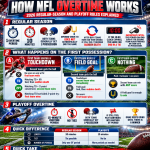
Overtime produces many walk-off field goals, although whether a particular kick immediately ends the game depends on the NFL’s overtime rules and what has happened earlier in the period.
The NFL has modified its overtime format multiple times, including rules governing possession opportunities and postseason games. [NFL Football Operations]
The key point is that an overtime field goal is a walk-off only when the kick establishes a result that ends the game under the applicable overtime rules.
Does A Field Goal On The First Overtime Possession Automatically Win?
Not necessarily.
The NFL’s overtime format determines whether the opponent is entitled to a possession after the first team kicks a field goal.
That is why fans should not automatically assume that every successful overtime field goal ends the game.
A field goal becomes a true walk-off only once the other team’s right to respond has been satisfied or the circumstances otherwise make the score immediately decisive. [NFL Football Operations]
What Does “Field-Goal Range” Mean?
Field-goal range is not an official line on the football field.
It describes the area where a team believes its kicker has a reasonable chance of making a field goal.
The distance varies depending on:
- The kicker’s leg strength
- Accuracy
- Weather
- Wind
- Altitude
- Field conditions
- Game situation
A team with an elite long-distance kicker may consider itself in range near midfield, while another team may want to reach the opponent’s 30-yard line or closer.
How Is NFL Field-Goal Distance Calculated?
The listed distance of a field goal is longer than the distance from the line of scrimmage to the goal line.
A useful approximation is:
Line of scrimmage + 17 yards = field-goal distance.
For example, if the ball is at the opponent’s 30-yard line:
30 + 17 = approximately a 47-yard field goal.
The additional yardage accounts for the end zone and the spot where the holder places the ball behind the line of scrimmage.
Why Does The Holder Set Up Behind The Line?
On a conventional NFL field goal, the long snapper sends the ball backward to a holder positioned several yards behind the line of scrimmage.
The holder catches the snap, rotates the football and places it on the ground for the kicker.
The entire process happens extremely quickly because defensive players are attempting to penetrate the protection and block the kick.
A poor snap or hold can ruin even a relatively short walk-off attempt.
Why Are Walk-Off Field Goals So Stressful For Kickers?
Because a single play can determine the outcome of the entire game.
The kicker may spend most of the afternoon on the sideline and then suddenly be asked to execute one precise movement with millions of people watching.
A successful kick can make the kicker the hero.
A miss can become the defining moment of the game.
That pressure is why coaches and commentators frequently discuss whether a kicker is reliable in clutch situations.
Can A Walk-Off Field Goal Happen In The Playoffs?
Yes.
Some of the most famous kicks in NFL history have ended playoff games.
The postseason adds another level of consequence because a successful walk-off field goal can immediately eliminate the opponent and send the winning team to the next round.
Unlike the regular season, postseason games cannot end in a tie, so overtime continues until a winner is determined under the playoff overtime rules. [NFL Football Operations]
What Is The Difference Between A Walk-Off Field Goal And A Walk-Off Touchdown?
The basic concept is the same.
A walk-off touchdown is a touchdown that immediately ends the game.
A walk-off field goal is a field goal that immediately ends the game.
The phrase describes the result rather than the type of scoring play.
An interception return, fumble return or safety can also produce a game-ending result under the appropriate circumstances, although “walk-off” is most commonly associated with field goals and touchdowns.
Why Is It Called A “Walk-Off”?
The expression became famous through baseball.
In baseball, the home team can win in the bottom of the final inning by scoring a run that immediately ends the game.
The players can essentially walk off the field because no further play is necessary.
The terminology eventually spread to other sports.
In football, a successful game-ending field goal produces the same basic effect: the kick goes through, the officials signal that it is good and the game is over.
Walk-Off Field Goal Example
Consider this situation:
| Situation | Example |
|---|---|
| Score | Chiefs 24, Bills 24 |
| Time remaining | 0:03 |
| Ball | Bills’ 30-yard line |
| Attempt | Approximately 47-yard field goal |
| Result | Kick is good as time expires |
| Final score | Chiefs 27, Bills 24 |
Because Buffalo never receives another possession, the kick is a walk-off field goal.
Walk-Off Field Goal Rules At A Glance
- Points: Three
- Official special scoring category? No
- Basic meaning: A field goal that immediately produces the final result
- Can happen in regulation? Yes
- Can happen in overtime? Yes
- Must clock show 0:00? No
- Can the kicking team be trailing? Yes, by one or two points
- Can it happen in a tie game? Yes
- Can a missed kick be returned? In applicable situations, yes
- Can penalties extend the game? Yes
So What Exactly Is A Walk-Off Field Goal?
A walk-off field goal is simply a successful field goal that ends the football game with the kicking team winning.
The most familiar version occurs when the score is tied, an offense drives into field-goal range and deliberately runs the clock down before attempting the kick.
The snap comes with only a few seconds remaining. The kicker sends the ball through the uprights. The clock reaches zero.
There is no kickoff. There is no answer from the opposing quarterback. There is no next possession.
The officials signal that the kick is good, the winning team celebrates and the game is finished.
That is why it is called a walk-off.