A hockey fight strap is a small piece of material sewn into the inside back of a player’s jersey that attaches the jersey to the player’s hockey pants. It is also commonly called a tie-down.
Despite the name, a fight strap is not designed to help a player fight. Its primary purpose is to prevent a player’s jersey from being pulled completely over his head or removed during an altercation. In the NHL, the device also has an important rules function: a player who fights without his jersey properly tied down and loses the jersey can receive a game misconduct in addition to the normal fighting penalty. [NHL]
The modern fight-strap rule is closely associated with former Buffalo Sabres enforcer Rob Ray, who became notorious for deliberately wearing his equipment in a way that allowed opponents to pull his jersey off during fights. His tactic helped lead to a rule commonly nicknamed the “Rob Ray Rule.” [Buffalo Sabres]
What Does A Hockey Fight Strap Look Like?
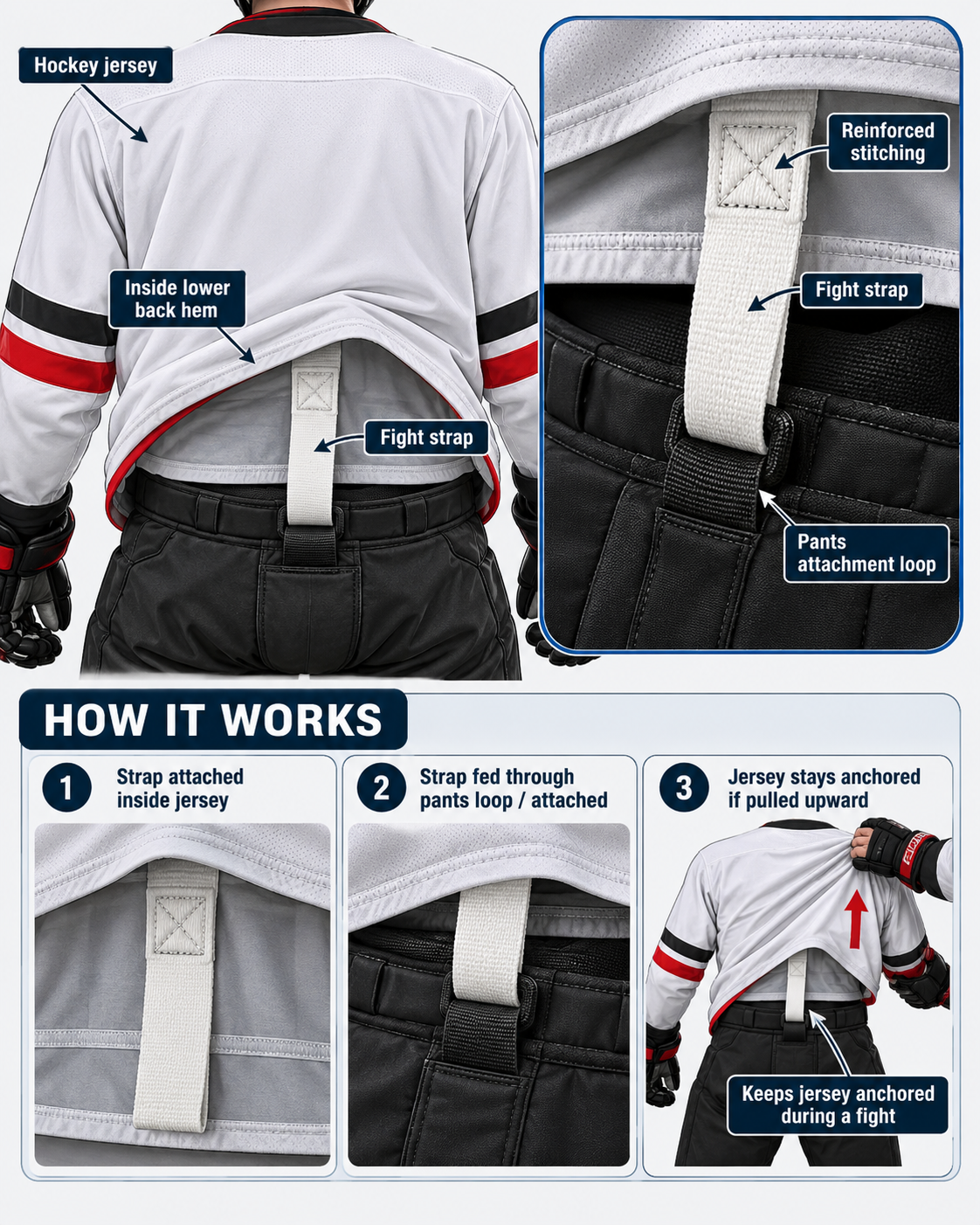
The fight strap is located inside the lower back of a hockey jersey. It is normally a short, reinforced strap that connects the jersey to the player’s hockey pants.
Because it is underneath the jersey, spectators normally cannot see it while watching a game.
When properly attached, the strap effectively anchors the back of the jersey to the player’s pants. The jersey can still move, stretch and be pulled during normal play, but it becomes much more difficult for another player to pull it completely over the wearer’s head and off his torso.
Why Is It Called A Fight Strap?
The name comes from one of the situations in which the strap matters most: a hockey fight.
During a fight, players frequently grab each other’s jerseys with one hand while throwing punches with the other. The jersey can become both a weapon and a vulnerability.
A player can use his opponent’s jersey to control distance, maintain balance, restrict the opponent’s punching arm or pull him off balance.
But if the jersey is pulled upward and over the player’s head, the fabric can cover his face and restrict his arms while his opponent remains able to punch.
The fight strap helps keep that from happening by anchoring the jersey to the pants.
How Does A Fight Strap Work?
The concept is extremely simple.
The strap is attached to the inside of the jersey and then fastened to the player’s hockey pants before he goes onto the ice.
Think of the arrangement like this:
Jersey → fight strap → hockey pants
If another player pulls upward on the jersey, the pants and strap resist that movement.
The jersey can still be stretched or pulled partially upward, but a properly secured strap makes it considerably harder to pull the sweater completely off the player’s torso.
Why Would Losing A Jersey During A Fight Be Dangerous?
A loose jersey can create a significant disadvantage during a hockey fight.
Players commonly grip the collar, shoulder or sleeve of an opponent’s sweater. If a player can pull the opponent’s jersey upward, the fabric can restrict the opponent’s arms or obscure his vision.
That is sometimes called “jerseying” an opponent.
A player whose jersey has been pulled over his head may have difficulty seeing punches or protecting himself. Linesmen will generally move in to stop a fight when a player becomes unable to defend himself, but the situation can develop quickly.
A fight strap reduces the likelihood of the jersey reaching that position in the first place.
What Is The NHL Fight Strap Rule?
The fight-strap provision appears in the NHL’s fighting rules.
Under Rule 46, a player who participates in a fight and whose jersey is not properly tied down to his pants can receive a game misconduct if the jersey comes completely off his torso during the altercation. [NHL]
The basic sequence is:
- A player participates in a fight.
- His jersey is not properly attached to his pants.
- The jersey comes completely off his torso during the fight.
- The player can receive a game misconduct in addition to the penalties resulting from the fight.
The rule is specifically intended to prevent players from deliberately wearing their jerseys loose enough to escape them during fights.
What Happens If The Fight Strap Breaks?
This is an important exception to the rule.
A player is not automatically given a game misconduct simply because his jersey comes off during a fight.
If the jersey was properly tied down and the strap remains attached or the equipment otherwise fails despite being properly secured, the game-misconduct provision does not automatically apply. The NHL rulebook says the incident should instead be reported to the league so the jersey and tie-down can be examined. [NHL Rulebook]
The distinction is important because the rule is aimed at players who fail to secure their jerseys properly, not players whose equipment legitimately fails during an altercation.
Can A Player Get A Game Misconduct For Not Using A Fight Strap?
Yes, but simply having an unattached strap does not necessarily mean a player is immediately ejected.
The key situation covered by the fighting rule occurs when the player:
fights + is not properly tied down + loses the jersey completely.
When those conditions are met, the player can receive a game misconduct.
That punishment is separate from the standard five-minute major assessed for fighting under NHL Rule 46. [NHL]
What If An Opponent Rips Off A Player’s Jersey?
The NHL rule contains another important exception.
If a player’s opponent is identified as the instigator of an altercation, the player whose jersey is removed is not assessed the tie-down game misconduct simply because the opponent or an official removed the jersey during the incident.
The rule prevents a player from receiving an additional punishment because of something done to him by an opponent who initiated the altercation. [NHL Rulebook]
Who Was Rob Ray?
Rob Ray was one of the NHL’s best-known enforcers of the 1990s and early 2000s.
He spent most of his career with the Buffalo Sabres and accumulated more than 3,200 penalty minutes. Fighting was a central part of his role.
Ray also developed an unusual equipment strategy that made him particularly difficult to control during fights.
He wore his equipment in a way that allowed his jersey and shoulder pads to come off relatively easily when an opponent grabbed him. Once the equipment came off, the other player could no longer use Ray’s jersey as leverage.
Former teammates and opponents have described how effective the tactic could be. Instead of having a large jersey for an opponent to grab and control, Ray could effectively emerge from his equipment and continue fighting with much less material available for his opponent to hold. [Buffalo Sabres]
What Was The “Rob Ray Rule”?
Ray’s ability to shed his jersey became sufficiently notorious that the NHL eventually changed its rules.
The provision became popularly known as the Rob Ray Rule.
Under the rule, players participating in fights had to have their jerseys properly tied down. A fighter who failed to secure his jersey and then lost it during an altercation could be ejected.
The Buffalo Sabres’ own history of Ray’s career specifically connects his tactics with Rule 46.13, the NHL provision requiring a player’s jersey to be properly fastened to his pants during a fight. [Buffalo Sabres]
Ray’s tactic therefore produced one of the unusual examples of an individual player’s strategy becoming so effective that the league changed its rules to eliminate the advantage.
Why Did Rob Ray Want His Jersey To Come Off?
Normally, losing a jersey during a fight sounds like a disadvantage. Ray turned it into an advantage.
A hockey fighter frequently uses his non-punching hand to grab the opponent’s jersey. That grip allows him to control the opponent’s upper body while maintaining punching distance.
If Ray’s jersey came off, however, his opponent suddenly lost much of that leverage.
Ray could continue throwing punches while his opponent had considerably less material to grab.
Former Sabres player Donald Audette recalled that Ray’s approach became one of the things for which he was known, while former teammate Jay McKee described it as a calculated attempt to gain an advantage in fights. [Buffalo Sabres]
Was Rob Ray The Only Player Who Used Loose Jerseys To Fight?
No. Ray became the player most closely associated with the tactic, but equipment manipulation was part of the broader arms race among NHL enforcers.
Fighters looked for ways to make themselves harder to grab while making opponents easier to control. Oversized jerseys, loose equipment and modifications to sweaters could potentially affect the mechanics of a fight.
The NHL eventually tightened uniform regulations more broadly. Current NHL equipment rules prohibit altered uniforms, including oversized jerseys, altered collars and certain other modifications. [NHL Rulebook]
Why Do Hockey Players Grab Jerseys During Fights?
Jersey control is one of the fundamental mechanics of a hockey fight.
A player will typically grab the opponent’s jersey with one hand while punching with the other.
The grip can be used to:
- control the opponent’s punching arm;
- keep the opponent at a preferred distance;
- maintain balance on skates;
- pull the opponent off balance;
- turn the opponent away from incoming punches;
- prevent the opponent from freely moving his upper body;
- pull the jersey upward to restrict movement or vision.
This is one reason NHL fights look different from boxing. The players are balancing on skates while simultaneously wrestling for control of each other’s equipment.
What Does It Mean To “Jersey” Someone In Hockey?
“Jerseying” an opponent generally means pulling the opponent’s sweater up over his head during a fight.
The technique can trap or restrict the player’s arms while also blocking his vision.
Historically, getting jerseyed could leave a fighter extremely vulnerable because the other player might still have one arm free to throw punches.
The fight strap makes a complete jerseying much more difficult because the bottom of the sweater is anchored to the player’s pants.
Do NHL Players Have To Wear Fight Straps Even If They Never Fight?
NHL jerseys are manufactured with tie-downs, and players are expected to wear their uniforms in compliance with league equipment rules regardless of whether they consider themselves fighters.
The name “fight strap” can therefore be misleading. It is part of the uniform rather than a special piece of equipment that enforcers put on immediately before fighting.
Most players may go through games — or entire seasons — without the strap ever becoming noticeable to spectators.
Is A Fight Strap The Same Thing As A Neck Guard?
No. They are completely different pieces of equipment.
A fight strap connects the player’s jersey to his hockey pants.
A neck guard is protective equipment worn around the neck and is designed to reduce the risk of lacerations from skate blades.
The two pieces of equipment have unrelated purposes despite both being associated with player safety.
For example, the American Hockey League made approved cut-resistant neck protection mandatory for all players and on-ice officials beginning with the 2024-25 season. That requirement concerns cut protection and has nothing to do with the jersey tie-down rule. [AHL]
Does A Fight Strap Prevent Hockey Fights?
No. It does not prevent a fight from happening and does not change the standard penalty for fighting.
Under NHL Rule 46, a player who fights normally receives a five-minute major penalty. Other circumstances can produce additional penalties, including instigator, aggressor and misconduct penalties. [NHL]
The fight strap addresses only the player’s uniform during the altercation.
It prevents a fighter from deliberately gaining an equipment advantage by wearing his jersey in a way that allows it to be easily removed.
Why Doesn’t The NHL Simply Ban Fighting?
Fighting occupies an unusual place in NHL rules.
It is against the rules, but unlike many serious infractions, it does not normally result in automatic ejection from the game. A standard fight produces a five-minute major penalty for each participant. [NHL]
The league has instead added rules over time designed to discourage particular kinds of fighting and dangerous behavior.
Examples include the third-man-in rule, penalties for leaving the bench to join an altercation, the instigator rule and additional discipline involving certain late-game fights. The NHL introduced formal fighting penalties as far back as 1922 and has repeatedly modified the rules since then. [The Hockey News]
The fight strap fits into that history. Rather than eliminating fighting, the rule attempts to regulate what players can do when a fight occurs.
Why Are Fight Straps Controversial?
The controversy surrounding fight straps is less about the small piece of equipment itself and more about what it represents.
Critics of fighting can point to the existence of detailed rules governing fight straps as an example of hockey’s unusual accommodation of fighting. The NHL has rules addressing what happens when players fight, how their jerseys must be secured and what additional penalties apply under particular circumstances.
Supporters of the traditional NHL approach have historically argued that fighting can police dangerous behavior, deter opponents from targeting skilled players and allow teams to respond to incidents on the ice.
The debate has changed as awareness of concussions and long-term brain injuries has increased and as the traditional NHL enforcer role has declined.
But fighting remains specifically addressed by NHL Rule 46, and the league’s current video rulebook continues to provide examples explaining how fighting penalties are enforced. [NHL]
Are Fight Straps Still Used In Modern Hockey?
Yes. Fight straps remain part of modern professional hockey jerseys.
They are far less noticeable than they were during the peak enforcer era because deliberate jersey-shedding is no longer a viable strategy under the rules and fighting itself occurs less frequently than during previous NHL eras.
But the underlying rule remains relevant. The NHL’s official rules still address jersey tie-downs in connection with fighting, and the league continues to prohibit players from using altered uniforms to gain an advantage. [NHL]
What Happens If A Player’s Jersey Comes Off Naturally During A Fight?
Officials have to determine why the jersey came off.
If the player failed to secure the jersey properly, losing it completely during a fight can produce the game misconduct.
If the jersey was properly secured and the tie-down or jersey failed anyway, the additional misconduct does not automatically apply. The equipment can instead be examined by the league. [NHL Rulebook]
This distinction prevents the rule from becoming an automatic punishment whenever equipment breaks during a physical altercation.
Why Does A Hockey Jersey Need A Fight Strap?
The fight strap ultimately serves three related purposes.
- Safety: It makes it harder for a jersey to be pulled completely over a player’s head during an altercation.
- Equipment control: It keeps the sweater attached to the player’s pants during highly physical play.
- Competitive fairness: It prevents fighters from deliberately shedding their jerseys to deprive opponents of something to grab.
Its importance is largely invisible during an ordinary hockey game. But the strap exists because players once discovered that something as simple as the way a jersey was attached could provide a meaningful advantage in a fight.
Rob Ray became the most famous practitioner of that strategy. The NHL responded by requiring jerseys to remain properly tied down and allowing officials to eject fighters who lose an unsecured jersey.
That history explains why a small strap hidden inside an NHL sweater is still commonly known by a much more dramatic name: the fight strap.