When an NFL player is listed as inactive, it means he is on his team’s roster but is not eligible to play in that particular game.
Teams announce their inactive players shortly before kickoff. Once a player has been designated inactive for that game, he cannot simply enter later because another player gets hurt or the team changes its mind.
But “inactive” does not necessarily mean “injured.” A player can be inactive because of an injury, a coaching decision, roster strategy or because the team has enough players at his position without using him on game day. [NFL Football Operations]
What Does Inactive Mean In The NFL?
An inactive player is a member of the team’s roster who has been designated as not participating in that day’s game.
The distinction is important because an NFL team’s full roster is larger than the number of players normally permitted to participate in a game.
Teams therefore submit a list before kickoff identifying which players will not dress and play.
Those players are commonly called the team’s game-day inactives.
Does Inactive Mean A Player Is Injured?
No.
An injury is one possible reason a player may be inactive, but it is not the only reason.
A player can be inactive because:
- He is injured.
- He is recovering from an illness.
- The coaching staff does not plan to use him.
- The team has more players at his position than it needs for that game.
- The team needs additional players at another position.
- A rookie or developmental player is not yet considered ready to play.
- The team prefers another player because of special-teams responsibilities.
- A healthy player has effectively lost his place in the game-day lineup.
When an uninjured player is left inactive for football reasons, he is often described as a “healthy scratch.”
What Is A Healthy Scratch?
A healthy scratch is a player who is physically capable of playing but is nevertheless made inactive.
For example, a team might carry eight defensive linemen on its roster but decide it needs only six or seven for a particular opponent.
One of the remaining defensive linemen could be made inactive even though he is completely healthy.
That is a coaching and roster-management decision rather than an injury designation.
When Do NFL Teams Announce Inactive Players?
NFL clubs generally must identify their inactive players 90 minutes before kickoff.
That is why fantasy-football players, bettors and fans frequently see a wave of official “inactive” announcements approximately an hour and a half before each NFL game.
The game-day announcement provides the definitive answer about whether a questionable or doubtful player will actually be available. [NFL Football Operations]
What Is The Difference Between Inactive And Out?
The terms are related but refer to different stages of the process.
Out is an injury-report designation used before the game. It means the team has determined the player will not participate.
Inactive is the game-day roster designation confirming that the player cannot play in that game.
So a player listed as out on Friday will ordinarily appear among his team’s inactive players before kickoff Sunday.
But an inactive player does not necessarily have to have been listed as out.
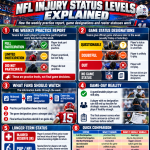
What Happens If A Player Is Questionable?
“Questionable” does not mean inactive.
It means the player’s participation is uncertain because of an injury or medical issue.
A questionable player can ultimately be:
- Active: He is eligible to play.
- Inactive: He cannot play.
The official game-day inactive list settles the question.
That is why a player can remain questionable throughout the week and then be announced as active 90 minutes before kickoff.
What Happens If A Player Is Doubtful?
A doubtful designation indicates that the team considers the player unlikely to participate.
However, “doubtful” is still an injury-report designation rather than the final game-day roster decision.
If the player ultimately cannot play, he will be placed on the inactive list before the game.
The NFL’s injury-reporting system is designed to provide information about a player’s expected availability during the week, while the inactive list determines actual game eligibility. [NFL Football Operations]
What Is The Difference Between Active And Inactive?
The simplest distinction is:
- Active: Eligible to participate in the game.
- Inactive: Not eligible to participate in the game.
Being active does not guarantee that a player will actually get onto the field.
A backup quarterback, reserve offensive lineman or special-teams player might be active for an entire game without playing a snap.
Active simply means the coaching staff is allowed to use him.
Can An Inactive Player Play If Someone Gets Hurt?
No.
Once the game begins, a standard inactive player cannot suddenly become active because one of his teammates suffers an injury.
Imagine a team makes its fifth wide receiver inactive.
If two active receivers are injured during the first quarter, the team cannot simply tell the inactive receiver to put on his helmet and enter the game.
The club must finish the game with the players who were eligible at kickoff, subject to specialized rules such as the emergency third-quarterback provision.
Does An Inactive Player Dress For The Game?
Generally, inactive players do not dress in full game uniform for participation.
They can still be present on the sideline and participate in meetings and other team activities, but they are not eligible to enter the game.
This is why broadcasts sometimes show an injured star standing on the sideline in team apparel rather than pads and a uniform.
Does An Inactive Player Still Get Paid?
Generally, yes.
A player on the active roster does not ordinarily lose his regular salary simply because the team makes him inactive for a particular game.
His compensation is governed by his contract and the NFL collective bargaining agreement rather than simply by whether he receives game-day snaps.
However, individual contracts can contain bonuses or incentives tied to being active, participating in games, playing a certain percentage of snaps or reaching other performance thresholds.
Does Being Inactive Remove A Player From The 53-Man Roster?
No.
This is one of the most important distinctions.
A player can remain on the team’s 53-man roster while being inactive for a game.
He does not have to be released, waived or moved to injured reserve.
After the game ends, the designation has served its purpose. The player can be active for the team’s next game.
Can A Player Be Inactive One Week And Active The Next?
Yes.
Game-day inactive status is normally a one-game designation.
A player could be:
- Inactive in Week 1
- Active in Week 2
- Inactive again in Week 3
- Active in Week 4
No transaction is necessarily required to make those changes if the player remains on the active roster.
What Is The Difference Between Inactive And Injured Reserve?
They are very different.
A player who is inactive remains on the active roster and can potentially play the following week.
A player placed on injured reserve, or IR, is moved off the active roster while recovering from an injury and must satisfy the NFL’s applicable return requirements before playing again.
Teams use IR for injuries expected to keep players out for a longer period rather than simply declaring them inactive week after week. [NFL Football Operations]
Inactive vs. Injured Reserve
| Status | Can Play That Game? | Still On Active Roster? | Could Play Next Week? |
|---|---|---|---|
| Active | Yes | Yes | Yes |
| Inactive | No | Yes | Yes |
| Injured Reserve | No | No | Only after satisfying applicable return rules |
What Is The Difference Between Inactive And The Practice Squad?
A practice-squad player is not the same thing as an inactive member of the 53-man roster.
The practice squad is a separate group of players who practice with the team but are not normally part of its active roster.
Teams can elevate eligible practice-squad players for games under NFL roster rules. [NFL Football Operations]
By contrast, an inactive player is already on the active roster but has been designated unavailable for that particular game.
Why Can’t Every Player On The 53-Man Roster Play?
The game-day roster system is designed partly around competitive balance.
Without restrictions, a team with several injured players might enter a game with substantially fewer usable players than a healthy opponent.
Game-day roster rules establish limits on how many players each team can make available.
The NFL has modified those rules over time, particularly to encourage teams to carry additional offensive linemen and to allow limited game-day elevations from the practice squad.
How Many Players Can Be Active For An NFL Game?
Under the NFL’s game-day roster rules, teams can generally have 48 active players if they meet the league’s requirements involving offensive linemen.
Otherwise, the limit can be 47.
The expanded game-day roster was introduced as part of the 2020 collective bargaining agreement, increasing the previous 46-player limit. [NFL Football Operations]
The exact number of players a team must designate inactive can vary because of roster circumstances, practice-squad elevations and other applicable rules.
Why Does The NFL Have A Special Rule For Offensive Linemen?
Offensive-line injuries can create unusual safety problems.
A team normally needs five offensive linemen on every offensive snap, and each position requires specialized skills.
The NFL therefore structured its expanded game-day roster rules to encourage clubs to dress additional offensive linemen.
A club can use the larger game-day roster when it has the required number of offensive linemen active. [NFL Football Operations]
What Is The Emergency Third Quarterback Rule?
The NFL has a special exception involving quarterbacks.
Teams can designate an eligible quarterback as an emergency third quarterback.
The rule is intended to prevent situations in which a team loses both of its normal active quarterbacks and is forced to use a non-quarterback at the position.
The emergency quarterback can enter only under the circumstances permitted by the NFL’s rule and does not function like an ordinary active backup who can freely rotate into the game. [NFL Football Operations]
Why Would A Healthy Player Be Inactive?
Because NFL game-day roster construction is about more than identifying the team’s best players.
Coaches have to make sure they have enough players available at every position while also filling special-teams units.
For example, a team may decide it needs:
- Extra defensive backs against a pass-heavy opponent
- An additional defensive lineman against a strong rushing team
- More special-teams coverage players
- An extra offensive lineman because of injuries
Making room for those players may require leaving another healthy player inactive.
Why Are Rookie Players Sometimes Inactive?
A rookie can make the 53-man roster without being ready for a major game-day role.
The coaching staff may believe the player has long-term potential but still needs additional practice, strength, scheme knowledge or special-teams experience.
Rather than waive the player and risk losing him to another team, the club can keep him on the roster while making him inactive on game days.
This is particularly common with developmental offensive linemen, defensive linemen and young skill-position players.
Can A Star Player Be A Healthy Scratch?
Yes, although it is unusual.
A team could make virtually any rostered player inactive for football reasons.
If a prominent healthy player unexpectedly appears on the inactive list, it can signal:
- A disciplinary decision
- A major change in the depth chart
- A trade-related roster decision
- A matchup-specific coaching decision
- An undisclosed issue that does not necessarily involve an injury
However, the inactive designation itself does not explain why the player was scratched.
The reason should be established separately through team statements or reliable reporting rather than inferred from the designation alone.
Can A Suspended Player Be Listed As Inactive?
A suspended player is normally in a different roster category.
A player serving an NFL suspension is not simply a healthy member of the active roster whom the team chooses to scratch on game day.
Suspended players are governed by separate league roster rules and are ineligible during the suspension period.
Therefore, “suspended” and “inactive” should not be treated as interchangeable terms.
What Does Inactive Mean For Fantasy Football?
For fantasy purposes, inactive means the player will produce no statistics from that game because he cannot play.
This is why the 90-minute pregame inactive announcements are so important to fantasy managers.
If a questionable running back is declared inactive, fantasy managers generally need to replace him before their lineup locks.
If he is declared active, he is eligible to play — although being active does not guarantee a normal workload.
Does Active Mean A Player Is Fully Healthy?
No.
This is another common misunderstanding.
A player can be active while dealing with an injury.
For example, a wide receiver with a hamstring injury could be listed as questionable all week and then be declared active before kickoff.
That only means he is eligible to play.
He could still:
- Play fewer snaps than normal
- Serve primarily as a decoy
- Be limited to certain formations
- Leave the game if the injury worsens
“Active” describes eligibility, not health or expected workload.
What If A Player Gets Hurt During Warmups?
Late pregame injuries can create unusual situations.
If a player suffers a setback before the inactive deadline, the team can make him inactive when submitting its list.
If an active player is injured after the game-day roster has effectively been established, the club generally has to deal with the loss using the other eligible players rather than activating a standard inactive player after kickoff.
This is one reason teams carefully evaluate questionable players during pregame warmups before making their final decisions.
Why Do Reporters Say “He’s Active” Right Before Kickoff?
Because that is often the final piece of information fans have been waiting for all week.
A player might progress through the week like this:
Wednesday: Limited practice.
Thursday: Limited practice.
Friday: Questionable.
Sunday, 90 minutes before kickoff: Active.
The final announcement means the player is officially eligible to participate.
If his name instead appears on the inactive list, he cannot play.
NFL Player Statuses At A Glance
| Term | What It Means |
|---|---|
| Active | Eligible to play in that game |
| Inactive | On the roster but not eligible to play in that game |
| Questionable | Participation is uncertain because of an injury or medical issue |
| Doubtful | Unlikely to play |
| Out | Will not play because of the reported injury/medical issue |
| Healthy scratch | Healthy player made inactive by coaching/roster decision |
| Injured reserve | Removed from the active roster while recovering from injury |
| Practice squad | Separate developmental/reserve group; player must be elevated or signed to be game eligible |
| Suspended | Ineligible under an NFL or team suspension |
What Is The Simplest Way To Understand “Inactive” In The NFL?
Think of the 53-man roster and the game-day roster as two different things.
A player can belong to the team and remain on its regular roster but still not be selected to play that Sunday.
That player is inactive.
The designation lasts for that game. It does not automatically mean the player is seriously injured, has been released or will miss additional games.
And when a player has spent the week listed as questionable or doubtful, the inactive list issued shortly before kickoff provides the answer that matters most: if he is inactive, he cannot play; if he is active, he can. [NFL Football Operations]