
Targeting is one of college football’s most important — and frequently misunderstood — player-safety rules.
Under NCAA rules, targeting generally involves a player making prohibited forcible contact with the crown of his helmet or making forcible contact to the head or neck area of a defenseless opponent. A confirmed targeting foul carries a 15-yard penalty and disqualification for the remainder of the game. [NCAA]
But not every hard hit, helmet-to-helmet collision or blow to the head automatically qualifies as targeting. Officials must determine that the play contains the elements required by the rule, and targeting disqualifications are subject to video review.
The NCAA also made a significant change for the 2026 season: a player’s first targeting foul of the season no longer causes him to automatically miss part of his next game. Instead, additional suspensions escalate for repeat targeting violations. [NCAA]
What Is The NCAA Targeting Rule?
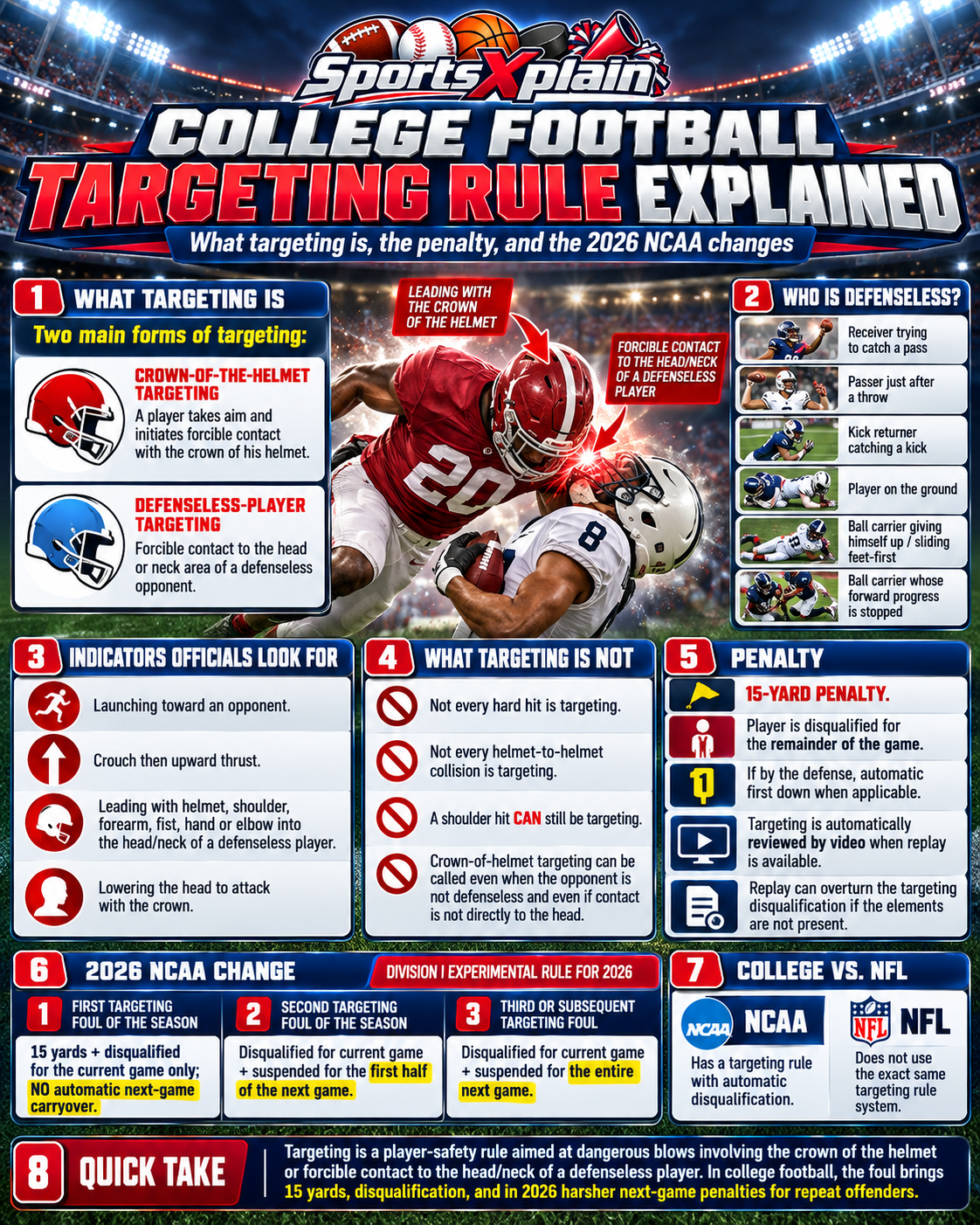
College football essentially has two major forms of targeting.
The first involves a player who takes aim at an opponent and initiates forcible contact with the crown of his own helmet.
The second involves a player who takes aim at a defenseless opponent and makes forcible contact to that player’s head or neck area.
The distinction is important because targeting is not simply another name for helmet-to-helmet contact. The rule focuses on the nature of the contact, the body part used to initiate it, whether the opponent was defenseless and whether the play contains an indicator that the player was deliberately attacking the opponent in the prohibited manner.
What Does “Targeting” Actually Mean?
In ordinary conversation, “targeting” can sound as though officials must determine that a player intentionally tried to injure somebody.
That is not what the rule requires.
Officials are evaluating the player’s actions rather than trying to determine what he was thinking.
Examples of actions that can indicate targeting include launching toward an opponent, crouching and thrusting upward into an opponent’s head or neck, leading with the helmet, shoulder, forearm, fist, hand or elbow into a defenseless player’s head or neck, or lowering the head before attacking with the crown of the helmet.
That means a player can commit targeting without intending to injure his opponent.
What Is The Crown Of The Helmet?
The crown is the top portion of a player’s helmet.
The NCAA prohibits players from lowering their heads and using that part of the helmet to deliver forcible contact.
This portion of the rule is designed to protect both players.
A defender who lowers his head and uses the crown as a weapon can injure the opponent, but he also places his own head and neck in a dangerous position during the collision.
Importantly, crown-of-the-helmet targeting does not require the opponent to be a defenseless player.
What Is A Defenseless Player?
A defenseless player is someone whose position or situation makes him particularly vulnerable to injury and limits his ability to protect himself from an incoming hit.
NCAA rules identify several situations in which a player can be considered defenseless. They include:
- A receiver attempting to catch a pass or who has just completed a catch and has not had time to protect himself.
- A passer during or immediately after throwing a pass.
- A kicker during or immediately after a kick.
- A kick returner attempting to catch or recover a kick.
- A player on the ground.
- A player obviously out of the play.
- A player receiving a blind-side block.
- A ball carrier whose forward progress has been stopped and who is already in an opponent’s grasp.
- A quarterback after a change of possession.
- A player attempting to recover a loose ball.
- A ball carrier who has clearly given himself up and is sliding feet-first.
Forcible contact to the head or neck of one of these players can result in targeting when the other requirements of the rule are satisfied.
Can You Hit A Quarterback Who Is Sliding?
A quarterback — or any other ball carrier — who clearly gives himself up with a feet-first slide is considered a defenseless player.
That does not mean every collision with a sliding quarterback is automatically targeting.
However, a defender who delivers forcible contact to the sliding player’s head or neck area using the helmet, shoulder, forearm, fist, hand or elbow can be penalized for targeting if the play contains the necessary targeting indicator.
The rule became particularly relevant during Oregon’s September 26, 2026 game against USC. Trojans linebacker Desman Stephens II was called for targeting and disqualified after striking Ducks quarterback Dante Moore as Moore slid at the end of a scramble.
Moore suffered a concussion and was transported from the stadium by ambulance. The play illustrated why a sliding ball carrier receives additional protection under the defenseless-player provisions.
Is Every Helmet-To-Helmet Hit Targeting?
No.
This is perhaps the most common misunderstanding surrounding the rule.
Helmet-to-helmet contact can occur during a football play without satisfying all of the requirements for targeting.
Officials look for specific elements such as forcible contact, a targeting indicator, use of the crown of the helmet or prohibited contact to the head or neck of a defenseless player.
Incidental helmet contact does not automatically result in a targeting foul.
Can A Shoulder Hit Be Targeting?
Yes.
A player does not have to use his helmet to commit targeting against a defenseless opponent.
A defender can be called for targeting if he makes prohibited forcible contact to the head or neck area with his helmet, shoulder, forearm, fist, hand or elbow.
That is why the phrase “helmet-to-helmet” is not a complete description of the targeting rule.
A shoulder directly into the head of a defenseless receiver, for example, can potentially qualify as targeting even if the defender’s helmet never touches the receiver’s helmet.
Can Targeting Be Called If The Hit Is Below The Head?
Potentially, depending on which targeting rule applies.
When the foul involves attacking a defenseless player’s head or neck, the forcible contact must be to the head or neck area.
But the separate crown-of-the-helmet rule prohibits a player from initiating forcible contact with the crown of his helmet against an opponent. That rule does not depend on hitting the opponent in the head.
This distinction is another reason targeting rulings can be confusing to viewers: there are two related but separate ways for a hit to qualify.
What Is The Penalty For Targeting?
A confirmed targeting foul normally produces a 15-yard penalty.
The offending player is also disqualified for the remainder of the game.
If the foul is committed by the defense, the penalty can also include an automatic first down when applicable.
The disqualification is what makes targeting significantly different from an ordinary personal foul.
Does A Player Get Ejected For Targeting?
In everyday football terminology, targeting is frequently described as an “ejection.” Technically, NCAA rules describe the player as being disqualified.
The difference matters.
A player disqualified solely because of targeting may generally remain in the team’s bench area rather than being forced to leave the playing enclosure entirely.
Either way, the practical effect for the game is the same: the player cannot participate again in that game.
What Changed About Targeting In 2026?
The NCAA significantly changed the punishment for repeat targeting fouls in Division I for the 2026 season.
The change is being used as a one-year experimental rule. [NCAA]
The system now works like this:
- First targeting foul of the season: 15-yard penalty and disqualification for the remainder of the current game. The player is eligible to play the entire next game.
- Second targeting foul of the season: Disqualification for the remainder of the current game plus suspension for the first half of the team’s next scheduled game.
- Third or subsequent targeting foul: Disqualification for the remainder of the current game plus an automatic suspension for the team’s entire next game.
The penalties apply to postseason games as well. [NCAA]
What Was The Old Targeting Rule?
Before the 2026 experiment, the timing of the targeting foul could affect the next game.
A player disqualified for targeting during the second half would also be required to miss the first half of his team’s next game.
That sometimes created controversial situations in which a player called for targeting late in one game effectively received punishment in two games.
The 2026 experiment replaced that system with a progressive structure based on the number of targeting fouls a player commits during the season. [NCAA]
Does A First Targeting Penalty Carry Over To The Next Game In 2026?
No.
This is the most important change for fans to understand in 2026.
If it is the player’s first targeting foul of the season, he is disqualified from the remainder of the current game but can play from the beginning of his team’s next game.
It does not matter whether the targeting foul occurred in the first half or second half.
A next-game suspension begins only after a player’s second confirmed targeting foul of the season. [NCAA]
Is Targeting Automatically Reviewed?
Yes, when instant replay is available, the disqualification for targeting is reviewed.
The replay official examines the play to determine whether the required elements of targeting are present.
That review is particularly important because targeting carries the unusually severe consequence of removing a player from the game.
The NCAA’s current standard requires the replay process to establish the elements necessary for targeting before the disqualification is upheld. [NCAA]
Can Replay Overturn Targeting?
Yes.
If replay determines that the play does not satisfy the targeting rule, the targeting ruling and disqualification can be overturned.
For example, a replay might show that the defender did not use the crown of his helmet or that the apparent blow to a defenseless player’s head actually landed below the head and neck area.
This is why fans sometimes hear a targeting announcement followed several minutes later by an announcement that the targeting ruling has been reversed.
Can A Targeting Suspension Be Appealed?
The 2026 experimental rule includes an appeals process for repeat offenses.
After a player’s second or subsequent upheld targeting foul of the season, his conference can ask the NCAA national coordinator of football officials to conduct a video review.
The review can examine the targeting calls that contributed to the player’s additional suspension.
If the national coordinator concludes that a player clearly should not have been disqualified on one of those plays, the additional suspension can be vacated. [NCAA]
Why Does College Football Have A Targeting Rule?
The rule is primarily intended to reduce dangerous blows involving the head and neck and discourage players from using their helmets as weapons.
Football inevitably involves violent collisions, so the NCAA does not attempt to eliminate hard tackling.
Instead, the targeting rules attempt to change tackling behavior by discouraging techniques considered particularly dangerous to either the player delivering the hit or the player receiving it.
The NCAA began emphasizing rules against using the crown of the helmet and attacking defenseless players as part of its broader effort to address potentially serious head and neck injuries.
Why Is Targeting So Controversial?
The controversy generally comes from the difference between what looks like a dangerous hit in slow motion and what the rule technically requires.
Players are moving extremely quickly. A receiver can suddenly lower his body. A quarterback can begin sliding after a defender has already committed to a tackle. An offensive player can change direction immediately before contact.
Replay then allows officials and viewers to examine those split-second collisions frame by frame.
As a result, two hits that appear very similar at normal speed can produce different targeting decisions because one contains all of the required elements and the other does not.
The disqualification component also raises the stakes. A borderline ruling does not merely cost a team 15 yards — it removes a player from the game.
Is Targeting The Same In The NFL?
No.
The NFL has rules designed to address many of the same dangerous actions, including illegal use of the helmet, unnecessary roughness and prohibited contact against defenseless players.
But the NFL does not use the NCAA’s targeting rule and automatic targeting-disqualification system in exactly the same way.
That distinction can create confusion for fans who watch both college football and the NFL.
College Football Targeting Rule At A Glance
- Penalty: 15 yards
- Player punishment: Disqualification for the remainder of the game
- Automatic review: Yes, when instant replay is available
- Does helmet-to-helmet automatically mean targeting? No
- Can a shoulder hit be targeting? Yes
- Can targeting occur without hitting a player’s head? Yes, under the crown-of-the-helmet rule
- Is a sliding ball carrier defenseless? Yes
- First targeting foul in 2026: No next-game carryover
- Second targeting foul: Miss first half of next game
- Third or subsequent foul: Miss entire next game
- 2026 penalty structure: Experimental for one season in Division I
The simplest way to understand targeting is that a violent-looking hit is not enough by itself. Officials must identify the specific elements required by the NCAA rule.
But once those elements are confirmed, targeting carries one of college football’s strongest in-game punishments: 15 yards and removal of the offending player for the remainder of the contest. And beginning in 2026, repeat offenders face increasingly severe next-game suspensions rather than every first-time second-half targeting foul automatically carrying over to the following game.





1 thought on “What Is Targeting In College Football? NCAA Rule, Penalty And 2026 Changes Explained”