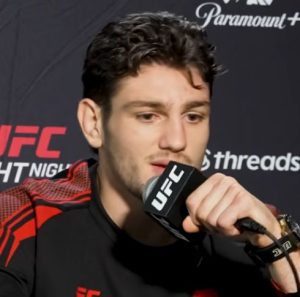
Mehemmedeli Osmanli appeared to have scored a devastating knockout in his UFC debut, but the strike that ended the fight was illegal.
Osmanli was disqualified after landing a powerful knee to the head of Ilimbek Akylbek Uulu while Akylbek was a grounded fighter during their bantamweight fight at UFC Vegas 121 on September 26, 2026. Because Akylbek could not continue after the illegal strike, referee Chris Tognoni stopped the bout and awarded Akylbek the victory by disqualification. [Yahoo Sports]
The official result was Ilimbek Akylbek Uulu def. Mehemmedeli Osmanli by disqualification at 2:19 of Round 1. The unusual ending also made Akylbek the men’s bantamweight winner of Season 34 of The Ultimate Fighter. [MMA Fighting]
What Did Mehemmedeli Osmanli Do?
The controversy occurred midway through the first round of Osmanli’s fight against Akylbek.
Akylbek went down during an exchange and was on his knees when Osmanli launched a knee directly into his head.
The blow landed cleanly and violently.
Akylbek initially grabbed at one of Osmanli’s legs following the impact before the referee intervened. He then went down onto his back as the fight was stopped.
Because Akylbek was grounded when the knee connected, the strike was illegal under the rules governing the fight. [MMA Fighting]
Why Was The Knee Illegal?
Under the Unified Rules of Mixed Martial Arts, fighters cannot deliver a knee or kick to the head of a grounded opponent.
The definition of a grounded fighter has changed over the years, but the current rule generally considers a fighter grounded when a part of the body other than the hands or feet is touching the fighting area.
That means a fighter with a knee on the canvas cannot legally be kneed in the head.
Akylbek was clearly down when Osmanli launched the strike, making the foul relatively straightforward for the referee to identify.
Why Was Osmanli Disqualified Instead Of Just Losing A Point?
Not every illegal strike produces a disqualification.
The critical issue was that the foul ended the fight.
If a fighter commits an illegal foul but the opponent can safely continue, the referee can give the injured fighter recovery time and potentially deduct one or more points from the fighter who committed the foul.
But Akylbek was determined unable to continue after Osmanli’s illegal knee.
That forced officials to determine how the bout should be recorded.
Because the strike was treated as an intentional illegal foul, Osmanli was disqualified and Akylbek was declared the winner. [Yahoo Sports]
Why Wasn’t The Fight Ruled A No Contest?
The distinction between a disqualification and a no contest generally comes down to the nature of the foul.
Under the Unified Rules, an intentional foul that causes an injury serious enough to immediately terminate a bout can result in the offending fighter losing by disqualification.
An accidental foul that makes it impossible for a fight to continue can instead produce a no contest or, if enough of the scheduled fight has been completed, a technical decision based on the judges’ scorecards.
Osmanli’s knee was not treated as an accidental collision. He deliberately threw the knee while Akylbek was grounded, even though the resulting foul may have been a mistake in judgment.
That is why the result became a DQ rather than a no contest.
Was Ilimbek Akylbek Knocked Out?
The illegal knee clearly hurt Akylbek, but the sequence created immediate controversy among viewers.
After absorbing the knee, Akylbek could still be seen holding onto Osmanli’s leg before the referee intervened. He subsequently rolled onto his back and remained down.
That led some viewers to question whether Akylbek was actually unconscious or whether he exaggerated the effects of the foul.
There is no basis, however, to independently conclude that Akylbek was faking an injury. A fighter can remain capable of instinctive movement while badly stunned, and the decisive issue for the official result was that an illegal knee had landed and Akylbek was deemed unable to safely continue.
The disputed reaction does not change the legality of Osmanli’s strike: Akylbek was grounded when he was kneed in the head.
Did Akylbek Have To Continue Fighting?
No.
A fighter who has suffered a serious illegal strike is not required to continue simply because he remains conscious.
The referee and ringside physician must determine whether the injured fighter can safely resume competition.
That distinction is important. Being able to stand, speak or move after a foul does not necessarily mean a fighter is medically capable of continuing an MMA fight.
An illegally injured fighter also should not be forced to compete in a compromised condition created by his opponent’s foul.
What Is A Grounded Opponent In UFC?
The definition matters because knees that would be perfectly legal against a standing opponent can become fouls as soon as the opponent becomes grounded.
Under the revised Unified Rules, simply placing one or both hands on the canvas does not necessarily make a fighter grounded.
A fighter is considered grounded when another part of his body — such as a knee, elbow, hip or buttocks — is touching the canvas.
That distinction was designed partly to prevent fighters from exploiting the old rule by briefly touching the floor with their fingertips to make otherwise legal knees illegal.
It did not help Osmanli in this case because Akylbek’s position clearly satisfied the grounded-fighter standard.
Can UFC Fighters Knee A Grounded Opponent In The Body?
Yes.
The prohibition applies specifically to kicks and knees to the head of a grounded fighter.
A fighter can legally knee a grounded opponent in the body, provided the strike does not violate another rule.
That means fighters must make a split-second decision about both the target and their opponent’s position.
Osmanli’s problem was not merely that he threw a knee while Akylbek was grounded. The knee landed on Akylbek’s head.
What Was At Stake In Osmanli vs. Akylbek?
The bizarre finish was particularly consequential because this was not an ordinary UFC preliminary bout.
Osmanli and Akylbek were fighting in the Season 34 bantamweight final of The Ultimate Fighter.
Both men were making their official UFC debuts after advancing through the reality show’s tournament. [UFC]
Osmanli had submitted both of his opponents during the season, defeating Artem Belakh by rear-naked choke in the quarterfinals and Christian Strong with a buggy choke in the semifinals. [UFC]
Akylbek advanced by defeating Sean Mora and Xavier Franklin by decision.
The finale was therefore supposed to determine the season’s bantamweight winner inside the Octagon.
Instead, the championship was decided by an illegal strike.
Who Won The Ultimate Fighter 34?
Ilimbek Akylbek won the Season 34 bantamweight tournament.
Because Osmanli was disqualified, Akylbek officially won their UFC Vegas 121 fight and the TUF tournament.
The manner of victory was unusual, but a disqualification is still an official victory for the fighter who was fouled.
Akylbek therefore became the TUF winner despite the fight ending just 2:19 into the opening round. [MMA Fighting]
Why Was The Fight Already Heated?
Osmanli and Akylbek had history before entering the Octagon.
The two had been teammates on Michael Bisping’s team during The Ultimate Fighter 34, but their relationship became contentious.
Osmanli openly criticized Akylbek before the finale, describing him as a wrestler who could do little else and predicting an easy victory. [MMA Junkie/Yahoo]
Osmanli was so confident that he was already discussing another fight in Abu Dhabi and even named former UFC bantamweight champion Sean O’Malley as an opponent he believed he could beat.
Instead, his UFC debut ended with his first apparent finish being overturned by his own illegal strike.
What Was Osmanli’s Record Before The Fight?
Osmanli entered the UFC as a highly regarded Azerbaijani prospect.
He had been a two-division champion for Next Generation Fighting and had accumulated a long winning streak before appearing on The Ultimate Fighter.
His background was particularly notable for his submission game. UFC listed nine submission victories on his professional résumé, including rear-naked chokes, guillotines, a D’Arce choke, an anaconda choke and a triangle. [UFC]
That made the disqualification an especially costly mistake for a fighter making his first official UFC appearance.
Does A Disqualification Count As A Loss On Osmanli’s Record?
Yes.
A disqualification is an official loss.
Unlike a no contest, which generally does not add a win or loss to either fighter’s record, the DQ awards the victory to the fouled fighter and a loss to the fighter responsible for the disqualifying foul.
So Akylbek receives an official victory and Osmanli receives an official defeat from the TUF 34 finale.
Could The UFC Book An Osmanli-Akylbek Rematch?
The UFC could choose to make a rematch, but one had not been announced in the immediate aftermath of UFC Vegas 121.
There would be an obvious sporting argument for another meeting because their first official UFC fight ended after only 2:19 and did not establish which fighter would have won a complete legal contest.
However, UFC matchmaking decisions depend on many factors, and the promotion is under no obligation to immediately run the fight back.
Mehemmedeli Osmanli Disqualification At A Glance
- Fight: Mehemmedeli Osmanli vs. Ilimbek Akylbek Uulu
- Event: UFC Vegas 121 / UFC Fight Night 289
- Date: September 26, 2026
- Division: Bantamweight
- Stakes: The Ultimate Fighter Season 34 bantamweight finale
- Foul: Illegal knee to the head of a grounded opponent
- Round: Round 1
- Official time: 2:19
- Result: Ilimbek Akylbek defeated Mehemmedeli Osmanli by disqualification
- TUF 34 bantamweight winner: Ilimbek Akylbek
The key to understanding the result is that Osmanli was not disqualified simply because he committed a foul. Fighters commit fouls without being disqualified in many MMA bouts.
The difference was the combination of circumstances: Akylbek was clearly grounded, Osmanli intentionally threw a knee that struck him in the head, the strike was illegal, and Akylbek was unable to continue because of it.
That turned what initially looked like a spectacular knockout for Osmanli into a disqualification loss — and handed Akylbek the TUF 34 bantamweight title.