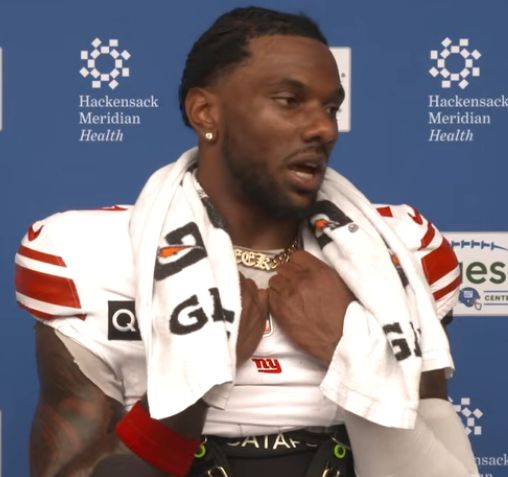

Miami Dolphins running back De’Von Achane suffered a torn ACL in his right knee during Miami’s Week 3 game, ending his 2026 season and creating a major question about when one of the NFL’s fastest offensive players will be ready to return in 2027.
The Dolphins confirmed the season-ending nature of Achane’s injury after additional testing. An ACL tear normally requires months of rehabilitation, meaning the important question is no longer whether Achane will return this season but whether he can complete his recovery in time for the beginning of the 2027 NFL season.
Miami must also replace a player who is far more than a conventional running back. Achane’s speed, receiving ability and big-play potential have made him one of the central pieces of the Dolphins’ offense.
What Is De’Von Achane’s Injury?
Achane tore the anterior cruciate ligament, or ACL, in his right knee.
The ACL is one of the major stabilizing ligaments in the knee. It helps control forward movement of the tibia and provides rotational stability when an athlete plants, cuts or changes direction.
Those movements are especially important for a running back such as Achane, whose game depends heavily on acceleration, sudden cuts and the ability to change direction at high speed.
How Did De’Von Achane Get Hurt?
Achane suffered the knee injury during Miami’s game and was unable to continue.
Initial concern centered on the severity of the knee injury before subsequent testing revealed the torn ACL.
ACL tears can occur on contact plays, but they can also happen when a player’s foot is planted and the knee twists or changes direction suddenly.
The precise mechanism matters medically, but the diagnosis itself is the most significant factor for Achane’s immediate future: his 2026 season is over.
Is De’Von Achane Out For The Season?
Yes.
A torn ACL at this stage of the NFL calendar means Achane will not return during the 2026 season.
Miami can place him on injured reserve, but unlike shorter-term injuries in which a player can return after the minimum IR absence, an ACL reconstruction and rehabilitation requires a much longer recovery period.
The Dolphins’ attention therefore shifts toward getting Achane healthy for 2027.
Will De’Von Achane Need Surgery?
ACL tears in elite athletes are commonly treated with ACL reconstruction when the goal is returning to a sport that requires cutting, pivoting and explosive changes of direction.
The American Academy of Orthopaedic Surgeons explains that ACL reconstruction replaces the damaged ligament with a tissue graft rather than simply stitching the torn ACL back together. [AAOS]
The exact timing of surgery can depend on swelling, range of motion and whether additional structures in the knee were injured.
That is why the date of surgery and details of any additional damage are important when evaluating Achane’s eventual return timeline.
How Long Does A Torn ACL Take To Recover From?
There is no universal ACL recovery timetable.
For an NFL player, rehabilitation frequently takes approximately nine to 12 months, although some athletes return sooner and others require longer.
The AAOS emphasizes that return-to-sport decisions should be based on functional recovery rather than simply the number of months since surgery. [AAOS]
A running back must recover enough strength and stability to:
- Sprint at full speed
- Plant and cut
- Accelerate and decelerate
- Change direction under contact
- Run routes
- Pass protect
- Absorb tackles
- Trust the reconstructed knee
Achane’s medical team will ultimately determine when he has reached those benchmarks.
When Could De’Von Achane Return?
Because the injury occurred in late September 2026, the timing creates a potentially close race for the beginning of the 2027 season.
A nine-month rehabilitation would reach approximately late June 2027.
A 10-month recovery would extend into late July.
An 11-month recovery would reach late August.
A 12-month recovery would extend into late September 2027.
Those dates are illustrations of the recovery window rather than predictions of Achane’s actual return.
If rehabilitation proceeds smoothly, Achane could potentially participate at some point during the 2027 offseason or training camp.
If Miami takes a more conservative approach, he could begin camp on the physically unable to perform list or have his workload carefully managed while preparing for the regular season.
Could De’Von Achane Be Ready For Week 1 In 2027?
It is possible, but far too early to guarantee.
The 2027 regular season is roughly a year away, putting a Week 1 return within the general recovery range for an ACL injury.
But several variables will determine whether that is realistic:
- When surgery occurs
- Whether the ACL is the only damaged structure
- How quickly swelling subsides
- How his graft heals
- How rapidly he regains strength
- Whether he experiences setbacks
- When doctors clear him for cutting and contact
The Dolphins have little incentive to establish a firm Week 1 target this early in the process.
Could Achane Start The 2027 Season On PUP?
That is one possible scenario if he is not ready for full football activity when training camp begins.
The NFL’s physically unable to perform designation allows teams to manage players who are still recovering from football-related injuries.
However, whether Achane actually needs the PUP list will not become clear until much later in his rehabilitation.
A player injured in September has substantially more recovery time before the following season than a player who tears an ACL late in December or during the playoffs.
That works in Achane’s favor.
Why Is Achane’s Speed Important To His Recovery?
Achane is one of the NFL’s fastest players.
That makes his rehabilitation particularly interesting because simply being medically cleared to play does not necessarily mean he has recovered all of the explosiveness that makes him special.
A running back can technically return to competition while still rebuilding:
- Top-end speed
- Acceleration
- Change-of-direction confidence
- Lower-body power
- Reaction speed
For Achane, those abilities are fundamental to his value.
Miami therefore has reason to prioritize a complete recovery over simply getting him back onto the field as quickly as possible.
Why Is Losing De’Von Achane Such A Big Deal For Miami?
Achane is not merely Miami’s leading running back.
He is one of the offense’s most versatile weapons.
His speed forces defenses to account for him on traditional runs, outside-zone concepts, screens and passing routes.
He can line up in the backfield, move into the slot and create mismatches against linebackers.
That versatility affects the entire structure of Miami’s offense.
What Makes De’Von Achane Different From A Traditional Running Back?
Achane’s defining trait is explosive speed.
He ran a 4.32-second 40-yard dash at the 2023 NFL Scouting Combine after also competing in track at Texas A&M. [NFL]
Miami has used that speed in multiple ways.
Instead of treating Achane exclusively as a between-the-tackles runner, the Dolphins can create opportunities for him in space where one missed tackle can become a long gain.
Defenses must therefore account for Achane even when he does not receive the football.
Who Replaces De’Von Achane For The Dolphins?
Miami will almost certainly have to replace Achane through a combination of players rather than expecting one running back to reproduce everything he provides.
The Dolphins can redistribute:
- Early-down carries
- Third-down snaps
- Pass protection
- Screen passes
- Receiving routes
- Red-zone opportunities
Miami could also explore outside help if the coaching staff believes its existing backfield cannot adequately replace Achane’s workload.
Could The Dolphins Trade For A Running Back?
That becomes a reasonable question after a season-ending injury to a starting running back.
The Dolphins have several possible approaches:
- Promote an internal option
- Use a committee
- Sign a veteran free agent
- Add a player from another team’s practice squad
- Explore a trade before the NFL deadline
The decision will depend on how Miami evaluates its remaining backs and whether an affordable upgrade becomes available.
Running backs generally cost less to acquire in trades than premium positions such as quarterback, offensive tackle or edge rusher, which could make an outside addition realistic.
Can Miami Replace Achane’s Speed?
Not easily.
Even if another running back can replace his carries, replacing his impact is a different challenge.
Achane’s speed can change defensive spacing.
A linebacker who takes a poor angle against him can surrender a long touchdown. A safety who hesitates can lose the edge. A defender assigned to Achane in coverage must account for his ability to turn a short pass into an explosive play.
Those threats influence how opponents defend Miami.
A conventional replacement may execute the same plays without creating the same stress.
What Does The Injury Mean For Miami’s Passing Game?
It removes a useful matchup weapon.
Achane’s receiving ability allows Miami to identify defensive coverages and create mismatches.
If a linebacker follows him when he moves out of the backfield, the Dolphins can attack that matchup.
If a defensive back follows him, Miami may have revealed that the defense is playing man coverage.
That type of information can help a quarterback before the snap.
Without Achane, Miami loses some of that flexibility.
Does The ACL Tear Threaten Achane’s Long-Term Career?
An ACL tear is a major injury, but it is no longer automatically viewed as career-altering in the way it once was.
Advances in reconstruction and rehabilitation have allowed many NFL players to return to high-level competition.
But outcomes vary.
Running back is also an especially demanding position because players must repeatedly accelerate, cut and absorb contact.
The relevant question is therefore not simply whether Achane can return.
It is whether he can return with the same explosiveness that has defined his game.
Have Other NFL Running Backs Returned From Torn ACLs?
Yes.
One of the most famous examples is Adrian Peterson.
Peterson tore the ACL and MCL in his left knee in December 2011 and returned for Minnesota’s 2012 season opener less than nine months later.
He then rushed for 2,097 yards and won NFL MVP.
Peterson’s recovery is frequently cited because it was extraordinary, not because it represents a normal timetable.
Players recover at different rates, and using Peterson’s unusually successful rehabilitation as a prediction for another player would be misleading.
What About Breece Hall?
Breece Hall provides a more recent example.
The Jets running back tore his ACL in October 2022 and returned for the beginning of the 2023 season.
His recovery demonstrated that a running back injured during the first half of one season can potentially be available when the next season begins.
Again, Achane’s rehabilitation has to be evaluated independently.
Why Does The September Injury Date Matter?
Timing can make a significant difference with an ACL tear.
A player injured in late September has roughly 11 months before the beginning of the following regular season.
A player injured in December may have only eight or nine.
That additional rehabilitation time improves the possibility that Achane could be ready for the beginning of 2027 without requiring an unusually accelerated recovery.
It does not guarantee it.
What Happens During ACL Rehabilitation?
The process generally progresses through several stages.
Immediately after the injury, doctors evaluate the knee and determine whether other structures such as the meniscus, MCL or cartilage were also damaged.
After surgery, rehabilitation initially focuses on reducing swelling and restoring range of motion.
The athlete then gradually rebuilds strength.
Later stages introduce:
- Jogging
- Sprinting
- Jumping
- Cutting
- Change-of-direction drills
- Position-specific work
- Non-contact practice
- Full football activity
Medical clearance generally depends on functional testing as well as time since surgery.
What Could Delay Achane’s Return?
Several factors could extend the recovery.
The most significant would be additional damage inside the knee.
An isolated ACL tear can produce one rehabilitation timeline, while an ACL injury accompanied by meniscus or other ligament damage may require different treatment and recovery.
Other potential complications include swelling, loss of strength, discomfort, graft healing issues or setbacks while increasing activity.
Until Miami provides complete information about Achane’s knee and surgery, precise predictions about his return should be treated cautiously.
Could Achane Return Before Training Camp?
Potentially.
If surgery occurs relatively quickly and his recovery progresses smoothly, the calendar could put Achane in position to perform some football activity during the 2027 offseason.
But participating in individual drills is different from being ready for unrestricted NFL practice.
Miami could gradually progress him through offseason workouts and training camp even if he is medically ahead of schedule.
Will Achane Be The Same Player When He Returns?
That cannot be known yet.
Achane’s age works in his favor, as does the amount of recovery time available before the 2027 season.
But his extraordinary acceleration makes lower-body explosiveness especially important to his game.
The Dolphins will likely evaluate not just whether his knee is stable but whether his speed, cutting ability and confidence have returned.
Those evaluations may continue even after he is cleared to play.
De’Von Achane ACL Injury At A Glance
- Player: De’Von Achane
- Team: Miami Dolphins
- Position: Running back
- Injury: Torn right ACL
- Season: 2026
- 2026 status: Out for the season
- Likely treatment: ACL reconstruction and rehabilitation
- Typical NFL recovery range: Approximately nine to 12 months, with substantial individual variation
- Potential return: 2027
- Week 1 availability: Possible but not guaranteed
- Training camp availability: Depends on rehabilitation progress
- Major concern: Regaining full acceleration and cutting ability
- 40-yard dash: 4.32 seconds at 2023 NFL Combine
When Will De’Von Achane Play Again?
The safest answer is sometime in 2027, with the beginning of the season a realistic goal but not yet a confirmed return date.
The timing of Achane’s injury gives him an important advantage.
Because the ACL tear occurred in September rather than late in the season, he has nearly a full year before the 2027 regular season begins.
That puts Week 1 within the broad range of modern ACL recovery timelines.
But Achane’s rehabilitation should not be judged solely by whether he can technically step onto the field.
His greatest weapon is speed.
Miami needs him capable of exploding through a running lane, planting at full speed, cutting away from defenders and turning a short reception into a touchdown.
The Dolphins therefore have every reason to prioritize getting the complete version of Achane back rather than chasing the earliest possible return date.
His 2026 season is over.
The next milestones will be surgery, rehabilitation and eventually a return to football activity. Those developments will provide a much clearer indication of whether Achane can be ready when Miami begins the 2027 season.