An ACL tear is one of the most significant knee injuries in football. When an NFL player is diagnosed with a torn ACL, his season is often over — but advances in surgery and rehabilitation mean the injury is no longer automatically career-threatening.
The ACL, or anterior cruciate ligament, is a ligament inside the knee that helps stabilize the joint during running, cutting, pivoting and sudden changes of direction. Those movements occur constantly in football, which is why a torn ACL can sideline a player for many months.
For NFL players, recovery is commonly measured in roughly nine to 12 months, although there is no universal timetable. The exact return depends on the severity of the injury, additional knee damage, surgery, rehabilitation progress, position and whether the player can safely regain football-specific strength and movement. [AAOS]
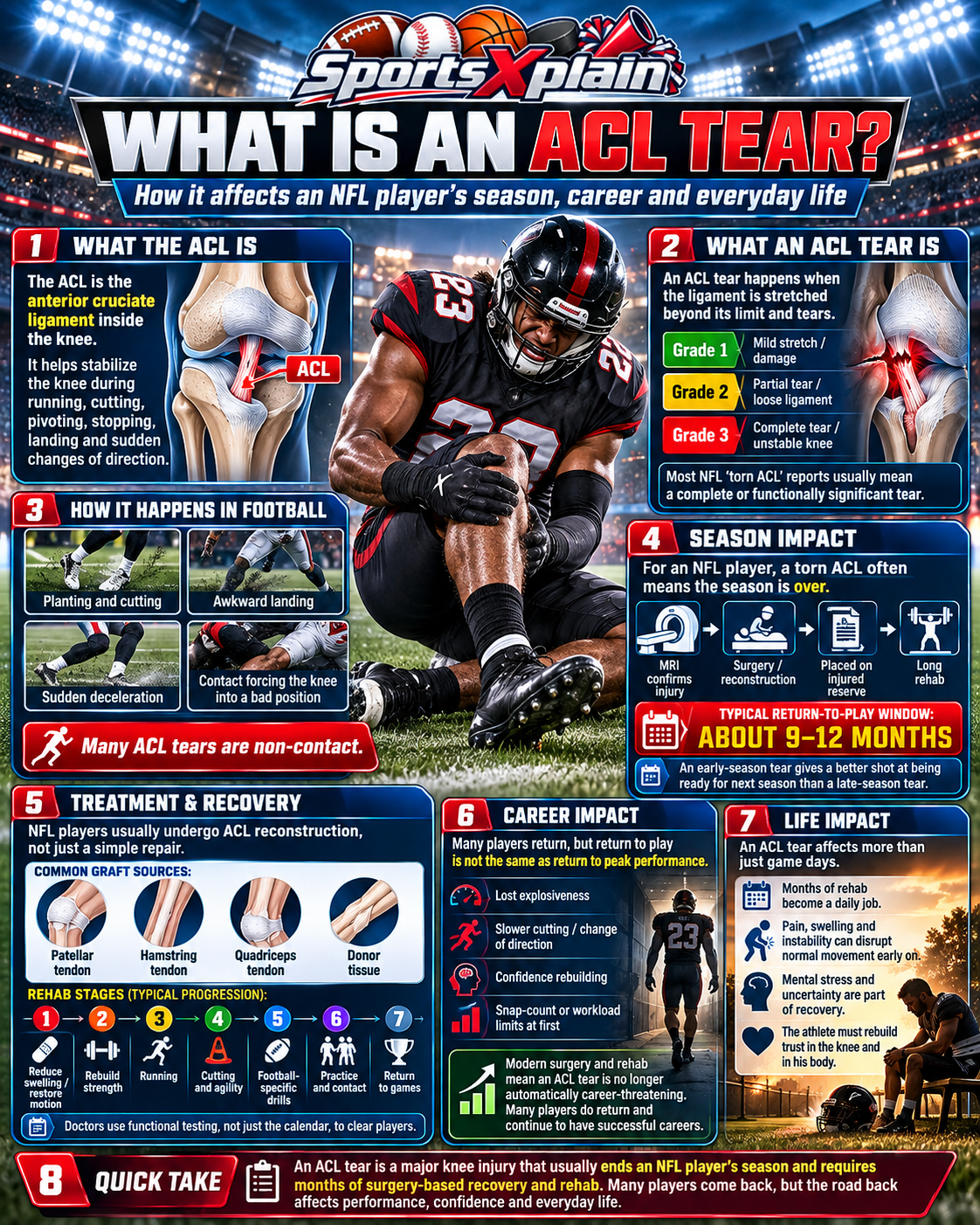
What Is The ACL?
The ACL is one of the major ligaments connecting the femur, or thigh bone, to the tibia, or shin bone.
It runs through the center of the knee and helps prevent the tibia from sliding too far forward while also providing rotational stability.
That stability becomes particularly important when an athlete:
- Plants a foot
- Cuts to another direction
- Stops suddenly
- Accelerates
- Changes direction
- Lands from a jump
- Absorbs contact
Those movements are fundamental to almost every NFL position.
What Is An ACL Tear?
An ACL tear occurs when the ligament is stretched beyond its ability to withstand the force being placed on it.
ACL injuries are generally classified by severity.
- Grade 1: The ligament is mildly damaged or stretched but remains capable of stabilizing the knee.
- Grade 2: The ligament is stretched to the point that it becomes loose, sometimes called a partial tear.
- Grade 3: The ligament is completely torn, leaving the knee unstable.
Most ACL injuries referred to as “torn ACLs” in NFL injury reports involve a complete or functionally significant tear.
The American Academy of Orthopaedic Surgeons notes that partial ACL tears are relatively uncommon and that most ACL injuries involve complete or nearly complete tears. [AAOS]
How Do NFL Players Tear Their ACL?
ACL tears do not always require a defender to hit the knee.
In fact, many occur through non-contact mechanisms.
A player may plant his foot while attempting to cut, causing the knee to rotate while the foot remains fixed to the ground.
ACL injuries can also happen when a player lands awkwardly, suddenly decelerates or receives contact that forces the knee into an unnatural position.
Common football situations include:
- A running back making a sharp cut
- A receiver changing direction on a route
- A defensive back reacting to a receiver
- A quarterback scrambling
- A lineman being hit around the knee while engaged with another player
- A player landing awkwardly after jumping
Can A Player Walk After Tearing An ACL?
Yes.
A player walking off the field does not rule out an ACL tear.
Some athletes experience immediate severe pain and cannot continue. Others are able to stand, walk or even briefly attempt to return.
The ACL’s primary job is stability rather than simply supporting body weight.
A person may therefore be capable of walking in a straight line while still having significant instability when attempting to pivot or cut.
That is why television footage of a player walking to the locker room cannot reliably establish the severity of a knee injury.
Does An ACL Tear Always Hurt Immediately?
Symptoms vary.
Some athletes report hearing or feeling a “pop” when the injury occurs.
Common symptoms can include:
- Rapid swelling
- Pain
- Loss of range of motion
- A feeling that the knee is unstable
- Difficulty putting weight on the leg
- The knee “giving way”
But not every player experiences every symptom. [AAOS]
How Do Doctors Diagnose A Torn ACL?
Diagnosis usually begins with a physical examination.
Team doctors can perform stability tests that evaluate how the tibia moves relative to the femur.
One commonly used examination is the Lachman test.
Doctors may strongly suspect an ACL tear based on the physical examination, which is why reports sometimes emerge shortly after an NFL game that a team “fears” a torn ACL.
An MRI is then commonly used to confirm the diagnosis and determine whether other parts of the knee were damaged. [AAOS]
Why Do NFL Players Get An MRI?
The MRI can show more than whether the ACL is torn.
Doctors also want to know whether the injury involves the:
- Meniscus
- Medial collateral ligament, or MCL
- Posterior cruciate ligament, or PCL
- Cartilage
- Bone
- Other structures surrounding the knee
That information can significantly affect treatment and the expected recovery.
What Does “Clean ACL Tear” Mean?
When football reports describe a “clean” or “isolated” ACL tear, they generally mean the ACL was damaged without major accompanying injuries to other important knee structures.
It does not mean the injury is minor.
A complete ACL tear remains a serious injury requiring substantial rehabilitation.
But an isolated tear can be less complicated than an injury involving the ACL plus the meniscus, MCL or other structures.
What Is The Meniscus And Why Does It Matter?
The menisci are pieces of cartilage inside the knee that help absorb shock and distribute force across the joint.
ACL injuries can occur along with meniscus damage.
If a player’s meniscus also requires surgical repair, doctors may need to modify the rehabilitation process to protect the repaired cartilage.
That is why the phrase “torn ACL” alone does not always provide enough information to predict a player’s return.
Does A Torn ACL Require Surgery?
Not every person with an ACL tear requires surgery.
Age, activity level, knee stability and lifestyle all influence treatment.
But an NFL player has unusual physical requirements.
Professional football requires repeated cutting, pivoting, acceleration and contact, making a stable ACL extremely important.
For that reason, complete ACL tears in NFL players are generally treated with ACL reconstruction.
The AAOS says surgical reconstruction may be recommended for active adults whose sports or jobs require pivoting, turning or hard cutting. [AAOS]
What Happens During ACL Surgery?
Surgeons usually do not simply sew the torn ACL back together.
Traditional ACL reconstruction replaces the damaged ligament with a graft.
The surgeon places the graft where the original ACL was located, creating a new structure capable of stabilizing the knee.
The graft can come from different sources, including portions of the patient’s:
- Patellar tendon
- Hamstring tendon
- Quadriceps tendon
In some situations donor tissue can also be used.
The choice depends on the athlete, surgeon and circumstances of the injury. [AAOS]
Do Players Have Surgery Immediately?
Not necessarily.
Doctors may wait for swelling to decrease and range of motion to improve before performing reconstruction.
Going into surgery with a stiff, swollen knee can complicate rehabilitation.
Some athletes therefore spend time doing prehabilitation before surgery.
The exact schedule depends on the condition of the knee and whether other injuries require treatment.
How Long Is ACL Recovery In The NFL?
There is no fixed NFL ACL timetable, but a practical range for returning to professional football is often approximately nine to 12 months.
Some athletes have returned sooner.
Others require a year or longer.
Modern return-to-play decisions increasingly depend on functional testing rather than simply reaching a particular date on the calendar.
An NFL player must be able to demonstrate adequate:
- Strength
- Range of motion
- Balance
- Coordination
- Acceleration
- Deceleration
- Cutting ability
- Football-specific movement
Doctors must also consider healing of the reconstructed ligament.
Why Does ACL Recovery Take So Long?
The challenge is not simply getting the surgical incision to heal.
The athlete must rebuild an entire movement system.
After surgery, the muscles around the injured knee — particularly the quadriceps — can lose significant strength.
The athlete must restore that strength while the graft itself goes through a biological healing process.
Later, the player has to relearn high-speed movements and demonstrate that the knee remains stable under football conditions.
A player who can jog comfortably is still far from being ready to play in an NFL game.
What Are The Stages Of ACL Rehabilitation?
Although programs differ, rehabilitation generally progresses through several broad stages.
Stage 1: Control Swelling And Restore Motion
The early focus is reducing swelling, regaining knee extension and flexion and beginning basic muscle activation.
Stage 2: Rebuild Strength
The player progressively strengthens the quadriceps, hamstrings, hips and surrounding muscles.
Stage 3: Running
Once sufficient strength and control return, straight-line jogging and running can begin.
Stage 4: Cutting And Agility
The player gradually introduces lateral movement, acceleration, deceleration and changes of direction.
Stage 5: Football-Specific Work
Position drills become increasingly important.
A receiver may run routes. A running back practices cuts. A defensive end works on bending around the edge. A defensive back practices backpedaling and changing direction.
Stage 6: Practice And Contact
The athlete progresses from individual work toward team drills and eventually contact.
Stage 7: Return To Games
Medical clearance does not necessarily mean an immediate full workload.
Teams may limit snaps as the player reacclimates to NFL game speed.
Can An NFL Player Return In Six Months?
Occasionally athletes have returned unusually quickly, but a six-month recovery should not be treated as the standard expectation.
Being capable of running at six months is different from being ready for unrestricted professional football.
Returning too early can be concerning because physical performance may recover before the reconstructed ligament has completed its biological maturation.
Modern rehabilitation therefore places greater emphasis on objective testing and safe progression.
Why Is Nine Months Often Mentioned?
Nine months has become a commonly discussed benchmark because many athletes can reach advanced return-to-sport testing around that point.
But it is not a deadline.
A player at nine months who lacks sufficient strength or movement quality may need more rehabilitation.
Another athlete may meet important benchmarks sooner.
The calendar provides context; medical and functional testing determines clearance.
Can An NFL Player Be Ready For The Next Season?
It depends heavily on when the ACL tear occurs.
A September injury gives a player nearly a full year before the next regular season.
An ACL tear in December or January creates a much tighter timetable.
For example:
| Approximate Injury Date | 9 Months Later | 12 Months Later |
|---|---|---|
| September | June | September |
| October | July | October |
| November | August | November |
| December | September | December |
| January | October | January |
This is why an early-season ACL tear, while devastating to the current season, can provide a better chance of being ready for the following opener than a postseason tear.
What Does PUP Mean For A Player Recovering From An ACL?
PUP stands for Physically Unable to Perform.
Teams can use the designation for players who are not medically ready to practice when training camp begins.
A player recovering from an ACL reconstruction may begin camp on the active/PUP list while continuing rehabilitation.
If the player remains on the reserve/PUP list when the regular season begins, NFL roster rules determine when he becomes eligible to return to practice and games.
The exact rules can change, so the current season’s NFL roster regulations should be checked when evaluating a specific player’s return.
What Is The Difference Between PUP And Injured Reserve?
Both designations can involve injured players, but they serve different roster purposes.
PUP is generally relevant to players who are already unable to practice when training camp begins because of a football-related injury.
Injured reserve can be used for players who suffer injuries at other points in the league calendar.
For a season-ending ACL tear, a team will commonly place the player on injured reserve during the current season.
Can A Player Return From ACL Surgery And Be The Same?
Yes, many players have returned to elite performance after ACL reconstruction.
But there is no guarantee.
Return to play and return to previous performance are two different milestones.
A player may be medically cleared while still rebuilding:
- Explosiveness
- Confidence
- Acceleration
- Lateral movement
- Endurance
Position also matters.
A running back or defensive back may rely on repeated high-speed cuts more heavily than some other positions.
What NFL Players Have Successfully Returned From Torn ACLs?
Perhaps the most famous example is Adrian Peterson.
The Minnesota Vikings running back tore the ACL and MCL in his left knee in December 2011.
He returned for the 2012 season opener, less than nine months later, and rushed for 2,097 yards, won NFL MVP and came within nine yards of Eric Dickerson’s then-single-season rushing record. [Pro Football Hall of Fame]
Peterson’s recovery is remembered precisely because it was extraordinary.
It should not be used as the standard timetable for every ACL injury.
How Did Breece Hall Recover From His ACL Tear?
New York Jets running back Breece Hall tore his ACL in October 2022.
He returned for the beginning of the 2023 season and gradually regained a substantial role.
Hall’s recovery is an example of an early-season injury providing enough time for a player to return by the following September.
It still does not mean every October ACL tear will follow the same path.
What About Joe Burrow?
Joe Burrow suffered a particularly severe left knee injury in November 2020 that included tears of the ACL and MCL along with other damage.
He returned for Cincinnati’s 2021 opener.
Burrow then led the Bengals to Super Bowl LVI.
His recovery demonstrates that even a quarterback with significant additional knee damage can return to elite competition, although his rehabilitation should not be treated as a universal model.
Can A Player Tear The Same ACL Again?
Yes.
A reconstructed ACL can suffer another injury, and athletes can also tear the ACL in the opposite knee.
Preventing reinjury is one reason return-to-play testing is important.
Medical staffs evaluate strength symmetry, movement mechanics and control before allowing unrestricted competition.
What Is An ACL Graft?
The graft is the tissue used to create the replacement ACL.
During reconstruction, surgeons place the graft through tunnels in the tibia and femur and secure it in position.
Over time, the body incorporates the graft and it functions as the new ligament.
That biological process is one reason recovery cannot be rushed simply because the athlete feels good.
What Is A Patellar Tendon Graft?
A patellar tendon graft uses tissue from the tendon connecting the kneecap to the tibia.
It has a long history of use in high-level athletes.
Other common choices include quadriceps and hamstring tendon grafts.
There are advantages and disadvantages to each, and the appropriate choice depends on the athlete and surgeon.
What Is The Difference Between An ACL Tear And An MCL Tear?
The ACL and MCL are different ligaments.
The ACL is located inside the knee and helps control forward and rotational movement.
The medial collateral ligament runs along the inside of the knee and helps resist forces pushing the knee inward.
Many isolated MCL injuries can heal without surgery.
A complete ACL tear in an NFL player is much more likely to require reconstruction.
What Is The Difference Between An ACL And Achilles Tear?
They affect entirely different structures.
The ACL is a ligament inside the knee.
The Achilles tendon connects the calf muscles to the heel.
Both are major injuries for NFL players, but the surgeries, rehabilitation and biomechanical challenges are different.
Why Do Teams Sometimes Say They “Fear” An ACL Tear?
Team doctors can often develop a strong suspicion from the injury mechanism and physical examination before an MRI is completed.
That leads to reports such as:
“The team fears a torn ACL.”
That wording does not mean the diagnosis has been formally confirmed.
The MRI normally provides additional confirmation and reveals whether other knee structures are damaged.
For injury reporting, there is therefore an important difference between:
- Suspected ACL tear
- Confirmed ACL tear
- ACL tear plus additional knee damage
Why Can A Player Sometimes Finish A Play With A Torn ACL?
The ligament can tear during a play without immediately making all movement impossible.
Other muscles and structures still support the knee.
Some athletes have even attempted another play before realizing the extent of the injury.
But high-speed cutting and pivoting with an unstable knee can be unsafe.
That is why medical staffs evaluate players even when they initially appear capable of walking.
Does An ACL Tear Always End An NFL Player’s Season?
Usually, if a complete tear occurs during the regular season.
The recovery process is too long for a player injured in September, October, November or later to return during the same NFL season.
An ACL tear suffered very early in the offseason could theoretically allow a return later in the same calendar year, but the timeline still depends on rehabilitation and medical clearance.
ACL Tear Recovery At A Glance
- ACL: Anterior cruciate ligament
- Location: Inside the knee
- Main function: Knee stability during forward and rotational movement
- Common NFL mechanism: Planting, cutting, pivoting, awkward landing or contact
- Diagnosis: Physical examination plus imaging such as MRI
- Typical treatment for NFL players: ACL reconstruction
- Typical grafts: Patellar tendon, quadriceps tendon or hamstring tendon
- Common return-to-football range: Roughly nine to 12 months, with significant individual variation
- Season-ending? Usually when suffered during the NFL regular season
- Can a player walk afterward? Yes
- Can a player return to elite performance? Yes, but recovery varies
- Biggest timetable variables: Additional knee damage, surgery, graft healing, strength and functional testing
How Soon Can An NFL Player Really Return From A Torn ACL?
The simplest answer is that nine to 12 months is a useful general framework, not a countdown clock.
An NFL player is not ready merely because nine months have passed.
He has to demonstrate that the reconstructed knee can withstand the forces generated by sprinting, cutting, jumping, absorbing contact and changing direction against world-class athletes.
The date of the injury also matters enormously.
A player who tears an ACL in September may have enough time to complete an approximately year-long rehabilitation before the following season. A player injured in December or January may still be working toward full clearance when the next season begins.
And even after a player returns to a game, the recovery story may not be finished.
Regaining confidence, explosiveness and pre-injury performance can take additional time.
That is why the most reliable return date for any specific NFL player comes not from the average ACL timetable but from the player’s surgery, rehabilitation milestones and eventual medical clearance.