
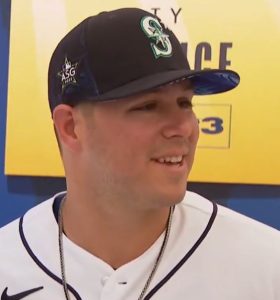
Ty France appeared to have a chance at a dramatic go-ahead home run for the San Diego Padres against the Milwaukee Brewers, only for his towering fly ball to strike a cable connected to the roof at American Family Field and fall into Jackson Chourio’s glove.
France was ruled out because of a specific ground rule at the Brewers’ stadium: a batted ball that hits the roof, roof truss or roof cable over fair territory remains live. If a defensive player catches it before it hits the ground, the batter is out.
What Happened To Ty France?
The bizarre play occurred in the top of the ninth inning of Game 1 of the National League Division Series on October 3, 2026.
Milwaukee led San Diego 3-2 with one out and a runner on first when France hit a towering drive to left field against Brewers closer Trevor Megill.
Instead of completing its normal flight, the ball struck a cable attached to American Family Field’s closed roof. The impact altered the ball’s path and sent it back toward the field, where Brewers left fielder Jackson Chourio tracked it down and caught it for the second out. [MLB] [Reuters]
Jackson Merrill then flew out to right field, ending the game and giving Milwaukee a 3-2 victory. [Reuters]
Why Was France Out If The Ball Hit The Roof?
The ruling came directly from American Family Field’s park-specific ground rules.
According to the Milwaukee Brewers’ official ground rules:
- A batted ball that strikes the roof, roof truss or roof cable over fair territory is in play.
- If a fielder catches the ball, the batter is out and runners may advance at their own risk.
- If a batted ball strikes the roof, roof truss or roof cable over foul territory, it is a dead ball.
Because the umpires ruled that France’s ball struck the cable while it was over fair territory, the baseball remained live. Chourio’s catch therefore legally retired France. [Brewers Ground Rules]
Why Did The Padres Challenge The Call?
The critical question was whether France’s ball had struck the cable while it was over fair or foul territory.
That distinction completely changed the result of the play.
If the ball struck the roof structure over fair territory, it remained live and Chourio could catch it for an out. If it struck the structure over foul territory, the ball would have been dead.
San Diego challenged the ruling, but replay review upheld the call on the field, leaving France out. [Reuters]
Was Ty France’s Ball Going To Be A Home Run?
That became the biggest question surrounding the play.
France’s fly ball had an unusually high 49-degree launch angle. MLB noted that only 10 over-the-fence home runs during the Statcast era had been hit with a launch angle of at least 49 degrees, and no previous home run at American Family Field had been hit with a launch angle higher than 46 degrees. [MLB]
Padres manager Craig Stammen believed France’s drive had a chance to leave the park if the cable had not interfered with its flight.
Brewers manager Pat Murphy disagreed, saying from his vantage point that he believed the ball was ultimately heading foul. [Reuters]
There is no definitive way to know where the baseball would have landed because the cable changed its trajectory.
Could The Umpires Have Awarded France A Home Run?
No.
The umpires could not simply decide that France’s ball probably would have cleared the fence and award him a home run.
The play had to be judged according to the stadium’s existing ground rules. Once the ball was determined to have contacted the roof cable over fair territory, it remained a live baseball.
That meant the outcome depended on what happened next—and Chourio caught it.
What If Chourio Had Dropped The Ball?
France would not have automatically been out.
Because the baseball remained live after hitting the cable, Chourio still had to make the catch. Had the ball landed on the field instead, France could have continued running and the runners could have advanced as the play developed.
The roof contact itself did not create the out. The combination of the ball remaining live and Chourio catching it created the out. [Brewers Ground Rules]
Why Can A Baseball Stadium Have Its Own Rule?
MLB uses universal playing rules, but individual ballparks can also have additional ground rules covering unusual stadium features.
That is necessary because baseball stadiums are not built to identical specifications. Walls, fences, roofs, scoreboards and other structures can create situations that do not occur at every park.
MLB’s universal ground rules specifically recognize that individual parks can have their own provisions concerning roof structures and other unique features. [MLB Ground Rules]
American Family Field requires special roof rules because it has a massive retractable roof consisting of multiple movable panels and structural components extending over portions of the playing field. [Brewers]
How Important Was France’s Roof Out?
It potentially changed the outcome of Game 1.
The Brewers led 3-2 when France came to the plate with a runner on first. A two-run homer would have put the Padres ahead 4-3 in the ninth inning.
Instead, France’s fly ball became the second out. Merrill then made the final out, allowing Milwaukee to take a 1-0 lead in the best-of-five NLDS. [Reuters]
The ending was even more notable because Chourio had already played a major role in Milwaukee’s comeback. He hit a two-run homer in the third inning to erase San Diego’s 2-0 advantage before William Contreras hit the go-ahead solo home run in the seventh. [Reuters]
Did The Brewers’ Roof Cost The Padres The Game?
It is fair to say the roof may have affected the result, but it is impossible to say with certainty that France would have hit a home run.
Stammen thought the baseball had home-run distance. Murphy believed it was going foul. The cable prevented anyone from finding out.
What is not particularly ambiguous is the rule itself. Once officials determined that the ball struck the cable over fair territory, it remained live under American Family Field’s ground rules. Chourio caught it, so France was out. [Brewers] [Reuters]
The Bottom Line
Ty France was out because a baseball that hits the American Family Field roof or roof cable over fair territory remains in play.
France’s ninth-inning drive struck a roof cable and dropped back toward the field. Jackson Chourio caught it before it landed, making France out under the Brewers’ stadium-specific ground rules.
The Padres challenged whether the ball had hit the cable over fair territory, but the ruling was upheld.
Whether France would have hit a go-ahead home run without the cable will remain one of the great what-if moments of the 2026 MLB postseason.