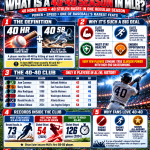
An MLB grand slam is a home run hit when the bases are loaded — meaning there is already a runner on first base, second base and third base.
When the batter hits the home run, all three runners score and the batter also circles the bases, producing four runs on one swing. That is the maximum number of runs that can score on a single home run. [MLB]
The batter receives one home run and four RBIs, making a grand slam one of the biggest possible offensive plays in baseball.
How Does A Grand Slam Work?
A grand slam requires two things:
- The bases must be loaded.
- The batter must hit a home run.
If those conditions are met, the runners on first, second and third all score, followed by the batter.
That creates four runs immediately. [Baseball Reference]
Why Is It Called A Grand Slam?
The term did not originally come from baseball.
MLB explains that “grand slam” originated in the card game bridge, where it refers to winning every possible trick in a hand. Baseball adopted the phrase because a bases-loaded home run produces the maximum possible number of runs from one at-bat. [MLB]
Broadcasters and fans may also call one a “slam,” “grand salami” or “grand-slam home run.”
How Many Runs Does A Grand Slam Score?
A grand slam scores exactly four runs.
Three runs come from the runners who were already on base, and the fourth comes from the batter who hit the home run.
The hitter is credited with four RBIs. [MLB]
Why Can’t A Home Run Score More Than Four Runs?
There are only three bases that can be occupied before a pitch: first, second and third.
That means a batter can never come to the plate with more than three runners already on base.
When all three are occupied and the batter homers, four players score. There is no legal way to place a fourth runner on base before the pitch, so four is the maximum.
What Does “Bases Loaded” Mean?
The bases are loaded when offensive players occupy first base, second base and third base at the same time.
That creates one of baseball’s highest-pressure situations because almost any ball put into play can potentially score at least one run.
A walk or hit-by-pitch with the bases loaded also forces home the runner from third, producing one run without the batter needing to get a hit.
Is Every Bases-Loaded Hit A Grand Slam?
No.
A grand slam specifically requires a home run.
For example, a batter could hit a bases-loaded double that scores three runners. That could produce three RBIs, but it would not be a grand slam because the batter did not hit a home run.
What Is The Difference Between A Grand Slam And A Regular Home Run?
The only difference is how many runners are on base when the home run occurs.
- Solo home run: Bases empty — 1 run.
- Two-run home run: One runner on base — 2 runs.
- Three-run home run: Two runners on base — 3 runs.
- Grand slam: Bases loaded — 4 runs.
The physical act is otherwise the same: the batter hits a fair ball out of the playing field or otherwise completes a legal home run.
Does A Grand Slam Count As Four Home Runs?
No.
The batter receives credit for one home run, regardless of how many runners score.
The four-run total refers to the runs produced, not the number of home runs credited.
For example, a player who hits one grand slam in a game finishes with one home run and at least four RBIs.
How Many RBIs Does A Grand Slam Produce?
A grand slam normally gives the batter four RBIs.
An RBI — run batted in — is credited when a batter’s offensive action directly causes a run to score under MLB scoring rules.
Because all four runs on a grand slam result from the batter’s home run, the hitter receives four RBIs. [MLB]
Can A Grand Slam Happen With Two Outs?
Yes.
The number of outs does not matter.
A grand slam can occur with:
- No outs
- One out
- Two outs
As long as the bases are loaded and the batter hits a home run before the third out is recorded, it counts as a grand slam.
Can A Grand Slam Happen In Extra Innings?
Yes.
A grand slam can occur in any inning, including extra innings.
Because MLB now begins regular-season extra innings with an automatic runner on second base, teams may have an easier path to creating bases-loaded situations in extras, although the batter still has to hit a home run for the play to become a grand slam.
What Is A Walk-Off Grand Slam?
A walk-off grand slam occurs when the home team hits a bases-loaded home run in the bottom of the ninth inning or later and the four runs give it the winning lead.
The game ends immediately because the visiting team does not receive another turn at bat.
Walk-off grand slams are among the most dramatic plays in baseball because one swing can instantly change a deficit into a victory.
Can A Team Hit More Than One Grand Slam In A Game?
Yes.
There is no rule limiting how many grand slams a team or player can hit in one game.
It is rare because the offense must repeatedly load the bases and then hit home runs, but it has happened numerous times in MLB history.
Can One Player Hit Two Grand Slams In The Same Game?
Yes.
Several Major League players have hit two grand slams in one game.
One of the most famous examples came on April 23, 1999, when Fernando Tatís Sr. hit two grand slams in the same inning for the St. Louis Cardinals against the Los Angeles Dodgers.
Both came against pitcher Chan Ho Park, giving Tatís eight RBIs in a single inning — an MLB record. [MLB]
Who Has Hit The Most Grand Slams In MLB History?
Alex Rodriguez holds the Major League career record with 25 grand slams. [MLB]
The career leaders include:
- Alex Rodriguez: 25
- Lou Gehrig: 23
- Manny Ramirez: 21
- Eddie Murray: 19
- Willie McCovey: 18
- Robin Ventura: 18
Rodriguez broke Gehrig’s longtime record with his 24th career grand slam in September 2013 and later extended the mark to 25. [MLB]
Why Are Grand Slams Relatively Rare?
A hitter cannot create the opportunity alone.
Three teammates must first reach base without the inning ending. Only then can the batter have a chance to hit a grand slam.
MLB notes that grand slams therefore depend heavily on circumstance. Even great home-run hitters may finish their careers with relatively few because bases-loaded plate appearances simply do not occur very often. [MLB]
Does A Grand Slam Always Change The Lead?
No.
A four-run swing can dramatically change a game, but the effect depends on the score beforehand.
For example:
- A team trailing 3-0 would take a 4-3 lead.
- A team trailing 5-0 would still trail 5-4.
- A team tied 2-2 would take a 6-2 lead.
- A team already leading 7-1 would extend its advantage to 11-1.
That is why grand slams are usually extremely important but do not automatically guarantee victory.
Can An Inside-The-Park Home Run Be A Grand Slam?
Yes.
A home run does not necessarily have to leave the ballpark.
If a batter hits a fair ball that stays in play and successfully circles all four bases before the defense records an out or commits an error that changes the scoring decision, it can be ruled an inside-the-park home run.
If the bases were loaded when that happened, it would be an inside-the-park grand slam.
Can A Grand Slam Be Hit In The World Series?
Yes.
Grand slams can occur in the postseason exactly as they can during the regular season.
They are especially memorable in October because four runs on one swing can dramatically alter a short playoff series.
World Series grand slams have been hit by players including Addison Russell, Alex Bregman and Adam Duvall. [Baseball Reference]
What Is A Grand Salami?
“Grand salami” is simply baseball slang for a grand slam.
It does not refer to a different play or statistic.
MLB’s glossary lists “salami” and “grand salami” among the common broadcast terms for a bases-loaded home run. [MLB]
Does A Grand Slam Count Differently In The Statistics?
The home run itself counts the same as any other home run.
The batter receives:
- One hit
- One home run
- One run scored
- Four RBIs
The statistic becomes notable because MLB also tracks grand slams separately as a situational home-run category.
Why Is A Grand Slam Such A Big Deal?
Few baseball plays can change a game as quickly.
A team can go from trailing to leading with one swing, while a pitcher can see an otherwise manageable inning turn into a four-run disaster instantly.
It also combines two relatively uncommon events: loading the bases and hitting a home run.
That combination of rarity, maximum run production and immediate scoreboard impact is why a grand slam remains one of baseball’s most celebrated plays.
Grand Slam Example
Imagine the Yankees have runners at first, second and third with one out.
The batter hits a pitch over the right-field fence.
The runner from third scores. The runner from second scores. The runner from first scores. The batter rounds the bases and scores.
The Yankees have scored four runs, and the batter receives one home run and four RBIs.
That is a grand slam.