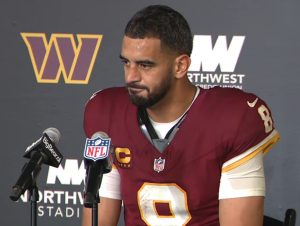
The Washington Commanders entered Week 3 without injured starting quarterback Jayden Daniels, carrying an 0-2 record and facing the defending Super Bowl champions riding a 12-game winning streak.
They left with one of the biggest upsets of the young NFL season.
Backup quarterback Marcus Mariota threw three touchdown passes without an interception, Washington’s defense forced three Seattle turnovers and rookie linebacker Kain Medrano delivered the game’s defining play with a 50-yard interception return for a touchdown as the Commanders defeated the Seahawks 33-31 on September 27, 2026. [ESPN]
Seattle actually outgained Washington by an enormous margin, 437 yards to 258. But the Commanders won the statistic that ultimately mattered most: turnovers. Washington committed none while Seattle committed three.
Why Was Washington’s Win Such A Big Upset?
The circumstances strongly favored Seattle.
The Seahawks entered the game 2-0 and had won 12 consecutive games dating to November 2025, a streak that included their run to the Super Bowl championship. [AP/MyNorthwest]
Washington was 0-2 after losses to Philadelphia and Dallas and was without Daniels because of a dislocated elbow.
That put the offense in the hands of Mariota, a 32-year-old veteran backup facing one of the NFL’s best teams.
Instead of simply keeping Washington competitive until Daniels could return, Mariota helped end the defending champions’ winning streak.
How Did Marcus Mariota Play Against Seattle?
Mariota wasn’t spectacular statistically, but he was exceptionally effective where Washington needed him most.
He completed 19 of 31 passes for 183 yards, three touchdowns and no interceptions. [NFL]
His three touchdown passes went to:
Rachaad White: 6 yards
Treylon Burks: 11 yards
Terry McLaurin: 30 yards
Mariota didn’t have to match Seattle quarterback Sam Darnold’s 379 passing yards. He instead protected the football, capitalized on favorable situations and converted Washington’s opportunities into points.
That difference became critical because Darnold threw four touchdown passes but also threw two interceptions.
How Did Washington Attack Seattle?
The Commanders did not beat Seattle by producing huge amounts of offense.
They produced only 258 total yards and averaged 4.0 yards per play.
Instead, Washington played complementary football.
Mariota distributed the ball efficiently, Terry McLaurin provided the biggest downfield threat, the Commanders avoided turnovers and Washington’s defense repeatedly created short fields and scoring opportunities.
McLaurin finished with six catches for 77 yards and a touchdown, including the 30-yard third-quarter score that extended Washington’s lead to 24-10.
How Important Was Terry McLaurin?
McLaurin gave Mariota the explosive receiving option Washington needed.
His biggest play came early in the third quarter.
Mariota found McLaurin deep down the left side for a 30-yard touchdown, extending Washington’s advantage to 24-10.
The touchdown was particularly important because Seattle had begun generating offensive momentum.
Rather than allow the defending champions to immediately seize control, Washington answered with its biggest offensive play of the afternoon.
How Did The Commanders Defense Beat Seattle?
Washington’s defense followed a classic upset formula: give up yards, but create turnovers.
Seattle accumulated 437 total yards and averaged 6.8 yards per play. Darnold threw for 379 yards and four touchdowns.
Those numbers would ordinarily suggest Seattle controlled the game.
But Washington forced three turnovers while committing zero. [AP/MyNorthwest]
The Commanders intercepted Darnold twice and recovered a Seattle fumble.
Those takeaways repeatedly erased Seattle’s offensive production.
What Was Kain Medrano’s Pick-Six?
It was the play that ultimately decided the game.
Washington led 27-24 with approximately four minutes remaining when Seattle had possession with a chance to drive for the tying field goal or go-ahead touchdown.
Darnold attempted a pass near midfield.
Linebacker Kain Medrano intercepted it and returned the ball 50 yards for a touchdown.
Instead of Seattle potentially taking the lead, Washington suddenly led 33-24 with 4:09 remaining. [AP/MyNorthwest]
That defensive touchdown proved essential because Seattle immediately responded.
Did Seattle Almost Come Back?
Yes.
The Seahawks refused to disappear.
Darnold quickly drove Seattle down the field and threw a 7-yard touchdown pass to Cooper Kupp with 2:55 remaining.
Jason Myers’ extra point cut Washington’s lead to 33-31.
Seattle therefore needed only one more possession and potentially a field goal to win.
It never got the ball back.
How Did Mariota Seal The Game?
Washington took possession with 2:55 remaining needing to prevent Seattle from getting another opportunity.
The Commanders did exactly that.
Rachaad White immediately broke a 19-yard run, forcing Seattle to begin using its timeouts.
Then came the decisive play.
Facing third down with Seattle out of timeouts, Washington used Mariota’s mobility rather than simply handing the ball to a running back.
Mariota kept the ball on a zone-read and ran around the right side for nine yards and the first down.
That conversion allowed Washington to kneel out the clock. [NFL]
It was a fitting ending: Mariota’s legs, experience and decision-making finished the upset.
Why Was The Final Mariota Run So Important?
If Washington had failed to convert, the Commanders likely would have been forced to give the ball back to Seattle.
That would have been extremely dangerous.
Darnold had already thrown for nearly 400 yards and had just driven Seattle for a touchdown in less than two minutes.
The Seahawks would have needed only a field goal to take the lead.
Instead, Mariota’s nine-yard keeper ended the game without giving Darnold another snap.
How Did Washington Win Despite Being Outgained 437-258?
The game is a good example of why total yardage can be misleading.
Seattle had:
437 total yards
379 passing yards from Darnold
6.8 yards per play
Four touchdown passes
Washington had:
258 total yards
183 passing yards from Mariota
4.0 yards per play
But Seattle also had three turnovers.
Washington had zero.
The Commanders effectively converted Seattle’s mistakes into the possessions and points needed to overcome the enormous yardage difference.
Why Were Seattle’s Turnovers So Costly?
Turnovers do more than end a possession.
They can erase long drives, create short fields and produce immediate points.
Medrano’s interception was the extreme example because Washington did not even need its offense to capitalize — he returned the ball directly for a touchdown.
Seattle therefore accumulated 179 more yards than Washington but repeatedly failed to translate that advantage into a corresponding advantage on the scoreboard.
What Happened To Seattle’s Running Game?
Seattle became heavily dependent on Darnold because its conventional running game accomplished almost nothing.
Seahawks running backs combined for only a small amount of rushing production, with Emanuel Wilson gaining 14 yards on nine carries and Jadarian Price producing 15 yards on five attempts.
That inability to run consistently contributed to Seattle attempting 45 passes.
Darnold made numerous big plays through the air, but the high-volume passing attack also created more opportunities for Washington’s defense to make a game-changing play.
How Good Was Sam Darnold Despite The Loss?
Darnold’s performance was simultaneously impressive and costly.
He completed 31 of 45 passes for 379 yards and four touchdowns.
Jaxon Smith-Njigba caught 10 passes for 128 yards and two touchdowns.
Those numbers explain how Seattle remained within striking distance despite repeatedly falling behind.
But Darnold also threw two interceptions, including Medrano’s fourth-quarter pick-six.
That one mistake effectively turned a potential Seattle game-winning drive into seven Washington points.
How Did Washington Start The Game?
The Commanders immediately demonstrated that they were not going to play conservatively simply because Daniels was unavailable.
Mariota led Washington to a touchdown on its opening scoring drive, finding Rachaad White for a 6-yard touchdown pass.
Seattle answered with Darnold’s touchdown pass to Smith-Njigba early in the second quarter.
Mariota then responded again, connecting with Treylon Burks for an 11-yard touchdown to make it 14-7.
Washington never trailed.
How Important Was Washington’s 57-Yard Field Goal?
Very important considering the final two-point margin.
Seattle kicker Jason Myers hit a 57-yard field goal with 57 seconds remaining in the first half, cutting Washington’s lead to 14-10.
The Commanders answered before halftime.
Drew Stevens kicked his own 57-yard field goal with three seconds remaining, restoring Washington’s seven-point advantage at 17-10.
Those three points ultimately mattered enormously in a game Washington won 33-31.
What Was Washington’s Biggest Offensive Advantage?
It was not raw production. It was efficiency in important situations.
Mariota threw only 31 passes and averaged 5.9 yards per attempt, but three of his completions produced touchdowns.
He did not throw an interception.
Washington also controlled possession slightly, holding the ball for 31:28 compared with Seattle’s 28:32.
The Commanders therefore kept the game manageable, avoided catastrophic offensive mistakes and allowed their defense to create the explosive plays.
Why Was Mariota Starting Instead Of Jayden Daniels?
Daniels was unavailable because of a dislocated elbow.
That forced Washington to turn to Mariota, who had already seen action during the Commanders’ Week 2 loss to Dallas.
Mariota’s role was supposed to be keeping Washington competitive while its franchise quarterback recovered.
Against Seattle, he did considerably more than that.
He became the first quarterback to defeat the defending champions during their 12-game winning streak.
How Did Dan Quinn’s Game Plan Help Mariota?
Washington did not ask Mariota to imitate Daniels or win a passing shootout.
The Commanders emphasized ball security, used Mariota’s mobility selectively and relied on their defense to create favorable situations.
The final possession illustrated that approach perfectly.
Rather than ask Mariota to throw on the decisive third down, Washington used the threat of its running game and Mariota’s ability as a runner to create the game-clinching zone-read keeper.
Afterward, Mariota described the victory as an important one for a Washington team that desperately needed to avoid an 0-3 start. [Yahoo Sports]
How Did The Commanders Stop Seattle On Fourth Down?
Washington also produced an important defensive stand near its own goal line.
Safety Jeremy Reaves broke up a Seattle pass on fourth-and-goal, ending a Seahawks scoring opportunity.
Plays like that helped explain the strange statistical profile of the game.
Seattle moved the football extremely well between the 20s, but Washington repeatedly made the high-leverage plays necessary to keep those yards from becoming points.
What Ended Seattle’s 12-Game Winning Streak?
Ultimately, three things:
Turnovers: Seattle committed three; Washington committed none.
Mariota’s efficiency: Three touchdown passes and zero interceptions.
Washington’s situational execution: The Commanders produced a goal-line stop, a 57-yard field goal, a pick-six and the game-clinching third-down run.
Seattle was the more explosive offensive team.
Washington was the more efficient team in the moments that decided the game.
What Did The Win Mean For Washington?
The Commanders improved to 1-2 and avoided an 0-3 start.
More importantly, Washington demonstrated that its season does not necessarily have to collapse while Daniels is sidelined.
Mariota showed that the Commanders can win with him at quarterback, even against one of the NFL’s strongest opponents.
Seattle fell to 2-1 and suffered its first loss since November 2025. [NFL]
Commanders-Seahawks Upset At A Glance
Final score: Commanders 33, Seahawks 31
Washington record: 1-2
Seattle record: 2-1
Washington quarterback: Marcus Mariota
Why Mariota started: Jayden Daniels was out with a dislocated elbow
So How Did The Commanders Actually Pull Off The Upset?
Washington did not beat Seattle by being the better offense for 60 minutes.
It won by playing a cleaner game.
Mariota gave the Commanders exactly what a backup quarterback needs to provide in an upset: touchdowns without turnovers. He threw three scoring passes, protected the football and then used his legs to convert the third down that prevented Seattle from getting one final possession.
Washington’s defense supplied the difference. Seattle generated 437 yards and Darnold threw four touchdowns, but three turnovers neutralized much of that production. None mattered more than Medrano’s 50-yard interception return with 4:09 remaining.
Seattle still nearly escaped. Darnold answered the pick-six with another touchdown drive to make it 33-31.
But Seattle never touched the football again.
White’s 19-yard run forced Seattle to burn timeouts, and Mariota’s zone-read keeper produced the final first down. Two kneel-downs later, the defending Super Bowl champions’ 12-game winning streak was over. [NFL]
It was an unusual upset in which Seattle dominated the yardage statistics but Washington dominated the game’s highest-leverage moments — and Mariota made sure the Commanders never gave the defending champions one final chance to change the result.