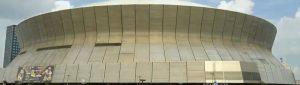
One of the most famous regular-season games in NFL history had little to do with championships, records or playoff implications.
On September 25, 2006, the New Orleans Saints defeated the Atlanta Falcons 23-3 on Monday Night Football in the first Saints game played at the Louisiana Superdome since Hurricane Katrina devastated New Orleans nearly 13 months earlier.
The game became known as the “Domecoming” or “Rebirth” game. It represented the Saints’ return from a season-long exile, the reopening of a stadium that had become one of the defining images of Katrina and, symbolically, another major step in New Orleans’ attempt to recover from the disaster. [Saints]
Then, only about 90 seconds into the game, Saints special-teamer Steve Gleason blocked an Atlanta punt. Curtis Deloatch recovered it in the end zone for a touchdown, producing one of the most celebrated plays in Saints history. [Saints]
What Was The Saints’ Domecoming Game?
The Domecoming was the September 25, 2006 game between the New Orleans Saints and Atlanta Falcons at the Louisiana Superdome.
It was New Orleans’ first regular-season game in the Superdome since December 26, 2004, and the Saints’ first true home game in New Orleans since Hurricane Katrina. [Saints]
The game was scheduled for Monday Night Football and televised nationally by ESPN.
Both teams entered 2-0, adding legitimate football significance to an event that already carried enormous emotional importance.
The Saints won 23-3, improved to 3-0 and took the early lead in the NFC South. [NFL]
Why Had The Saints Left New Orleans?
Hurricane Katrina struck the Gulf Coast on August 29, 2005.
The hurricane and subsequent levee failures caused catastrophic flooding throughout New Orleans. The Superdome, which had been designated a refuge of last resort, sheltered approximately 30,000 evacuees during the disaster. [Saints]
The building itself suffered extensive damage, including major damage to its roof.
The Superdome could not host Saints games during the 2005 NFL season, and the team became effectively homeless.
Where Did The Saints Play In 2005?
The Saints did not play a single game in New Orleans during the 2005 season.
Their nominal home schedule was scattered among several stadiums.
Three home games were played at the Alamodome in San Antonio, four were played at LSU’s Tiger Stadium in Baton Rouge, and one was played against the New York Giants at Giants Stadium in New Jersey. [ESPN]
The arrangement created one of the strangest seasons in NFL history. Players, coaches and staff were displaced while many members of the organization were also dealing with the effects of Katrina on their families and homes.
The Saints finished 3-13.
Could The Saints Have Permanently Left New Orleans?
That possibility became a major source of anxiety during the Saints’ displaced 2005 season.
San Antonio officials openly pursued the possibility of making the Saints a permanent tenant of the Alamodome. ESPN later reported that then-NFL commissioner Paul Tagliabue said owner Tom Benson wanted the team based in San Antonio for the 2006 season, while Saints officials have disputed the idea that Benson intended to permanently abandon New Orleans. [ESPN]
The NFL ultimately pushed for the franchise to remain in New Orleans.
On December 30, 2005, the Saints announced that they would return to the city for the 2006 season. [ESPN]
That made repairing the Superdome in time for football one of the most visible pieces of the city’s recovery effort.
How Badly Was The Superdome Damaged By Hurricane Katrina?
The Superdome had become internationally recognizable during Katrina.
Large sections of the roof covering were ripped away by the storm, rain entered the building, electrical systems were damaged and thousands of evacuees lived inside under increasingly difficult conditions while awaiting evacuation.
Afterward, there were questions about whether the stadium could or should be saved.
Engineers eventually determined that its basic structure remained sound. Crews began an enormous cleanup and reconstruction project.
Workers removed thousands of tons of debris before repairing and upgrading the building. The post-Katrina project included a new roof, new turf, new seats, improved scoreboards, sound systems and lighting. [Los Angeles Times]
How Quickly Was The Superdome Rebuilt?
The timetable was remarkable.
After roughly five months of remediation and cleanup, major construction began on March 1, 2006.
About 35 contractors and approximately 850 workers participated in the effort, with many crews working seven days a week. Less than seven months later, the building was ready for an NFL game. [Saints]
The initial restoration cost approximately $185 million. Later phases of rebuilding and improvements increased the overall investment substantially. [Saints]
FEMA provided funding for portions of the debris removal, roof work and other repairs. [FEMA]
Why Was The Game Called “Domecoming”?
“Domecoming” was a play on “homecoming.”
The Saints were coming home, but so was the Superdome.
The stadium had gone from hosting Saints games to serving as an emergency shelter, becoming heavily damaged and facing an uncertain future. Its reopening therefore represented more than simply the restoration of a sports venue.
The game has also become commonly known as the “Rebirth” game because of its association with New Orleans’ post-Katrina recovery. The Saints themselves have used both descriptions when remembering the event. [Saints]
Why Did The Saints Play The Falcons?
Atlanta was an especially appropriate opponent because the Falcons are one of the Saints’ oldest and most intense rivals.
The franchises had been divisional rivals for decades, first in the NFC West and later in the NFC South.
When the NFL announced the Superdome reopening game, commissioner Paul Tagliabue specifically noted that the event would feature the renewal of the traditional Saints-Falcons rivalry. [NFL/AP]
There was also real competitive intrigue. Both New Orleans and Atlanta entered the game undefeated at 2-0.
The Falcons were led by quarterback Michael Vick, while the Saints were beginning a new era with coach Sean Payton and quarterback Drew Brees.
Why Was The 2006 Saints Team So Different?
The franchise had undergone a dramatic transformation during the offseason.
New Orleans fired coach Jim Haslett after the 3-13 season and hired Sean Payton, then an assistant with the Dallas Cowboys, as head coach.
The Saints also signed quarterback Drew Brees, whose future had been uncertain after a serious shoulder injury ended his career with the San Diego Chargers.
New Orleans then selected USC running back Reggie Bush with the second overall pick in the 2006 NFL Draft. [Saints]
The Saints unexpectedly won their first two road games, defeating Cleveland and Green Bay.
That meant the team’s emotional return to New Orleans was also a matchup between two 2-0 NFC South teams.
What Happened Before The Domecoming Game?
The event was treated more like a major national celebration than a normal regular-season football game.
Thousands of people gathered around the Superdome hours before kickoff.
The Goo Goo Dolls performed outside the stadium. Inside, U2 and Green Day performed together during an elaborate pregame show that included “The Saints Are Coming,” a song that became closely associated with New Orleans’ recovery. [Saints]
New Orleans musicians Irma Thomas, Allen Toussaint and Kermit Ruffins also participated in the ceremonies.
Former President George H.W. Bush conducted the coin toss. [Saints]
The announced crowd was 70,003.
What Was Steve Gleason’s Blocked Punt?
The defining moment occurred almost immediately.
Atlanta received the opening kickoff but failed to score on its first possession. Falcons punter Michael Koenen lined up to punt from deep in Atlanta territory.
Saints safety and special-teams standout Steve Gleason burst through the middle of Atlanta’s protection untouched.
Gleason blocked Koenen’s punt.
The football bounced into the Falcons’ end zone, where Saints cornerback Curtis Deloatch recovered it for a touchdown.
Only about 90 seconds had elapsed. [Saints]
The Superdome erupted.
The play immediately became the enduring image of the Domecoming.
Why Is The Steve Gleason Blocked Punt So Famous?
Under ordinary circumstances, it would have been a memorable special-teams touchdown.
The circumstances transformed it into something much larger.
The Saints had spent an entire season displaced. Their stadium had been severely damaged. Their city’s population had been scattered across the country. The future of both the stadium and the franchise had been uncertain.
Then, during the first minutes of the first game back, the Saints blocked a punt and scored in front of an overwhelmingly emotional home crowd.
Former players have repeatedly described the noise after the play as extraordinary. Payton later said it was the loudest stadium he could remember experiencing. [Saints]
The play became so closely associated with the city’s recovery that a statue commemorating it was eventually installed outside the Superdome.
What Is The Rebirth Statue?
The statue outside the Superdome depicts Gleason extending his arms to block Koenen’s punt.
It is called “Rebirth.”
The name reflects what the play came to symbolize: the Saints’ return, the Superdome’s reopening and New Orleans’ determination to recover after Katrina.
The statue ensures that a play occurring less than two minutes into a September regular-season game remains permanently memorialized at the Saints’ stadium.
What Happened During The Rest Of The Game?
New Orleans dominated Atlanta.
After Gleason’s blocked punt produced the first touchdown, the Saints built a 14-3 first-quarter lead.
Saints kicker John Carney added two field goals in the second quarter, including a 51-yarder before halftime.
New Orleans’ special teams produced another major play when Josh Bullocks blocked a 25-yard Morten Andersen field-goal attempt. [Saints]
The Saints led 20-3 at halftime and added another Carney field goal in the third quarter.
Atlanta never scored again.
New Orleans won 23-3.
How Did The Saints Stop Michael Vick?
Atlanta entered the game with one of football’s most dangerous quarterbacks in Michael Vick.
But New Orleans’ defense largely contained him.
Vick began the game 2-for-12 passing and at one point threw seven consecutive incompletions. The Saints also limited his ability to change the game with his legs. [Saints]
The Falcons finished with only three points after entering the game undefeated.
How Many People Watched The Domecoming Game?
The Domecoming became a major national television event.
Nearly 15 million viewers watched ESPN’s Monday Night Football broadcast. At the time, it was the largest television audience in ESPN history. [Saints]
That enormous audience helped turn what might otherwise have been primarily a New Orleans sports moment into a national symbol of the city’s recovery.
Why Was The Domecoming Game So Significant?
The importance of the Domecoming went far beyond the final score.
New Orleans was still badly damaged. Thousands of residents remained displaced. Homes remained destroyed or uninhabitable, neighborhoods were still recovering and the city’s post-Katrina future remained uncertain.
A football game obviously could not solve those problems.
But reopening one of the city’s most recognizable buildings demonstrated that New Orleans could again host a massive public event and gave residents a shared celebration after a year dominated by loss and recovery.
Saints writer John DeShazier later described the reopening as symbolic of resilience while emphasizing that the city remained far from fully recovered. [Saints]
At the end of the ESPN broadcast, Mike Tirico acknowledged that New Orleans’ problems would still exist the following morning but that the night had given residents an opportunity to celebrate inside a building many feared they might never enter again. [Saints]
Did Everyone Think Reopening The Superdome Was A Good Idea?
No.
The decision to spend heavily on repairing a football stadium while New Orleans residents were still struggling to rebuild generated understandable criticism.
Homes, schools, businesses and infrastructure still required enormous amounts of work. Thousands of people remained displaced.
Supporters of the Superdome project argued that restoring the building was not simply about football. The Dome was one of the city’s major event facilities and an important component of New Orleans’ tourism and convention economy.
Its reopening also demonstrated that large-scale events could return to the city.
The rebuilt Superdome subsequently hosted the Sugar Bowl, Final Fours, concerts, major conventions and Super Bowls in addition to Saints games. Saints and stadium officials later described its reconstruction as an important economic investment as well as a symbolic one. [Saints]
What Happened To The Saints After The Domecoming?
The Domecoming was not merely one great night during another losing season.
The 2006 Saints became one of the biggest surprises in the NFL.
New Orleans finished 10-6, won the NFC South and returned to the playoffs for the first time since the 2000 season.
The Saints then defeated the Philadelphia Eagles 27-24 in the divisional round.
That sent New Orleans to the NFC Championship Game for the first time in franchise history. The Saints lost 39-14 to the Chicago Bears, ending their season one victory short of the Super Bowl. [Saints]
Payton was named NFL Coach of the Year, and Brees emerged as one of the league’s elite quarterbacks.
How Did The Domecoming Change The Saints?
The game became the unofficial beginning of the most successful era in franchise history.
Before 2006, the Saints had spent most of their existence associated with losing. The franchise did not record its first winning season until 1987 and did not win its first playoff game until the 2000 season.
The combination of Payton and Brees transformed the organization.
Three seasons after the Domecoming, the Saints produced the greatest season in franchise history.
New Orleans went 13-3 in 2009, defeated Minnesota in the NFC Championship Game and beat the Indianapolis Colts 31-17 in Super Bowl XLIV.
Brees later described the 2006 reopening of the Superdome as a symbol that New Orleans was going to come back. [Saints]
Why Is Steve Gleason Still Connected To The Domecoming?
Gleason’s connection to the game became even more meaningful because of what happened later in his life.
Exactly five years after the Domecoming — September 25, 2011 — Gleason publicly announced that he had been diagnosed with amyotrophic lateral sclerosis, or ALS.
He subsequently created Team Gleason and became a prominent advocate for people living with ALS and other neuromuscular diseases. [Saints]
That made the player responsible for the most famous moment of the Saints’ post-Katrina return an important figure in New Orleans far beyond football.
Is The 2006 Domecoming Still Remembered Today?
Yes. It remains one of the defining events in Saints history.
The franchise regularly commemorates the game, and the Rebirth statue outside the Superdome permanently memorializes Gleason’s blocked punt.
The NFL also scheduled the Saints and Falcons for Monday Night Football in New Orleans during the 2026 season as part of the recognition of the game’s 20th anniversary. [Saints]
The matchup is scheduled for October 5, 2026, again placing the Saints-Falcons rivalry in prime time in New Orleans near the anniversary of the original Domecoming.
Watch The Saints’ 2006 Superdome Return
The Saints have preserved video of the game, including Gleason’s blocked punt and the celebrations surrounding the reopening.
[Watch Saints-Falcons 2006 Domecoming Highlights]
The team also produced The Saints Are Coming, a documentary about Hurricane Katrina, the rebuilding of the Superdome and the Saints’ return to New Orleans. [Watch The Saints Are Coming]
Saints Domecoming Game At A Glance
- Game: Atlanta Falcons at New Orleans Saints
- Date: September 25, 2006
- Location: Louisiana Superdome, New Orleans
- Nickname: Domecoming / Rebirth Game
- Reason for significance: First Saints game in the Superdome after Hurricane Katrina
- Time since Katrina: 392 days
- Attendance: 70,003
- Broadcast: ESPN Monday Night Football
- Final score: Saints 23, Falcons 3
- Defining play: Steve Gleason blocked Michael Koenen’s punt; Curtis Deloatch recovered it for a touchdown
- Saints record afterward: 3-0
- 2006 result: NFC South champions and first NFC Championship Game appearance in franchise history
The Domecoming is remembered because the football game and the history surrounding it became almost impossible to separate.
A year earlier, the Superdome had been one of the most visible symbols of the catastrophe unfolding in New Orleans. The Saints had been scattered around the country, their stadium was unusable and even the franchise’s future in the city had been questioned.
On September 25, 2006, 70,003 people filled the rebuilt Superdome. U2 and Green Day played “The Saints Are Coming.” The Saints took the field against their biggest rival. Steve Gleason broke through the Falcons’ line and blocked a punt. New Orleans recovered it for a touchdown.
For the Saints and their fans, that sequence turned an ordinary Week 3 NFL game into something that has lasted far beyond the 2006 season: a symbol of the team coming home.