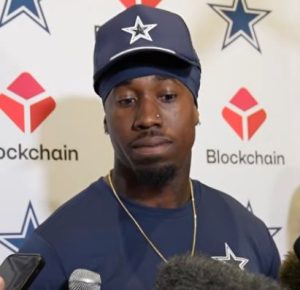
The Pittsburgh Steelers traded cornerback Joey Porter Jr. to the Dallas Cowboys because a months-long contract dispute had reached an impasse, Porter had yet to play in 2026, and Pittsburgh chose to recover valuable future draft capital rather than continue a standoff with a player entering the final year of his rookie deal.
Dallas sent Pittsburgh a 2027 sixth-round pick and a 2028 second-round pick for Porter. The Steelers officially completed the trade on October 1, 2026. [Steelers] [Cowboys]
The deal ended one of the NFL’s most unusual early-season disputes. Porter had been seeking a major extension, reportedly worth more than $30 million per year, while Pittsburgh had offered roughly $27 million annually and maintained its long-standing policy of not negotiating multiyear contracts once the regular season begins. [CBS Sports]
Why Did The Steelers Trade Joey Porter Jr.?
The simplest explanation is that the Steelers and Porter could not agree on a new contract and neither side was willing to back down.
Porter became eligible for an extension after completing three NFL seasons. His rookie deal was scheduled to expire after 2026, making this the first offseason in which Pittsburgh could negotiate a long-term second contract with him.
Negotiations stalled while the market for elite cornerbacks continued rising. Porter reportedly wanted more than $30 million per season, while Pittsburgh’s offer was around $27 million annually. [CBS Sports]
Once the regular season began, the Steelers’ policy against in-season contract negotiations left little room for a compromise. NFL.com reported that the combination of Porter’s position and Pittsburgh’s organizational precedent made a trade increasingly inevitable. [NFL/The Athletic]
What Did The Cowboys Give The Steelers For Joey Porter Jr.?
Dallas sent Pittsburgh two future draft picks:
- 2027 sixth-round pick
- 2028 second-round pick
The Steelers announced those exact terms when the trade became official. [Steelers]
The second-round selection is the centerpiece of the deal because second-round picks frequently become immediate starters or important long-term contributors.
Why Did Pittsburgh Accept A 2028 Second-Round Pick Instead Of Immediate Help?
The Steelers were operating from a weakened negotiating position.
Other teams knew Porter was unhappy, knew he wanted a new contract and knew Pittsburgh had stopped negotiating once the season began. That reduced the Steelers’ leverage.
NFL.com noted that Pittsburgh received draft capital but no immediate player who could help its 2026 secondary, creating a short-term competitive cost. [NFL/The Athletic]
The Steelers nevertheless gained an additional premium pick that can be used in the 2028 draft or packaged in a future trade.
What Was Joey Porter Jr.’s Contract Dispute About?
Porter wanted to be paid like one of the NFL’s top cornerbacks.
CBS Sports reported that he was seeking more than $30 million annually. The top of the cornerback market had moved well above Pittsburgh’s reported offer, with several elite players already earning $30 million or more per season. [CBS Sports]
Pittsburgh’s offer was reported at approximately $27 million per year.
That is still elite-cornerback money, but Porter could point to his recent coverage performance as evidence that he deserved to be paid closer to the top of the market.
How Good Was Joey Porter Jr. In 2025?
Porter had one of the strongest coverage seasons of any NFL cornerback.
CBS Sports reported that opposing quarterbacks posted a 49.1 passer rating when targeting Porter as the primary defender in 2025, the lowest figure among 128 qualifying defenders who faced at least 60 targets. [CBS Sports]
He started all 14 games he played and finished with:
- 52 tackles
- 14 passes defensed
- 1 interception
- 1 sack
The 14 pass breakups led Pittsburgh. [Steelers]
Why Had Porter Not Played In 2026?
Porter missed Pittsburgh’s first three games and had already been ruled out for Week 4 before the trade.
The team officially listed him with a combination of a back issue and conditioning concerns. He spent training camp on the Active/Physically Unable to Perform list before being activated in late August. [NFL]
The back injury became intertwined with the contract dispute because Porter was seeking an extension at the same time he remained unavailable.
NFL reporting noted the similarity to previous contract disputes involving players represented by the same broader agency network who were listed with back issues while negotiating new deals. [NFL/The Athletic]
Was Porter’s Back Injury Real?
There is no verified basis to say it was fake.
Pittsburgh officially listed him with a back injury, and injury details are medical matters that cannot be established simply from the timing of a contract dispute.
What is clear is that the injury and the contract negotiations overlapped for months, creating uncertainty about when Porter would return to the field.
Did Porter Threaten To Sit Out The Whole Season?
Porter had publicly left open the possibility that his absence could continue without a contract resolution.
NFL.com reported that after he was activated from the PUP list, Porter indicated there was a chance he would not play in 2026 without a new deal. [NFL]
That increased the pressure on Pittsburgh to either restart negotiations, allow the stalemate to continue or trade him.
Why Didn’t The Steelers Just Keep Negotiating?
Pittsburgh has traditionally avoided negotiating multiyear contracts after the regular season begins.
That organizational rule became particularly important here because Porter and the Steelers reached September without completing an extension.
General manager Omar Khan publicly indicated that the team would not negotiate during the season. Once that happened, the two sides effectively lost their easiest path to a compromise. [NFL]
Why Are The Steelers So Strict About In-Season Contract Talks?
The policy is designed to prevent contract negotiations from becoming a distraction during the season and to create a clear organizational deadline.
But Porter’s situation also illustrates the downside.
If negotiations are unresolved when the season begins, the Steelers can effectively remove their own ability to solve the disagreement through a new contract.
NFL.com’s analysis argued that Pittsburgh’s adherence to precedent helped turn the dispute into a trade rather than an extension. [NFL/The Athletic]
Did Guaranteed Money Matter?
Yes, according to reporting around the dispute.
The Steelers have historically been more conservative than some NFL teams about fully guaranteeing money deep into multiyear contracts.
NFL.com connected Porter’s negotiations to previous Pittsburgh disputes in which guarantees became a major obstacle, including the Le’Veon Bell standoff. [NFL/The Athletic]
The combination of annual salary and guaranteed structure therefore appears to have contributed to the inability to reach an agreement.
Could The Steelers Have Used The Franchise Tag On Porter?
Yes.
If Pittsburgh had kept Porter through the season without signing him to an extension, the franchise tag would have been one possible way to prevent him from immediately becoming an unrestricted free agent in 2027.
NFL.com reported that a 2027 tag for a cornerback was projected at a little more than $23 million, substantially below the annual salary Porter was seeking. [NFL/The Athletic]
That possibility may have made the relationship even more difficult because Porter could have faced another offseason without the long-term security he wanted.
Why Did The Cowboys Want Joey Porter Jr.?
Dallas desperately needed help at cornerback.
The Cowboys entered the trade 1-2 and had one of the NFL’s weakest defenses through three games.
CBS Sports reported that Dallas was allowing 387 total yards per game, had recorded only two sacks and had not intercepted a pass. No Cowboys team in the modern statistical era had opened a season with that exact combination of defensive problems. [CBS Sports]
Porter gives first-year defensive coordinator Christian Parker an established outside cover corner who can immediately upgrade the secondary.
Were The Cowboys Also Dealing With Cornerback Injuries?
Yes.
Dallas had injuries to multiple corners when it made the trade.
Cobie Durant was dealing with a hamstring problem, while Shavon Revel Jr. appeared on the injury report with knee and ankle issues. [Cowboys]
That made acquiring a starting-caliber outside corner more urgent.
What Will Dallas’ Secondary Look Like With Porter?
When healthy, Porter gives Dallas another high-level outside corner alongside DaRon Bland.
That could allow the Cowboys to be more aggressive with their coverage schemes, send additional pressure and reduce the amount of safety help required on the perimeter.
It also creates more flexibility for Durant, Revel and other defensive backs once they return to full health.
Will Joey Porter Jr. Play Immediately For Dallas?
That depends on his health, conditioning and how quickly he learns the Cowboys’ defensive terminology.
The Cowboys were scheduled to play Houston in Week 4 shortly after the trade, leaving Porter only a short period to prepare. [NFL]
Dallas could choose to give him a limited role initially before expanding his responsibilities.
Does Joey Porter Jr. Already Have A New Contract With Dallas?
No new long-term agreement was announced as part of the trade.
Porter remains in the final year of his rookie contract unless Dallas and his representatives agree on an extension. [CBS Sports]
That means the Cowboys acquired both an elite coverage player and the same contractual question Pittsburgh had been unable to resolve.
Will The Cowboys Give Porter The $30 Million-Plus Contract He Wants?
That remains unresolved.
Dallas has sufficient mechanisms to create salary-cap room, but the Cowboys also have other expensive players and future contract decisions.
CBS Sports noted that Dallas entered the deal with more than $20 million in 2026 cap space and could create additional flexibility through restructures. [CBS Sports]
The trade therefore gives Dallas the opportunity to negotiate, but it does not guarantee Porter will receive the exact contract he sought in Pittsburgh.
Could Dallas Use The Franchise Tag?
Potentially.
If Porter finishes the season without a long-term extension, Dallas could consider using the franchise tag to keep him for 2027.
The Cowboys will have to balance that possibility against their other pending free agents and salary-cap obligations.
Could The Cowboys Lose Porter After One Season?
Yes.
If Dallas neither signs Porter to an extension nor uses the franchise tag, he could become an unrestricted free agent after the season.
That makes the trade somewhat risky.
However, CBS Sports noted that a large free-agent contract elsewhere could potentially return a compensatory draft pick to Dallas, reducing the long-term cost of the trade. [CBS Sports]
Why Would Dallas Trade A Second-Round Pick For A Possible Rental?
The Cowboys appear to believe they need immediate defensive help badly enough to accept that risk.
Owner and general manager Jerry Jones had repeatedly indicated that Dallas was willing to use meaningful draft capital to acquire an impact defensive player. [Cowboys]
A 2028 second-round pick is also far enough in the future that Dallas receives several seasons before paying the full draft-capital cost.
Why Did Pittsburgh Trade Porter To The NFC?
Trading Porter to Dallas kept him outside the AFC.
That reduces the chance that Pittsburgh will have to compete directly with him for a playoff spot every season.
Before the deal, Dallas and Detroit had both reportedly contacted Pittsburgh about Porter’s availability. [CBS Sports]
An NFC destination was therefore strategically preferable to sending a top cornerback to another AFC contender if the offers were comparable.
Why Is Joey Porter Jr.’s Steelers Exit So Significant?
Porter was more than an ordinary Steelers draft pick.
His father, Joey Porter Sr., was a four-time Pro Bowler, Super Bowl champion and one of the most recognizable Pittsburgh defensive players of his generation.
The Steelers selected Porter Jr. with the 32nd overall pick in the 2023 draft, making the Pittsburgh connection one of the biggest stories surrounding his arrival. [NFL]
Instead of developing into a long-term franchise cornerstone, his Steelers career ended after three seasons and a contract standoff.
What Were Porter’s Career Numbers With Pittsburgh?
Porter appeared in 47 games and made 41 starts for the Steelers.
He recorded:
- 165 tackles
- 31 passes defensed
- 3 interceptions
- 1 sack
Those numbers were confirmed by Pittsburgh when the trade was announced. [Steelers]
Who Replaces Joey Porter Jr. In Pittsburgh?
The Steelers are expected to rely on a combination of Jamel Dean, Asante Samuel Jr. and rookie Daylen Everette.
That is one of the biggest risks in the deal.
NFL.com’s analysis noted that Pittsburgh no longer has a clear No. 1 outside corner and that Dean has dealt with injuries while Samuel struggled badly against Cincinnati before being benched. [NFL/The Athletic]
Does The Trade Make The Steelers Worse In 2026?
Potentially, yes.
Pittsburgh did not receive a player who can immediately replace Porter.
That means a team trying to compete now with Aaron Rodgers at quarterback exchanged its most talented young cornerback for future draft assets.
The move therefore prioritizes avoiding an unresolved contract problem and gaining long-term value over maximizing the current roster.
Why Would A Contending Team Make That Choice?
Because Porter was not helping Pittsburgh on the field during the standoff anyway.
He had missed the first three games and was already ruled out for the fourth.
If the Steelers believed there was a realistic chance he could remain unavailable or unhappy for a significant part of the year, converting him into a second-round pick and another selection could be preferable to receiving no immediate production and continuing the dispute.
What Does The Trade Mean For Mike McCarthy?
It puts additional pressure on McCarthy’s team to succeed despite losing one of its most talented defenders.
The Steelers entered the season with a veteran-heavy roster built to compete immediately.
Trading Porter removes a high-end coverage player without providing an immediate replacement, meaning McCarthy and the defensive staff must compensate schematically.
What Does The Trade Mean For Omar Khan?
The Porter trade puts Pittsburgh general manager Omar Khan’s roster-building strategy under additional scrutiny.
Porter was one of Khan’s first major draft selections as general manager.
He has now traded both Porter and 2023 first-round pick Broderick Jones to Dallas in separate deals. [NFL/The Athletic]
The success of those moves will ultimately depend on what Pittsburgh does with the resulting draft picks.
How Much Draft Capital Has Pittsburgh Received From Dallas?
The Steelers have now made multiple significant trades with the Cowboys.
In the Broderick Jones deal, Pittsburgh received additional 2027 draft capital. In the Porter deal, it added a 2027 sixth-rounder and a 2028 second-rounder. [Steelers Transactions]
That gives Khan more flexibility to move around future drafts or trade for established players.
Could Pittsburgh Use The Picks To Replace Porter?
Yes.
The 2028 second-round selection could eventually be used directly on a cornerback.
It could also be packaged with other assets in a trade or used to move up in a future draft.
The challenge is timing: any player selected in 2028 obviously provides no help to Pittsburgh’s 2026 roster.
What Does The Trade Mean For Dallas’ Super Bowl Chances?
Porter directly addresses one of Dallas’ most obvious weaknesses.
The Cowboys’ offense had been productive through three games, but their defense was allowing too many yards and points and had generated no interceptions. [CBS Sports]
If Porter returns healthy and performs at his 2025 level, Dallas gains a corner capable of matching up with top opposing receivers.
Whether that is enough to transform the entire defense remains to be seen.
Is Joey Porter Jr. A True No. 1 Cornerback?
His 2025 coverage numbers support the argument that he can function as one.
Porter has excellent size at 6-foot-2 and has shown the ability to play aggressive man coverage against high-level receivers.
His low interception totals — three over his first three seasons — are less impressive, but interceptions are only one measure of cornerback play.
His ability to prevent completions and disrupt throws is the main reason Dallas was willing to surrender a future second-round pick.
What Are Porter’s Weaknesses?
Porter has not been a flawless player.
NFL.com noted that he has had issues against the run at times, and his physical coverage style has occasionally produced penalties. [NFL]
His lack of high interception totals also means he has not consistently turned strong coverage into turnovers.
Dallas is betting that his shutdown ability outweighs those concerns.
What Did The Steelers Lose Beyond The Player?
The trade also ends what Pittsburgh once hoped would become a multigenerational franchise story.
Porter Sr. won a Super Bowl in Pittsburgh and became synonymous with the Steelers’ aggressive defensive identity.
Porter Jr. grew up around the organization and was drafted by the same franchise.
The younger Porter’s exit therefore carries more emotional significance for Pittsburgh fans than an ordinary contract-driven trade.
Was Trading Porter Inevitable?
Probably not at the beginning of the offseason.
But by the time the season began without an extension, Pittsburgh’s negotiating policy and Porter’s willingness to remain unavailable dramatically narrowed the possible outcomes.
Once other teams began calling, the Steelers had to decide whether preserving organizational precedent was worth losing their top cornerback.
They chose the picks.
Who Won The Joey Porter Jr. Trade?
It is too early to know.
Dallas gets the better player right now and fills an immediate need.
Pittsburgh gets meaningful future draft capital and removes a contract dispute that had become a distraction.
The long-term evaluation will depend on three questions:
- How well Porter plays in Dallas.
- Whether Dallas signs him to a long-term extension.
- What Pittsburgh ultimately does with the 2027 sixth-round and 2028 second-round picks.
What Is The Bottom Line?
The Steelers traded Joey Porter Jr. because his contract dispute had reached a point where keeping him no longer looked sustainable.
Porter wanted a contract worth more than $30 million per year. Pittsburgh reportedly stopped around $27 million annually and then shut down negotiations when the regular season started.
Meanwhile, Porter remained unavailable through the first month of the season.
Dallas needed a top cornerback, was willing to take on both the football and contract risk, and offered Pittsburgh a 2027 sixth-round pick plus a valuable 2028 second-rounder. [Steelers] [Cowboys]
The result is a rare early-season trade in which both teams made opposite bets.
Dallas is betting that Joey Porter Jr. can help fix its defense immediately.
Pittsburgh is betting that future draft capital is worth more than continuing a costly and increasingly bitter fight over its former No. 1 cornerback.