Indiana’s game against Northwestern began in bizarre fashion when the Hoosiers were penalized for two consecutive illegal snaps before they had run their first offensive play.
Center Bray Lynch was flagged twice in the opening seconds of Indiana’s 29-23 victory on September 25, 2026. The calls pushed the Hoosiers from first-and-10 to first-and-20 and infuriated head coach Curt Cignetti, who called a timeout only eight seconds into the game to demand an explanation from the officials. [Indiana]
The unusual sequence raised a basic question for viewers: How can a center commit an illegal snap before the ball is even put into play?
College football’s snap rules require the center’s movement of the football to meet specific requirements. A center cannot use movements of the ball that simulate the beginning of a snap without actually completing the snap. Indiana’s situation was particularly controversial because Cignetti said the Hoosiers had not been warned that officials would be watching Lynch’s technique and suggested Northwestern had alerted the Big Ten to something it had spotted on film. [NCAA][Indiana]
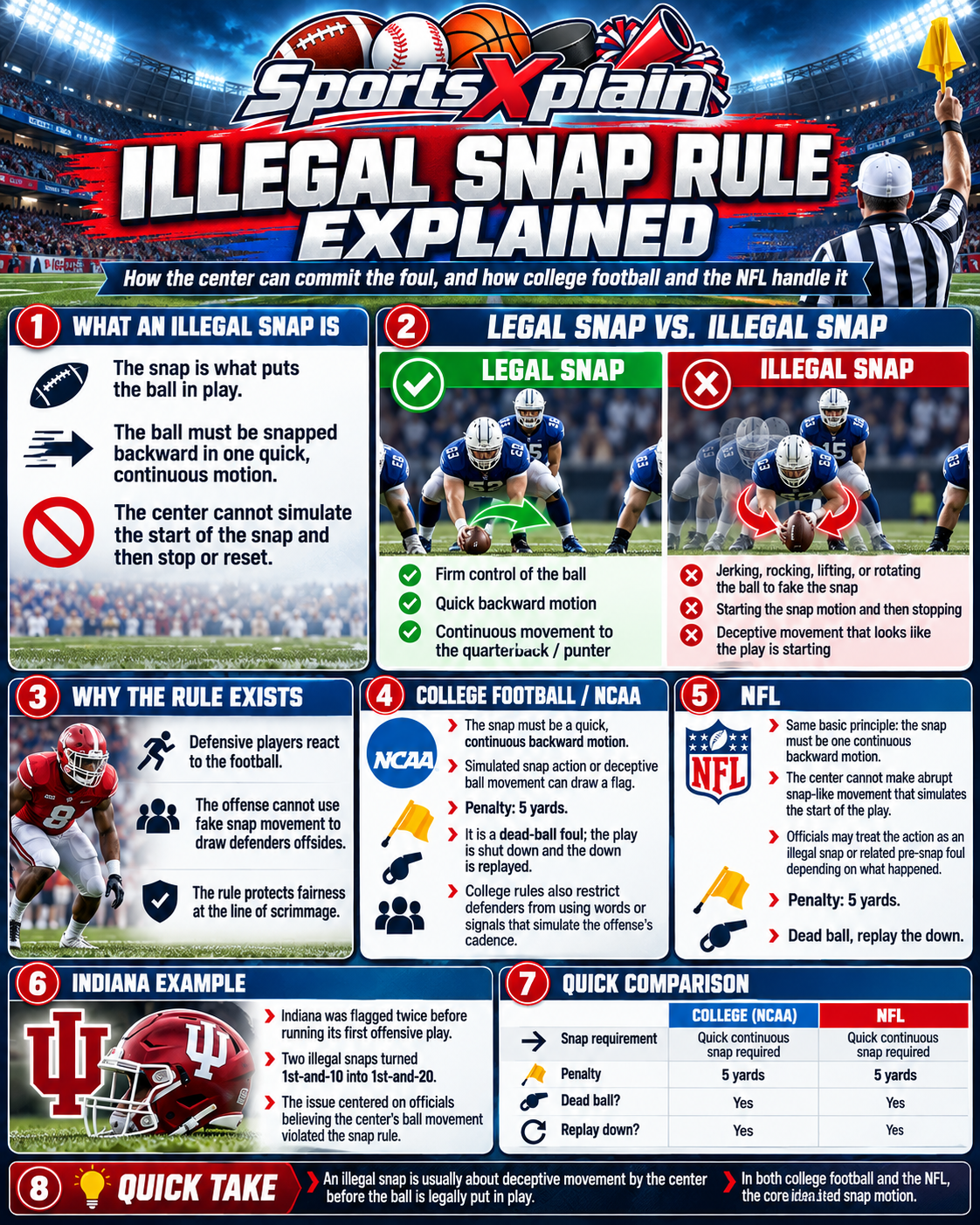
Illegal Snap Rule Explainer Infographic
What Happened On Indiana’s First Drive Against Northwestern?
Indiana received the opening kickoff and prepared to run its first offensive play.
Instead, Lynch was called for an illegal snap. Before Indiana could run the next play, officials called him for the same violation again.
The back-to-back five-yard penalties meant Indiana had gone from first-and-10 to first-and-20 without actually running an offensive play. [Indiana Daily Student]
Cignetti was furious. He attempted to get the officials’ attention and ultimately used a timeout just eight seconds into the game.
After the timeout, the illegal-snap penalties stopped. Running back Turbo Richard then broke a 33-yard run that helped Indiana recover from the first-and-20 situation. The Hoosiers eventually drove to Northwestern’s 1-yard line before the Wildcats stopped Richard on fourth down. [Indiana]
What Is An Illegal Snap In College Football?
A snap is more than simply the center giving the football to the quarterback.
Under NCAA football rules, the snap is the action that puts the ball into play. Once the snap begins, the movement must be a quick and continuous backward motion of the football from its position on the ground. [NCAA]
That requirement is important because defensive players are reacting to the movement of the football.
A center cannot make deceptive preliminary movements with the ball that look like the beginning of the snap and then stop or reset it. If officials determine that the snapper has illegally moved the football rather than executing a legal continuous snap, they can kill the play and assess a five-yard penalty.
Why Can’t The Center Move The Football Before The Snap?
The rule is designed in part to prevent the offense from unfairly causing the defense to react.
Defensive linemen often key on movement of the football. If a center could jerk, lift, rotate or otherwise make snap-like movements before actually snapping it, defenders could be induced to cross the neutral zone.
That would give the offense a way to manufacture defensive penalties.
College football therefore places restrictions on both sides. The offense cannot illegally simulate the start of a play through movements associated with the snap, while the defense also faces restrictions on using words or signals designed to imitate the offense’s cadence. The NCAA strengthened its rules involving simulated action and deceptive signals beginning with the 2025 season. [NCAA]
Why Was Bray Lynch Being Flagged?
The officials evidently determined that something in Lynch’s pre-snap handling of the football violated the snap rule.
What made the situation unusual was how quickly and consistently it was enforced. Lynch was penalized on Indiana’s first two attempted snaps of the game.
Cignetti indicated afterward that Indiana had not expected the calls.
“Northwestern must have turned something in (to the Big Ten office),” Cignetti said after the game. “Something they saw on tape. I’m not aware what it was. None of us were. Usually, you get a heads up, a midweek warning. That’s the protocol.” [Indiana]
Cignetti’s explanation suggests he believed Northwestern had noticed something about Lynch’s snapping mechanics while studying Indiana film and brought it to the conference’s attention.
That was Cignetti’s account, however. There was no publicly released Big Ten explanation immediately after the game confirming that Northwestern had submitted such a complaint or detailing precisely what officials had been instructed to watch.
Can Teams Alert Officials To Something They See On Film?
Yes. Coaching staffs routinely study opponents for tendencies and rule issues, and they can raise concerns with conference officiating personnel before games.
That does not mean the opposing team gets to decide whether something is a penalty. Officials still have to observe the action and determine that it violates the rules.
Cignetti’s complaint centered on what he said was the lack of advance notice. According to the Indiana coach, the normal protocol would have been for his team to receive a warning during the week if officials had concerns about something Indiana was doing. [Indiana]
Why Did Curt Cignetti Call A Timeout Eight Seconds Into The Game?
After the second penalty, Cignetti wanted an explanation before Indiana tried to snap the ball again.
He said officials initially would not discuss the issue with him, prompting him to use a timeout.
“They wouldn’t talk to me,” Cignetti said. “I had to call a timeout and they still didn’t want to talk to me.” [Indiana]
Television cameras captured an animated Cignetti confronting officials on the sideline during the sequence. [USA Today]
The timeout at least gave Indiana an opportunity to address Lynch’s technique before the next snap.
It worked: Lynch was not called for another illegal snap immediately afterward, and Indiana was finally able to begin running its offense.
Is An Illegal Snap The Same As A False Start?
No, although both are pre-snap offensive fouls and can look similar to viewers.
A false start generally involves an offensive player making movement that simulates the beginning of a play before the ball is snapped.
An illegal snap specifically concerns the snapper and the way the football is handled or put into play.
Both can result in the officials stopping the action before a normal play develops and assessing a five-yard penalty, which is one reason the terms can sometimes be confused in game reports.
Can A Center Adjust The Football Before Snapping It?
A center is allowed to establish control of the football before the snap, but that does not give him unlimited freedom to move it once the offense is set and preparing to begin the play.
The critical distinction is between legally getting into position to snap and making a movement of the football that officials interpret as beginning or simulating the snap.
Once the actual snap begins, NCAA rules require the ball to be moved backward in a quick and continuous motion. [NCAA]
Could Northwestern Have Been Simulating Indiana’s Snap Count?
There was also discussion during the game about whether Northwestern defenders were doing something that contributed to Indiana’s pre-snap problems.
USA Today reported that Cignetti appeared to take issue with the possibility that Northwestern was simulating Indiana’s snap count while he argued with officials. [USA Today]
That matters because NCAA rules also restrict defenders from using signals or sounds that simulate an opponent’s offensive signals. The NCAA specifically strengthened rules concerning simulated action at the snap and words or signals designed to distract opponents. [NCAA]
However, no publicly available officiating explanation established that Northwestern had illegally simulated Indiana’s cadence on the two plays. The penalties were assessed against Indiana.
Did The Illegal Snaps Cost Indiana The Game?
No. They created an extraordinary start, but Indiana recovered.
The consecutive penalties left the Hoosiers facing first-and-20 on their opening possession. Richard’s 33-yard run helped erase that disadvantage, and Indiana eventually reached Northwestern’s 1 before being stopped on fourth down. [Indiana]
Indiana later took a 12-0 halftime lead and survived Northwestern’s second-half comeback to win 29-23.
The illegal-snap sequence nevertheless became one of the strangest moments of the game: Indiana was penalized twice before running a single offensive play, its head coach was forced to spend a timeout eight seconds into the contest, and Cignetti later suggested Northwestern had discovered something on film that Indiana itself had not been told officials would be watching.