
When an NFL player is listed as doubtful on the final injury report, the team is officially saying that the player is unlikely to play in the upcoming game.
It is one of three game-status designations used by the NFL: Questionable, Doubtful and Out. They tell fans, opponents and the media whether an injured player’s availability for the upcoming game remains uncertain. [NFL]
One important misconception is that “doubtful” officially means a player has a 75 percent chance of missing the game. That was once the NFL’s definition, but it is no longer the rule. The league eliminated the percentage-based definitions in 2016. [NFL]
What Does Doubtful Mean In The NFL?
The NFL’s definition is straightforward:
Doubtful = Unlikely to play.
A doubtful designation therefore indicates that the team believes the player probably will not be available, but his absence has not yet been confirmed. [NFL]
There can still be circumstances in which a doubtful player improves before kickoff and plays. That is why the designation is different from “Out.”
But if a player is listed as doubtful, fans should generally view his chances of playing much less optimistically than those of a player listed as questionable.
What Does Questionable Mean In The NFL?
Questionable = It is uncertain whether the player will play.
This is the broadest of the NFL’s injury designations.
A questionable player might ultimately be active and play his normal role. He might play with a reduced workload. Or he might be declared inactive before kickoff.
The designation simply means the team cannot say with certainty when it files the Game Status Report whether the player will be available. [NFL]
For example, a player who was limited in practice throughout the week while recovering from an ankle injury could be listed as questionable while the medical staff evaluates how he responds before game day.
What Does Out Mean In The NFL?
Out = The player will not play.
This is the only one of the three designations that provides a definitive answer about a player’s availability.
If a player is listed as out, the team has determined before the game that he will not participate. [NFL]
What Is The Difference Between Questionable, Doubtful And Out?
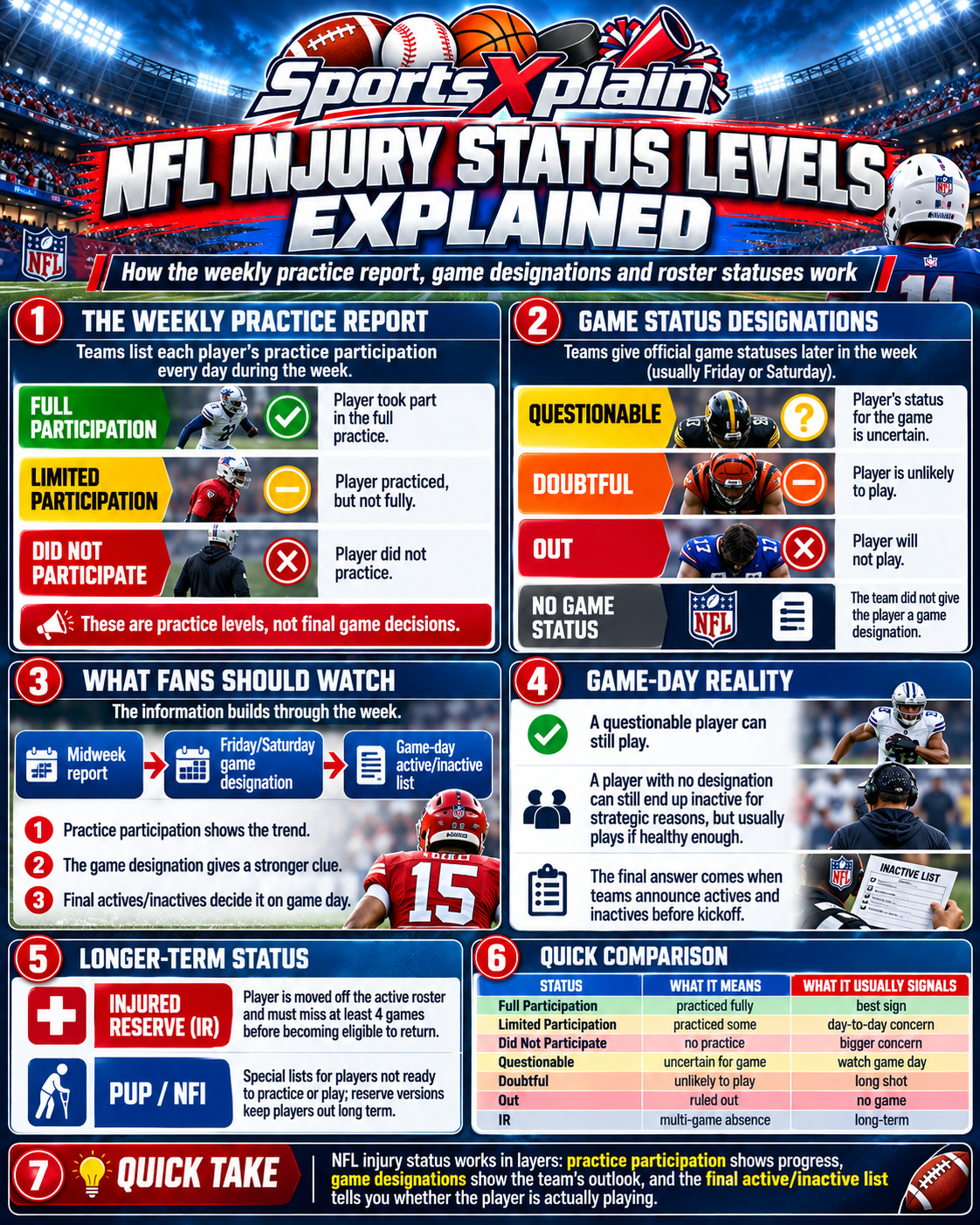
The easiest way to understand the NFL’s current game-status system is:
- Questionable: Uncertain whether the player will play.
- Doubtful: Unlikely to play.
- Out: Will not play.
The categories represent increasing levels of certainty that a player will miss the game. [NFL]
There is no longer an official “Probable” designation.
Does Doubtful Mean A Player Has A 75 Percent Chance Of Missing The Game?
Not anymore.
This is one of the most common sources of confusion surrounding NFL injury reports.
Under the NFL’s older system, the designations were explicitly connected to probabilities:
- Probable: Virtual certainty the player would be available.
- Questionable: 50-50 chance the player would not play.
- Doubtful: At least a 75 percent chance the player would not play.
- Out: Definitely would not play.
Those percentage definitions are outdated. [NFL]
The NFL changed its injury-reporting system beginning with the 2016 season and specifically removed the percentages.
The league’s policy even used “Doubtful” as an example, explaining that it was no longer defined as having at least a 75 percent chance of not playing. [NFL]
So while “doubtful” clearly indicates a worse outlook than “questionable,” it should not be translated into an official numerical probability.
Why Did The NFL Eliminate The Probable Designation?
The NFL eliminated “Probable” because it had become largely unnecessary.
According to the league, approximately 95 percent of players listed as probable actually played. The designation therefore provided relatively little uncertainty about a player’s availability. [NFL]
Under the revised system, a player who is expected to play does not need a final game-status designation simply because he appeared on the practice injury report earlier in the week.
If there is legitimate uncertainty about whether he will play, he should be listed as questionable.
Why Can A Player Be On The Injury Report Without Being Questionable?
The NFL actually uses two related but different injury reports: the Practice Report and the Game Status Report.
The Practice Report tells you how much an injured player participated in practice.
The Game Status Report tells you whether his availability for the upcoming game is in doubt.
Those are not the same thing.
A player can therefore appear on the injury report throughout the week because he was limited in practice but receive no Questionable, Doubtful or Out designation on the final report if the team expects him to play.
What Do DNP, Limited And Full Mean?
The NFL’s Practice Report uses three main participation categories:
- DNP / Did Not Participate: The player did not participate in practice.
- Limited Participation: The player took fewer than 100 percent of his normal repetitions.
- Full Participation: The player took 100 percent of his normal repetitions.
The NFL specifically defines limited participation as less than 100 percent of a player’s normal repetitions and full participation as 100 percent. [NFL]
These practice classifications describe what happened at practice. They do not directly tell you whether the player will play in the game.
Can A Player Be DNP And Still Play?
Yes.
“Did Not Participate” describes a player’s practice activity on a particular day. It is not a game-status designation.
A veteran player dealing with an injury could miss Wednesday’s practice, return on a limited basis Thursday, practice fully Friday and play Sunday.
Teams also sometimes manage injured veterans’ workloads during the week.
The final Game Status Report — Questionable, Doubtful, Out or no designation — is generally more useful when trying to determine whether the player is expected to be available for the game.
Can A Player Practice Fully And Still Be Questionable?
Yes.
Practice participation and game status measure different things.
A player can complete a full practice but still have uncertainty surrounding how an injury will respond afterward. The team can therefore list him as questionable even though he participated fully in practice.
The NFL’s official injury reports regularly contain players with Full Participation listed under practice status but Questionable under game status. [NFL]
Can A Doubtful NFL Player Still Play?
Yes.
Doubtful means unlikely to play, not “will not play.”
If the team knew the player would not participate, he should be listed as Out.
A doubtful player could improve enough before kickoff to be active, although the designation signals that the team considers participation unlikely when the Game Status Report is submitted.
When Do NFL Teams Release Injury Reports?
NFL teams submit practice reports throughout the week and then issue a Game Status Report closer to the game.
For a normal Sunday game, teams file Practice Reports on Wednesday, Thursday and Friday. The Game Status Report is also filed Friday. Different schedules apply when teams play on Monday, Thursday, Friday or Saturday. [NFL]
Teams are also required to report changes if a player’s condition changes after the Game Status Report has been filed.
When Do We Find Out If A Questionable Or Doubtful Player Is Actually Playing?
The final answer often comes when teams announce their inactive players before kickoff.
An NFL team’s active roster is larger than the number of players permitted to dress for a game, so clubs announce which players will be inactive on game day.
A questionable or doubtful player who appears on the inactive list will not play.
If he is active, he is eligible to play, although being active does not guarantee that he will receive his normal number of snaps.
What Does Game-Time Decision Mean?
“Game-time decision” is commonly used by coaches, reporters and broadcasters, but it is not one of the NFL’s official Game Status Report designations.
It generally means the team plans to wait until close to kickoff before deciding whether the player can participate.
A player described publicly as a game-time decision will often carry a Questionable designation on the official injury report.
Teams may evaluate how the player feels after treatment, stretching or a pregame workout before deciding whether to make him active.
What Does No Injury Designation Mean?
If a player appeared on the practice injury report during the week but has no Questionable, Doubtful or Out designation on the final Game Status Report, the team is indicating that his availability is not in question.
The NFL changed its reporting system in 2016 so players who are certain to play no longer need to receive a “Probable” label. [NFL]
That means seeing an injury next to a player’s name earlier in the week does not automatically mean he is in danger of missing the game.
Can An NFL Team Change A Player’s Status?
Yes.
An injury can improve or worsen after the final injury report is initially filed.
The NFL requires clubs to update the league if there is a change in a player’s condition after the Game Status Report has been submitted. [NFL]
For example, a player could be listed as questionable Friday and then downgraded to out Saturday if his condition worsens.
A new injury or illness can also emerge after the week’s normal practices have concluded.
Why Does The NFL Require Injury Reports?
The injury-report system is designed to give opposing teams, the media and the public consistent information about injuries that could affect player availability.
The NFL requires injuries to be described with a reasonable degree of specificity. For example, teams generally cannot simply report a vague “leg injury.” They are expected to identify the relevant area, such as the ankle, knee, thigh or calf. [NFL]
Teams are also expected to accurately report practice participation and whether an injured player’s game availability is uncertain.
NFL Injury Report Designations At A Glance
- Questionable: Uncertain whether the player will play.
- Doubtful: Unlikely to play.
- Out: Will not play.
- DNP: Did not participate in that day’s practice.
- Limited: Participated in less than 100 percent of normal practice repetitions.
- Full: Participated in 100 percent of normal practice repetitions.
- Probable: No longer used as an official NFL game-status designation.
The most important distinction is that practice participation and game status answer different questions. DNP, Limited and Full tell you how much a player practiced. Questionable, Doubtful and Out tell you what the team is reporting about his availability for the game.
And despite the old percentages that are still frequently repeated online, the modern NFL definition of doubtful is much simpler: the player is unlikely to play.