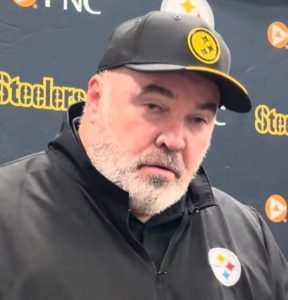
Aaron Rodgers and Mike McCarthy had a heated sideline exchange during the Pittsburgh Steelers’ 27-24 loss to the Cleveland Browns on Thursday night, but the argument was not about one specific play call.
Rodgers was frustrated with how long it was taking Pittsburgh to get the offensive play call communicated to him during the Steelers’ opening drive. He yelled toward the sideline for McCarthy to get the call in faster, and McCarthy appeared to respond with an angry, profane remark of his own. [NBC Sports]
McCarthy later said the drive had been unusually difficult from a communication standpoint because Pittsburgh ran 17 plays and the crowd noise in Cleveland forced the coaching staff to work faster than normal. Rodgers separately said the noise made some calls difficult to hear. [Yahoo Sports]
The exchange looked dramatic on television because of the history between Rodgers and McCarthy, who spent more than a decade together in Green Bay. But neither man suggested after the game that it represented a larger personal rupture.
What Did Aaron Rodgers And Mike McCarthy Argue About?
The core issue was the speed of Pittsburgh’s offensive communication.
Rodgers wanted the play call delivered faster so he could get the offense lined up, diagnose Cleveland’s defense and make any necessary changes before the snap.
During Pittsburgh’s first drive, television cameras showed Rodgers angrily gesturing toward the sideline and shouting for the call to come in more quickly.
McCarthy then appeared to respond sharply from the sideline.
McCarthy explained after the game that Pittsburgh’s first possession was unusually long and required rapid communication throughout. [NBC Sports]
What Did Mike McCarthy Say After The Game?
McCarthy acknowledged the exchange and expressed regret about the language he used.
He said he wished he had not used those words and noted that microphones and cameras now capture conversations that once would have remained private. [NBC Sports]
McCarthy also said the communication issue was largely limited to the opening possession.
After that drive, he said Pittsburgh settled down operationally and the problem improved.
What Did Aaron Rodgers Say After The Game?
Rodgers was not directly asked about the sideline argument, but his postgame comments supported McCarthy’s explanation that crowd noise was a factor.
Rodgers said Cleveland’s stadium was loud and that some calls were difficult to hear. [Yahoo Sports]
He did not publicly criticize McCarthy’s play-calling or suggest that their disagreement had continued after the game.
Did Rodgers And McCarthy Fight Over A Bad Play Call?
Not according to the available reporting.
The disagreement was primarily about how quickly the call was getting to Rodgers, not whether McCarthy had selected the wrong play.
That distinction matters because Rodgers has historically wanted substantial time at the line of scrimmage to read defenses, change protections and audible into different plays.
If the call arrives late, that reduces the time he has to make those adjustments.
Why Was The First Drive So Chaotic?
Pittsburgh’s opening possession lasted 17 plays.
Long drives can create logistical problems because coaches must rapidly choose personnel groupings, formations and play calls while managing the play clock and substitutions.
Cleveland’s crowd noise made that process even more difficult.
Despite the argument, the drive ended successfully when Rodgers threw a touchdown pass to Roman Wilson.
Did The Argument Affect Pittsburgh’s Offense?
Not immediately.
The Steelers scored a touchdown on the same drive.
The larger offensive problems came later.
Rodgers finished 22-of-40 for 299 yards, three touchdowns and two interceptions in Pittsburgh’s 27-24 loss. [NFL]
Pittsburgh rallied from a 21-7 deficit and tied the game 24-24 late in the fourth quarter, but Cleveland kicked a 56-yard field goal with 15 seconds remaining.
Rodgers then threw an interception on Pittsburgh’s final possession.
What Was The Fallout From The Argument?
The immediate fallout was minimal.
There was no reported fine, suspension or team discipline for either Rodgers or McCarthy.
McCarthy treated it as a heat-of-the-moment sideline exchange, and Rodgers did not publicly escalate the situation.
The larger consequence was that the moment instantly revived discussion about their complicated history together in Green Bay.
Why Does Rodgers And McCarthy’s Green Bay History Matter?
Rodgers and McCarthy worked together with the Green Bay Packers from 2006 through 2018.
They won Super Bowl XLV together and reached the playoffs repeatedly, but their relationship became one of the most heavily scrutinized coach-quarterback partnerships in the NFL.
Reports over the years described disagreements involving play-calling, offensive philosophy and Rodgers’ freedom to change plays at the line of scrimmage.
Rodgers has repeatedly disputed portrayals of the relationship as a bitter feud, saying that two strong personalities could disagree without hating each other. [ESPN]
Did Rodgers And McCarthy Argue On The Sideline In Green Bay?
Yes.
One of their most famous confrontations occurred during a 2013 Packers game against the Cincinnati Bengals.
Rodgers and McCarthy were caught having a heated exchange on the sideline after an offensive possession. [NFL]
That confrontation ultimately had little lasting effect on the season, but it became an enduring example of the intensity of their working relationship.
The Pittsburgh exchange immediately reminded viewers of that episode.
Did Rodgers And McCarthy Hate Each Other In Green Bay?
Rodgers has said no.
He has acknowledged that he and McCarthy had disagreements but rejected some reports portraying their relationship as completely dysfunctional. [ESPN]
The two men also reunited in Pittsburgh years later, which itself suggests their relationship was not irreparable.
How Much Freedom Does Rodgers Have In McCarthy’s Offense?
Historically, a great deal.
During their best years in Green Bay, McCarthy allowed Rodgers significant control at the line of scrimmage.
Rodgers could change plays, adjust protections, operate no-huddle and make decisions based on defensive alignment. [ESPN]
That freedom can make late play calls especially frustrating because Rodgers needs enough time before the snap to process the defense and make those adjustments.
Why Is Fast Play-Calling Important For Rodgers?
A veteran quarterback often wants the play as early as possible so he can:
- Identify the defensive coverage.
- Recognize potential blitzes.
- Adjust pass protection.
- Change the route concept.
- Audible to a run or pass.
- Manipulate defenders with cadence.
If the play arrives with only a few seconds remaining on the play clock, many of those options disappear.
That is why what looked like a small operational problem can matter significantly to the effectiveness of an offense built around a quarterback with Rodgers’ experience.
Is This A Sign Rodgers And McCarthy’s Relationship Is Falling Apart?
There is no evidence yet that it is.
Arguments between quarterbacks and coaches are common in the NFL, particularly when both parties have extensive experience and strong opinions about offensive football.
The key question is whether the disagreement becomes a pattern.
If Rodgers repeatedly criticizes how McCarthy is handling the offense or if McCarthy begins publicly pushing back against Rodgers, the situation would become more significant.
One sideline argument by itself does not establish that kind of breakdown.
What Does The Loss Mean For The Steelers?
Pittsburgh fell to 2-2 with the defeat.
The Steelers showed encouraging offensive potential by scoring 17 fourth-quarter points and rallying from a 14-point deficit.
But the game also exposed several problems:
- Two Rodgers interceptions.
- Eight penalties.
- Communication problems early.
- Difficulty stopping Cleveland’s offense.
- A late defensive possession that allowed the Browns to move into field-goal range.
The Steelers gained 361 total yards but could not finish the comeback. [NFL]
How Important Is The Argument For Pittsburgh’s Season?
The argument itself may not be important.
The problem behind it could be.
If Pittsburgh repeatedly struggles to get plays communicated quickly enough in loud road environments, that could limit Rodgers’ ability to control the offense before the snap.
For a team relying on an experienced quarterback to diagnose defenses and make adjustments, that would be a meaningful weakness.
What Should The Steelers Change?
The most obvious adjustment is simplifying and accelerating the communication process.
Pittsburgh can accomplish that by:
- Getting personnel decisions made earlier.
- Shortening lengthy play-call terminology.
- Using wristband calls in loud stadiums.
- Allowing Rodgers to use more no-huddle offense.
- Giving Rodgers a smaller menu of automatic checks.
The goal would be to give Rodgers more time at the line without reducing McCarthy’s control over the overall offensive plan.
Could Pittsburgh Use More No-Huddle?
Potentially.
No-huddle offense allows the quarterback to receive the next play more quickly and prevents the defense from substituting as freely.
Rodgers has extensive experience operating that style of offense.
Using it more frequently could reduce communication problems in loud stadiums, although it would also place more responsibility on Rodgers to control tempo and personnel.
Does McCarthy Still Call Pittsburgh’s Offensive Plays?
Yes.
McCarthy’s role as head coach includes direct responsibility for the offense and play-calling.
That creates an unusual dynamic because Rodgers is also one of the most experienced quarterbacks in NFL history.
The offense therefore depends heavily on collaboration between two people who both possess strong ideas about how the game should be managed.
Could Rodgers Start Ignoring McCarthy’s Play Calls?
There is no evidence that Rodgers did that Thursday.
Rodgers has long possessed the freedom to change plays at the line, but that is different from simply refusing to run the offense called by the coaching staff.
The more likely issue is determining how much audible freedom Rodgers receives within McCarthy’s system.
What Are The Long-Term Effects For The Steelers?
The long-term effect depends almost entirely on whether Thursday’s exchange was isolated.
If the Steelers clean up their communication, it may become nothing more than an amusing footnote.
If similar arguments continue, several issues could emerge:
- Questions about offensive authority.
- Increased media scrutiny.
- Pressure on McCarthy’s play-calling.
- Questions about Rodgers’ willingness to operate within the system.
- Potential tension during losing streaks.
Those concerns become more important because both men already carry a highly public history of disagreements.
Could The Argument Affect The Locker Room?
There is no indication that it has so far.
Players are accustomed to emotional sideline exchanges.
The bigger locker-room issue would arise if teammates believed there was confusion about who actually controls the offense.
Clear authority matters because receivers, linemen and running backs need to know whether late adjustments are coming from McCarthy, Rodgers or both.
What Does The Incident Mean For Mike McCarthy?
McCarthy is under pressure to make the Rodgers partnership work quickly.
The reunion carries expectations precisely because the two men previously produced a Super Bowl championship and years of elite offense together.
If Pittsburgh’s offense struggles, the public history of their Green Bay disagreements will inevitably become part of the discussion.
McCarthy’s challenge is therefore not merely designing good plays. He also has to make sure the offensive operation is efficient enough for Rodgers to use his strengths.
What Does The Incident Mean For Aaron Rodgers?
Rodgers faces a similar challenge.
His experience gives him unusual authority, but his public reactions will receive greater scrutiny because of his history with McCarthy.
A sideline argument that might be ignored if it involved another quarterback can become a national story when Rodgers and McCarthy are involved.
That means both men have an incentive to prevent routine football disagreements from becoming recurring public controversies.
Could This Affect The NFL Beyond Pittsburgh?
There is unlikely to be any direct league-wide consequence.
No NFL rule was violated, and there is no apparent disciplinary issue.
The incident does, however, highlight two broader trends in the modern NFL.
First, veteran quarterbacks increasingly have significant control over offensive decisions at the line of scrimmage.
Second, sideline microphones and television cameras make it much harder for coaches and players to keep emotional exchanges private.
McCarthy acknowledged that reality after the game when discussing his regret over the language caught during the confrontation. [NBC Sports]
Why Did The Rodgers-McCarthy Argument Become Such A Big Story?
Mostly because of who was involved.
If a random quarterback and coach yelled at each other over a late play call, the incident might receive little attention.
Rodgers and McCarthy already have one of the most famous complicated coach-quarterback histories in recent NFL memory.
Any visible disagreement therefore immediately invites comparisons to Green Bay.
Was The Argument Responsible For Pittsburgh Losing?
No.
The exchange happened during a touchdown drive and the communication reportedly improved afterward.
Pittsburgh lost because of a combination of turnovers, defensive breakdowns and late-game execution.
Rodgers threw two interceptions, including one on the final possession after Cleveland took a 27-24 lead with 15 seconds remaining. [NFL]
The argument was memorable, but it was not the decisive play of the game.
What Should Steelers Fans Watch Next?
The biggest indicators will be operational rather than emotional.
Watch whether Pittsburgh:
- Gets plays to Rodgers earlier.
- Uses more tempo or no-huddle.
- Reduces pre-snap confusion.
- Continues giving Rodgers substantial audible freedom.
- Avoids repeated sideline confrontations.
If those issues improve, Thursday’s argument probably will not matter much.
If the same problems recur, the exchange could eventually look like the first visible sign of a larger offensive problem.
What Is The Bottom Line?
Aaron Rodgers and Mike McCarthy argued because Rodgers believed Pittsburgh’s offensive play calls were arriving too slowly during a loud, lengthy opening drive in Cleveland.
McCarthy responded angrily, later regretted his wording and said the communication improved after the first possession.
There has been no reported disciplinary fallout and no evidence that their relationship has fractured.
The more important question is whether Pittsburgh can eliminate the communication problem that caused the argument.
For now, the incident looks like a heated football disagreement between two strong personalities who have been having versions of the same argument for more than a decade.